
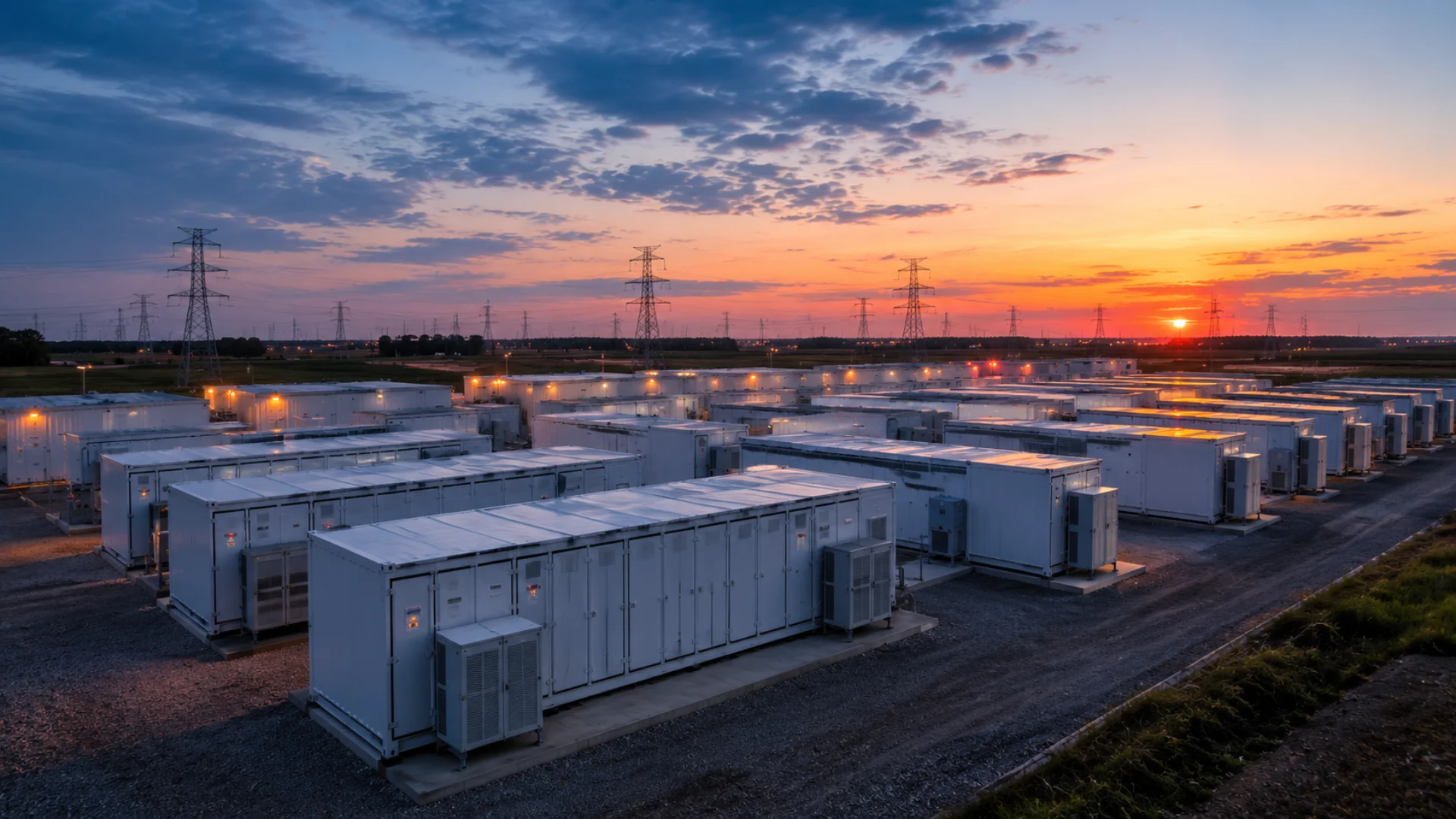
Form Energy Best Guide to Tech and Funding
Search for “Form Energy stock”, and you’ll land on a strange mix of results: crowdfunding-style pre-IPO listings, valuation trackers quoting different numbers, and a company website that never mentions a stock price at all. That’s not a glitch. It’s what happens when one of the most talked-about battery startups in the country is still a private company.
This guide breaks down what Form Energy actually does, how its iron-air battery technology works, its full funding history, and what “Form Energy stock” really means right now if you’re an investor trying to get in early. It also covers what the company’s own site and most stock-tracker pages leave out: the technical trade-offs of iron-air storage, and how its valuation estimates differ wildly depending on the source.
What Is Form Energy?
Form Energy is an American energy storage company based in Somerville, Massachusetts, with its first manufacturing plant in Weirton, West Virginia. It was founded in 2017 by a team with serious battery pedigree: Mateo Jaramillo, Tesla’s former head of battery development, alongside MIT professor and battery scientist Yet-Ming Chiang, plus Ted Wiley, William Woodford, and Marco Ferrara.
The company’s mission is narrow and specific: build a battery that can store electricity for multiple days, not just a few hours, at a cost cheap enough to replace natural gas peaker plants on the grid. That’s a different problem than the one most battery companies are solving, and it’s the reason Form Energy has attracted so much attention from utilities, steelmakers, and climate-focused investors.
How Form Energy’s Iron-Air Battery Technology Works
Form Energy’s core product is an iron-air battery, and the chemistry behind it is almost deceptively simple.
The “Reversible Rusting” Concept
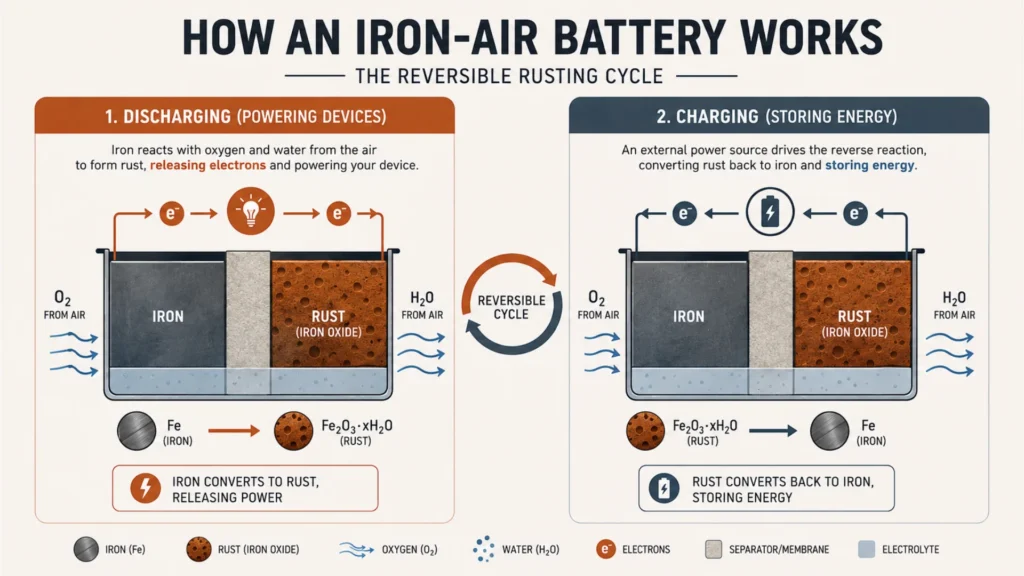
The battery relies on iron, water, and air, three of the cheapest and most abundant materials on the planet. While discharging, the battery pulls oxygen from the surrounding air and converts iron metal into rust. While charging, an electrical current reverses that reaction, turning the rust back into iron and releasing oxygen. Engineers at Form Energy have described this as “reversible rusting,” essentially running the natural rusting process backward and forward on demand.
Each battery module is roughly the size of a washing machine and is filled with a water-based, non-flammable electrolyte similar to that used in ordinary AA batteries. Inside each module are stacked iron and air electrodes that drive the chemical reaction. Thousands of these modules are grouped into megawatt-scale power blocks, and depending on how densely they’re arranged, a one-megawatt system can require as little as one acre of land, or as much as a third of that in higher-density configurations.
Why 100 Hours Matters
Lithium-ion batteries are excellent for short bursts, typically lasting two to four hours. That works fine for smoothing out daily solar or wind fluctuations. It does not work for a multi-day wind lull or an extended cloudy stretch, sometimes called a “Dunkelflaute,” which can knock renewable generation offline for far longer than any lithium-ion system is built to cover economically.
Form Energy’s iron-air system is designed to discharge continuously for 100 hours, over four days, at system costs the company says can run under $20 per kilowatt-hour, compared to roughly $130 to $150 per kilowatt-hour for equivalent lithium-ion capacity. The tradeoff is round-trip efficiency: iron-air batteries typically return 40% to 50% of the energy put into them, compared to about 90% for lithium-ion. That’s a real limitation, but it matters less when the batteries are charged using cheap, curtailed renewable power that would otherwise go to waste.
Manufacturing at Form 1
Form Energy’s Weirton, West Virginia facility, referred to internally as “Form 1,” is a converted steel mill site and the company’s first at-scale manufacturing plant. The $760 million project, partly funded by $105 million in West Virginia state surplus tax dollars, was designed to employ around 750 workers. According to the National Association of Manufacturers, Form Energy has since tripled commercial sales and scaled up production at the facility to keep pace with a fast-growing order book.
Form Energy’s Major Projects and Customers
Form Energy has moved well past the pilot stage. Its first commercial deployment, a 1.5 MW/150 MWh project with Minnesota utility Great River Energy, began construction in 2023. Since then, the project pipeline has grown considerably:
- Xcel Energy contracted two 10 MW/1 GWh systems in Colorado and Minnesota, tied to sites near retiring coal plants.
- Georgia Power and Puget Sound Energy have signed agreements to evaluate similar multi-day storage deployments.
- Google and Xcel Energy partnered on a 30 GWh multi-technology storage agreement, described at the time as the largest energy storage project announced globally by capacity.
- Crusoe, an AI-focused data center developer, signed a 12 GWh supply agreement with Form Energy in March 2026 at CERAWeek in Houston to secure reliable, low-carbon power for its data center infrastructure.
- FuturEnergy Ireland signed on for a 10 MW/1,000 MWh system in March 2026, Form Energy’s first international deployment, expected to come online in 2029.
That shift toward data center customers is worth noting. AI infrastructure has become one of the fastest-growing sources of electricity demand in the country, and multi-day storage is increasingly pitched as a way to keep that demand reliable without leaning entirely on natural gas.
Form Energy Funding History and Investors
Form Energy has raised more capital than almost any other early-stage battery hardware company in the United States, placing it alongside major clean tech innovators like EnergyX. Its total funding, across multiple venture rounds and a loan facility, sits at roughly $1.4 billion as of its most recent disclosed round.
Here’s the rough funding timeline:
- 2021: A $240 million Series D round led by ArcelorMittal’s XCarb innovation fund.
- 2022: A $450 million Series E round led by TPG Rise Climate, which helped fund the construction of the Weirton plant.
- 2024: A $405 million Series F round led by T. Rowe Price, with GE Vernova joining as a new investor alongside a broad group of returning backers.
- December 2024: A $50 million loan round, bringing cumulative funding to approximately $1.4 billion.
The investor list reads like a who’s who of climate-focused capital: Breakthrough Energy Ventures (backed by Bill Gates and Jeff Bezos), Coatue Management, TPG, ArcelorMittal, Temasek, GIC, Macquarie Capital, Canada Pension Plan Investment Board, Eni Next, Energy Impact Partners, Capricorn Investment Group, NGP Energy Technology Partners, and MIT’s venture arm, The Engine.
The October 2024 Series F round set Form Energy’s valuation at an estimated $2.9 billion to $3.3 billion, according to data compiled by CB Insights. Some secondary marketplace estimates pushed that figure as high as $3.5 billion around the same period, though more recent secondary trading data from platforms like Caplight and Hiive suggests the implied valuation has since settled somewhat below that peak.
Is Form Energy Stock Publicly Traded?
No, and this is the single most important thing to understand if you’re searching for “Form Energy stock.” Form Energy is privately held. It has no ticker symbol, doesn’t trade on the NYSE or Nasdaq, and can’t be bought through a normal brokerage account.
A company is assigned a public ticker only after it completes an IPO or another public listing event, and Form Energy hasn’t announced a confirmed timeline for either. Any “stock price” you see quoted for Form Energy online reflects private secondary market activity, not an exchange-traded price.
What Determines the Form Energy Stock Price
Since there’s no public market, the number labeled “Form Energy stock price” on various sites comes from indirect sources:
- Last funding round pricing. The October 2024 Series F round is the most concrete data point, implying a valuation in the $2.9 billion to $3.3 billion range.
- Secondary marketplace quotes. Platforms like Hiive and Forge Global, which facilitate private share trading among accredited investors, have shown per-share price estimates in the $14 to $18 range as of early-to-mid 2026, though these figures shift with supply, demand, and platform-specific data.
- Algorithmic valuation models. Some data aggregators generate model-based valuation estimates that have occasionally reached as high as $3.3 billion, independent of any actual funding round or trade.
These three sources rarely agree exactly, and that’s normal for private companies. If you want to check the most current figures rather than rely on any single source, Form Energy’s page on Hiive publishes updated secondary market pricing, and Form Energy’s Wikipedia entry links out to primary reporting on each funding round rather than summarising secondhand.
How to Buy Form Energy Stock (Pre-IPO Shares)
There’s currently one realistic path to owning Form Energy shares before an IPO: accredited investor marketplaces.
Platforms such as Hiive, Forge Global, UpMarket, and Nasdaq Private Market connect accredited investors with existing Form Energy shareholders, typically early employees or fund investors, who are looking to sell some of their private shares. These platforms generally require:
- Proof of accredited investor status, typically based on income or net worth thresholds under SEC rules.
- A completed KYC/AML identity verification process.
- A signed subscription or purchase agreement, often with a minimum investment in the tens of thousands of dollars.
Even after all of that, transactions can be blocked or delayed by a company’s right of first refusal (ROFR), a clause that lets Form Energy itself or its existing investors match any outside offer and buy the shares instead. This is a standard feature of private company share transfers, but it’s one reason pre-IPO trades can take longer to close than a public stock purchase.
There is no public path for retail, non-accredited investors to buy Form Energy shares at this time. That could change if the company eventually runs a Regulation A+ or similar retail-accessible offering, but nothing like that has been announced as of this writing.
Form Energy vs. Lithium-Ion and Other Long-Duration Storage
Form Energy competes in what’s becoming a genuinely crowded field of long-duration energy storage (LDES) technologies, including flow batteries, thermal storage, and compressed air systems, as well as iron-air-specific competitors.
The core tradeoff to understand is duration versus efficiency. Lithium-ion dominates the market for storage durations under four hours because of its high round-trip efficiency and mature supply chain, even though lithium prices have shown real volatility, rising roughly 22% over six months in late 2025 and early 2026 as EV and grid-storage demand both surged. Iron-air batteries can’t match that efficiency, but they solve a duration problem lithium-ion structurally can’t touch cost-effectively: replicating Form Energy’s 100-hour discharge with lithium-ion would require stacking around 25 separate four-hour battery units, multiplying both capital costs and physical footprint.
That’s the argument for why iron-air and lithium-ion aren’t really head-to-head competitors. They’re built for different jobs on the grid, and utilities increasingly deploy both technologies side by side rather than choosing one over the other.
Recognition and Industry Standing
Form Energy has been named a finalist for the Earthshot Prize, the environmental award founded by Prince William, in recognition of its work on long-duration storage technology aimed at decarbonizing the grid. The company’s batteries also underwent UL9540A fire safety testing in 2024, a standard test used to evaluate thermal runaway risk in battery energy storage systems, alongside comparable testing for lithium-ion systems from other manufacturers.
Common Mistakes to Avoid When Researching Form Energy Stock
Assuming a quoted “price” means the stock is tradable today. Secondary marketplace estimates and algorithmic valuation models are informational, not an offer you can act on without going through an accredited investor platform.
Treating the highest valuation figure as current. Valuation estimates for Form Energy have ranged from under $3 billion to $3.5 billion depending on the source and the date. Always check when a figure was published before citing it.
Overlooking the ROFR clause. Even a completed secondary market match doesn’t guarantee you’ll end up owning the shares. Company or investor right-of-first-refusal provisions can redirect the sale.
Ignoring the efficiency tradeoff. Iron-air batteries aren’t a drop-in replacement for lithium-ion. Comparing them purely on a dollar-per-kilowatt-hour basis, without accounting for round-trip efficiency and use case, misses why utilities are deploying both technologies rather than picking a winner.
Frequently Asked Questions
Is Form Energy publicly traded?
No. Form Energy is a private company with no ticker symbol. It doesn’t trade on any public stock exchange, and any online “stock price” reflects private funding rounds or secondary marketplace estimates.
How much has Form Energy raised in total funding?
Approximately $1.4 billion as of its most recent disclosed rounds, including a $405 million Series F round in October 2024 and a $50 million loan facility closed in December 2024.
What is Form Energy’s current valuation?
Estimates vary. The October 2024 Series F round implied a valuation between $2.9 billion and $3.3 billion, with some secondary market and algorithmic estimates running as high as $3.5 billion in late 2025 and early 2026.
Can regular investors buy Form Energy stock?
Not currently. Only accredited investors can access Form Energy shares, and only through secondary marketplaces like Hiive, Forge Global, or UpMarket. There’s no public offering available to retail investors at this time.
How does an iron-air battery differ from a lithium-ion battery?
Iron-air batteries use iron, water, and air to store energy through a reversible rusting reaction, and they’re designed for 100-hour discharge durations at a much lower cost per kilowatt-hour than lithium-ion. Lithium-ion batteries offer much higher round-trip efficiency but are typically limited to two- to four-hour discharge durations for cost reasons.
When might Form Energy go public?
Form Energy hasn’t announced an IPO date. Given the size of its private funding rounds and continued access to capital, the company may complete additional private rounds before pursuing a public listing.
Conclusion
Form Energy sits at an unusual intersection: hardware-heavy, capital-intensive, and solving a problem, multi-day grid storage, that most of the battery industry has largely ignored in favor of shorter-duration lithium-ion systems. The engineering is real, the manufacturing plant is running, and the customer list now includes major utilities and AI data center operators.
None of that changes the basic fact for anyone searching “Form Energy stock,” though. It’s a private company, shares are illiquid, and getting in requires accredited investor status and a willingness to hold through an uncertain timeline to any liquidity event. Anyone considering an investment should treat every valuation figure as an estimate rather than a fact, and should read primary sources, funding announcements, SEC-adjacent disclosures where they exist, and reporting from outlets that cite named sources, rather than relying on any single tracker site.