
EnergyX Best Guide to Tech and Funding
You can’t actually pull up a live ticker chart of EnergyX; isn’t it strange? That’s because it isn’t a public company. It’s one of the most closely watched private startups in the lithium and battery world, and understanding why requires looking past the stock-quote pages and into what the company actually does.
This guide covers EnergyX’s technology, its funding history, its current valuation, how people access shares before any IPO, and what to watch out for if you’re considering an investment. It goes deeper than the typical company snapshot because EnergyX’s story involves real engineering milestones, real regulatory filings, and some real skepticism from industry insiders worth knowing about.
What Is EnergyX?
EnergyX, formerly known as Energy Exploration Technologies, Inc., is an American clean-technology company that develops direct lithium extraction (DLE) systems and next-generation battery materials. The company was founded in 2018 by Teague Egan and is headquartered in San Juan, Puerto Rico, with research and manufacturing operations in Austin, Texas.
Egan, the son of Alamo Rent A Car founder Michael Egan, started the company after backing early-stage renewable energy projects and investing in Tesla in 2013. It grew out of research at the University of Texas at Austin’s Center for Materials for Water and Energy Systems, under chemical engineering professor Benny Freeman, whose lab developed the membrane science that became the foundation of EnergyX’s extraction platform.
The company isn’t a lithium miner. It licenses and deploys technology that helps lithium brine operators extract more lithium from the ground, faster, and with a smaller environmental footprint than traditional evaporation ponds.
EnergyX’s Core Technology
EnergyX’s flagship platform was originally branded LiTAS (Lithium-ion Transport and Separation) and has since been rebranded as GET-Lit. It’s a direct lithium extraction system built around proprietary membranes, solvent extraction, and ion-adsorption technology.
Direct Lithium Extraction, Explained Simply
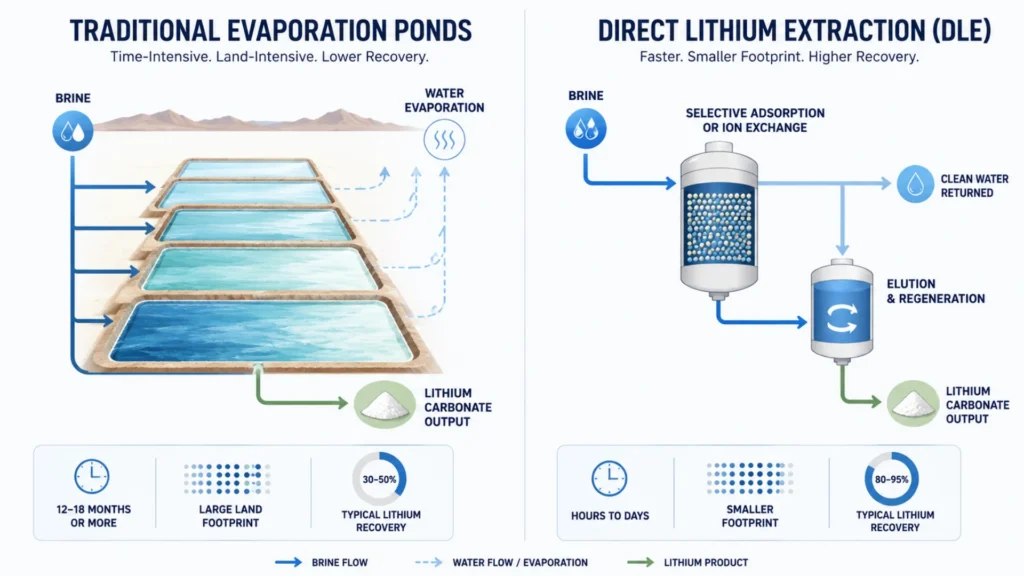
Traditional lithium production relies on massive evaporation ponds. Brine sits in the sun for 12 to 18 months while water evaporates and lithium concentrates, a process that typically recovers only 30% to 50% of the lithium in the brine and uses enormous volumes of freshwater.
Direct lithium extraction skips the ponds. Instead, brine is pumped through selective membranes or sorbent materials that pull lithium ions out directly, in hours instead of months. EnergyX says its GET-Lit process can recover roughly 90% of available lithium, a meaningful jump in efficiency, while cutting freshwater use dramatically compared to evaporation-based methods.
SoLiS and the Solid-State Battery Push
Beyond extraction, EnergyX is also developing SoLiS, a lithium-metal technology aimed at improving the energy density of next-generation solid-state batteries. This dual focus—extraction technology on one side and advanced battery materials on the other—is what separates EnergyX from pure-play mining companies and other DLE technology providers pushing the boundaries of clean energy storage, much like Form Energy’s long-duration battery innovations in the grid-scale space.
Patent Portfolio
According to the company’s SEC offering filings, EnergyX holds roughly 134 patents and patent applications covering its extraction and battery technologies, with about 50 of those published. That’s a substantial intellectual property position for a company still in its commercialization stage, and it’s one of the metrics EnergyX points to when making its case to investors.
EnergyX’s First U.S. Production Plant
In March 2026, EnergyX commissioned Project Lonestar, its first operating lithium production facility in the United States, at a former U.S. Army munitions site in Hooks, Texas, near the Texas-Arkansas border. The demonstration plant processes brine from the Smackover Formation, a geological formation stretching across Texas, Arkansas, and Louisiana that has become a major focus for domestic lithium development.
The Lonestar plant produces roughly 250 metric tons per year of battery-grade lithium carbonate equivalent (LCE), marking the first industrial-scale use of the GET-Lit platform. EnergyX has said this facility is meant to validate a path toward a much larger commercial-scale operation, with plans to eventually scale toward 5,000 tons per year and beyond.
This matters for the “is EnergyX real” question that shows up a lot in search results. A commissioned, operating plant processing actual brine is different from a lab demo or a pitch deck projection, and it’s one of the clearest signs of technical progress the company has shown to date.
EnergyX has also expanded its Smackover land position through the 2025 acquisition of Daytona Lithium’s roughly 35,000-acre resource in Arkansas, bringing its total Smackover holdings to about 47,500 acres.
EnergyX Funding History and Investors
EnergyX has raised capital through an unusually wide mix of channels for a company its size, ranging from retail crowdfunding to strategic investment from a major automaker and an energy major.
Here’s a rough timeline of the company’s funding milestones:
- 2021: EnergyX raised $20 million from Obsidian Acquisition Partners, Helios Capital, and a group of angel and institutional investors, alongside roughly $5 million to $9.7 million raised through Netcapital’s retail crowdfunding platform.
- 2023: General Motors led a $50 million Series B round, gaining rights to a share of future lithium production as part of the deal.
- 2024: EnergyX completed a $75 million Regulation A+ offering, a type of SEC-qualified raise that lets ordinary retail investors, not just accredited investors, buy shares directly.
- 2025–2026: EnergyX secured a $225 million strategic investment from Italian energy company Eni for a 25% stake in Black Giant, its lithium project in Chile’s Antofagasta region, with Eni receiving offtake rights to a portion of future production.
Across its funding history, various company disclosures put the total capital raised in the range of $150 million to $180 million, not counting project-level investments like the Eni deal. Notable backers include General Motors, Eni, POSCO, Obsidian Acquisition Partners, and The Global Emerging Markets Group.
Founder Teague Egan has said he deliberately chose Regulation A+ retail fundraising over additional venture capital in part because it let him retain a larger ownership stake, reportedly around 47%, compared with the terms institutional investors typically negotiate.
Is EnergyX Stock Publicly Traded?
No. This is the most important thing to understand if you’re searching for EnergyX stock. EnergyX is a private, pre-IPO company. It does not trade on the NYSE, Nasdaq, or any public exchange, and you can’t buy shares through a regular brokerage account like Fidelity or Charles Schwab.
You may have seen a listing under the symbol ENRX.PVT on financial sites like Yahoo Finance. That “.PVT” suffix is a placeholder used specifically to track private companies. It isn’t a real, tradable stock ticker, and its presence doesn’t mean EnergyX has gone public.
What Determines the EnergyX Stock Price
Since there’s no open market, the “EnergyX stock price” you’ll find quoted online usually comes from one of two sources:
- Direct offering price. During its Regulation A+ crowdfunding round, EnergyX set a direct share price of $11.00.
- Secondary market prices. Platforms that facilitate private share trading between existing shareholders and accredited investors have shown indicative prices ranging roughly from $5.40 to $11.00, depending on the platform, timing, and available supply.
Valuation estimates for the company vary quite a bit depending on the source and the date, ranging from a few hundred million dollars in some third-party trackers to over $1 billion according to figures the company itself has published. That gap is normal for a private company: without a public market setting the price every day, valuation depends heavily on the terms of the most recent funding round and who’s doing the estimating.
If you want to check current figures rather than rely on any single source, EnergyX’s private-market profile is tracked on Yahoo Finance under the ticker ENRX.PVT and independent data aggregators like StockAnalysis publish updated valuation and funding figures pulled from public filings and news reports.
How to Buy EnergyX Stock (Pre-IPO Shares)
There are two general paths to owning a piece of EnergyX, and they aren’t equally available to everyone.
Retail crowdfunding rounds. When EnergyX runs a Regulation A+ offering, non-accredited investors can typically buy shares directly through the company’s investor portal or through platforms it partners with. These rounds aren’t always open, so availability depends on timing.
Secondary marketplaces for accredited investors. Platforms such as Forge (a subsidiary of Charles Schwab), EquityZen, Hiive, and UpMarket connect accredited investors with existing EnergyX shareholders looking to sell. These platforms typically require proof of accredited status under SEC Regulation D, completion of a KYC/AML onboarding process, and a signed subscription agreement before any transaction is processed.
Either way, shares purchased this way are illiquid. There’s no guarantee of a future exit, and a return on investment depends on an eventual IPO, acquisition, or an organized liquidity event down the road.
This isn’t financial advice, and EnergyX shares carry the same risks as any early-stage private equity investment: the possibility of losing your full investment, long holding periods, and limited information compared with public companies. Anyone considering this kind of investment should carefully read the company’s SEC offering filings and consider speaking with a financial advisor first.
Separating Hype From Substance
EnergyX has generated significant attention, including features in Forbes, Bloomberg, the BBC, and the Financial Times, and comparisons of founder Teague Egan to Elon Musk. That kind of visibility is unusual for a company still years away from commercial-scale production, and it has drawn scrutiny as well as praise.
A 2024 Wall Street Journal profile of Egan noted that some competitors and industry consultants view EnergyX’s public claims skeptically, arguing the company has made statements about its technology that other DLE firms would typically back up with published, third-party engineering studies before making them public. The same reporting described an incident in which EnergyX sent a cease-and-desist letter to a lithium industry consultant after he posted on social media suggesting the company’s reputation owed more to marketing than to its underlying technology; the post was subsequently taken down.
None of that means the technology doesn’t work. EnergyX does have an operating demonstration plant, a real patent portfolio, and paying strategic partners like GM and Eni, which is more tangible progress than many early-stage cleantech startups can show. But the gap between “commissioned a 250-ton demonstration plant” and “operating at the 100,000-ton commercial scale needed to matter to the global lithium market” is still wide, and that gap is worth keeping in mind before treating any valuation figure as settled fact.
For readers who want a neutral, citation-heavy overview of the company’s history and the controversy around its claims, EnergyX’s Wikipedia entry is a useful starting point, since it links out to the original news coverage rather than summarising it secondhand.
EnergyX vs. Other Direct Lithium Extraction Companies
EnergyX competes in a crowded and fast-moving DLE field that includes Standard Lithium, Lilac Solutions, ElectraLith, and Controlled Thermal Resources (CTR), among others. Industry analysts generally split DLE players into two camps: technology licensors that sell or lease extraction systems to producers, and vertically integrated companies that plan to extract, refine, and sell lithium themselves.
EnergyX sits closer to the vertically integrated camp, alongside Standard Lithium and CTR, since it holds its own brine acreage in the Smackover Formation and in Chile rather than purely licensing technology to third parties. Estimated DLE operating costs across the industry, EnergyX included, run somewhere between $4,000 and $7,000 per ton of lithium carbonate equivalent, which compares favorably to conventional hard-rock mining costs of $6,000 to $18,000 per ton.
Common Mistakes to Avoid When Researching EnergyX Stock
Assuming a listed “price” means the stock is publicly tradable. Yahoo Finance displays private-market data for informational purposes. Seeing a number doesn’t mean you can call your broker and buy shares that afternoon.
Treating the highest valuation figure as the accurate one. Different platforms and press releases cite different valuations. Compare the source and the date before assuming any single number is current.
Skipping the SEC filings. EnergyX’s Regulation A+ offering circulars and annual reports, filed with the SEC, contain far more detail on financials, risk factors, and share structure than most third-party summary sites. These are public documents worth reading directly.
Ignoring liquidity risk. Pre-IPO shares can’t be sold on demand. Anyone investing should be comfortable holding the position for years with no guaranteed exit.
Frequently Asked Questions
Is EnergyX publicly traded?
No. EnergyX is a private company. Any “stock price” you see online for EnergyX reflects private funding-round pricing or secondary-market activity, not a public exchange listing.
What does ENRX mean? PVT ticker mean?
ENRX.PVT is a placeholder symbol used by financial data sites, including Yahoo Finance, to track private companies. It doesn’t represent an actual tradable security.
How much has EnergyX raised in funding?
Across crowdfunding rounds, a General Motors-led Series B, a Regulation A+ offering, and project-level investment from Eni, EnergyX has raised well over $150 million, plus additional project financing tied to specific facilities, such as Black Giant in Chile.
Can regular investors buy EnergyX stock?
Yes, but only during specific windows. Non-accredited investors can participate when EnergyX runs a Regulation A+ crowdfunding round. Outside of those windows, buying existing shares generally requires accredited investor status through a secondary marketplace.
Is EnergyX a legitimate company?
EnergyX has an operating demonstration plant, SEC-qualified offerings, a substantial patent portfolio, and strategic investments from companies such as General Motors and Eni. At the same time, some industry participants have publicly questioned whether its technology claims are fully substantiated, so it’s worth doing independent research before investing.
When might EnergyX go public?
The company hasn’t announced a confirmed IPO timeline. Like most pre-IPO companies, its stated path to a public listing depends on first hitting commercial production milestones, including scaling Project Lonestar beyond its current demonstration capacity.
Conclusion
EnergyX occupies an interesting spot in the clean energy landscape: a private company with real engineering milestones, a growing list of strategic partners, and enough public attention that people search for its stock price the way they would for a public company. But the fundamentals matter more than the headlines here. There’s no public ticker, no daily market price, and no guaranteed path to liquidity for anyone who invests.
If you’re researching EnergyX because you’re interested in direct lithium extraction technology, the Project Lonestar plant and the GET-Lit platform are genuinely worth following as the DLE industry matures. If you’re researching it as a potential investment, treat every valuation figure with appropriate skepticism, read the SEC filings directly, and remember that pre-IPO shares are illiquid, high-risk investments regardless of how promising the underlying technology looks.