

What Jobs Are Safe From AI Automation? Proven Careers That Will Thrive Through 2030
Every few weeks, a new headline claims AI is about to wipe out half the workforce. Then a different headline says the panic is overblown. Neither can be fully right, and if you’re trying to figure out whether your own job is actually at risk, that noise doesn’t help you.
Here’s a more useful way to think about it: AI doesn’t replace jobs so much as it replaces tasks. A job survives when most of what makes it valuable can’t be reduced to a repeatable, well-defined task. That’s the filter this guide uses to answer what jobs are safe from AI, and it’s also why the answer looks different depending on whether you’re asking about accountants, lawyers, doctors, or your own specific role.
What Jobs Are Safe From AI? The Quick Answer
Roughly 30% of U.S. workers currently work in occupations with near-zero AI exposure, according to Anthropic’s Economic Index, which analyzed millions of real Claude conversations to see which job tasks actually appear in AI usage rather than guessing from job titles alone. The common thread across that low-exposure group is physical, hands-on work done in person: skilled trades, hospitality, direct caregiving, and maintenance and repair roles.
At the same time, the World Economic Forum’s Future of Jobs Report 2025 projects that AI and automation will displace roughly 92 million jobs globally by 2030, while creating around 170 million new ones- a net gain, but one that requires real skill shifts for the people caught in the displaced group. McKinsey Global Institute’s research points to a similar pattern: fewer than 5% of occupations are fully automatable with current technology, but around 60% have at least some meaningful share of their tasks exposed to automation.
In plain terms: almost no job disappears overnight, but almost every job changes.
Why “AI-Proof” Is the Wrong Way to Think About This
Most competing lists rank jobs as simply safe or unsafe. That framing misses something important, since it’s tasks, not job titles, that get automated.
Take a marketing manager and a data entry clerk. Both technically work in an office. But a marketing manager’s job includes strategy conversations, stakeholder negotiation, brand judgment, and creative direction, tasks that resist automation. A data entry clerk’s job is, almost by definition, a repeatable, rule-based task, which is exactly what current AI systems handle well.
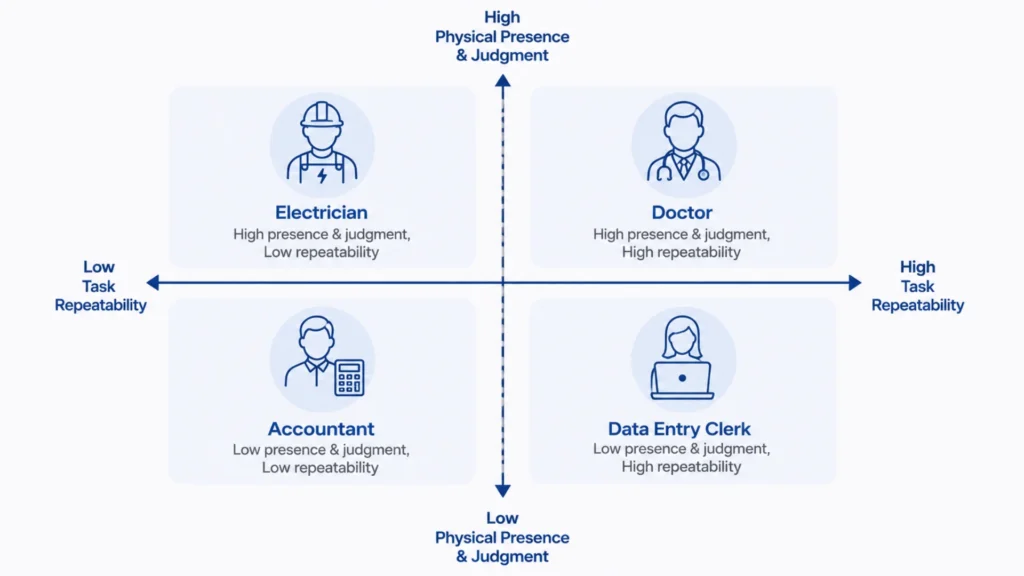
When analyzing what jobs are safe from AI, three factors consistently determine how exposed a role actually is:
Physical presence. A robot or software model still can’t fix your plumbing, deliver a baby, or install an HVAC system in a century-old building with no blueprints. Hands-on work tied to unpredictable physical environments remains the hardest category to automate.
Licensed judgment and accountability. Professions built around a license that carries personal legal or medical liability, such as doctors, lawyers, and engineers, tend to keep a human explicitly in the loop, even as AI tools handle more of the supporting research and drafting work beneath that decision.
High-trust human relationships. Therapy, teaching, caregiving, and leadership roles depend on trust that’s built through consistent human interaction over time. People generally don’t want to build that kind of relationship with software, even a very good one.
Jobs With the Lowest AI Exposure Right Now
Based on labor-market data from the Bureau of Labor Statistics, the WEF’s 2025 report, and Anthropic’s Economic Index, these categories consistently show the least AI exposure:
Skilled Trades
Electricians, plumbers, HVAC technicians, and construction workers remain difficult to automate because their work happens in constantly changing physical environments. Demand for electricians, specifically, has grown due to data center construction and EV infrastructure buildout, an ironic twist, as the AI boom itself is driving demand for one of the jobs least exposed to AI.
Healthcare and Direct Patient Care
If you are evaluating what jobs are safe from AI in healthcare, nurse practitioners, home health aides, and physical therapists top the list by combining hands-on care with deep relational trust. The BLS projects strong growth for nurse practitioner roles specifically, driven by an aging population and ongoing physician shortages in many regions.
Mental Health and Therapy
Licensed therapists and counselors work in a field where AI chatbots have rapidly expanded for basic support and coaching, but a major academic review found that the evidence base for AI-only mental health interventions remains limited and short-term, particularly for higher-acuity cases. Complex diagnosis, risk assessment, and medication management still require a licensed human.
Skilled Trades in Emergency and Safety Roles
Firefighters, aviation mechanics, and safety inspectors combine physical unpredictability with high-stakes judgment calls, a combination that keeps these roles near the bottom of every automation-exposure ranking.
Senior Creative and Strategic Roles
Senior creative roles are often overlooked when discussing which jobs are safe from AI. Creative directors, brand strategists, and experienced UX researchers use AI tools constantly, but the judgment about what actually resonates with an audience, and why, remains a human call. Entry-level creative and copywriting work has softened noticeably more than senior creative direction has.
Will AI Replace Accountants?
Not the profession as a whole, but the day-to-day work is shifting fast. Data entry, first-pass reconciliations, categorization, and routine bookkeeping are exactly the kind of repeatable, rule-based tasks AI handles well, and adoption has accelerated sharply. Thomson Reuters’ 2026 professional services research found generative AI adoption among accounting firms nearly doubled year over year, and firms using it well are pulling ahead of those that aren’t.
But independent benchmark testing in 2026 found that even the strongest AI models still miss enough real accounting tasks, particularly around judgment calls in reconciliation, reporting, and month-end close, that human review remains necessary. The BLS’s occupational projections show bookkeeping roles declining modestly through the early 2030s, while accountant and auditor roles overall continue to grow, a split that tells you exactly where the risk is concentrated: entry-level, transaction-heavy work is being automated, while the advisory, judgment, and controls side of accounting isn’t.
When evaluating which jobs are safe from AI, accounting often raises concerns, but if you’re asking whether accountants will be replaced wholesale, the honest answer is no. If you’re asking whether AI is taking over the more repetitive parts of accounting, that’s already happening, and it’s reshaping what an entry-level accounting job looks like.
Will AI Replace Lawyers?
AI is unlikely to replace lawyers as a licensed profession, but it’s already automating a meaningful share of the work that used to fill junior associates’ billable hours: first-pass legal research, document review, contract comparison, due diligence, and boilerplate drafting.
In assessing what jobs are safe from AI within legal professions, the lawyers most exposed are those focused on repeatable document processing rather than courtroom advocacy or strategic client counseling. Dedicated legal automation tools like GC AI have moved well past the experimental phase; they’re now a standard line item on major law firm technology budgets rather than a novelty. That shift has real implications for how firms structure entry-level associate roles, since some of the traditional training-ground tasks for new lawyers are now handled by AI first.
Will AI Replace Doctors?
This is where the data gets genuinely surprising, and most competitor content undersells it. A 2026 study by Harvard Medical School and Beth Israel Deaconess Medical Center found that an OpenAI reasoning model outperformed experienced internal medicine physicians in diagnosing real emergency department cases, using the same messy electronic health record data available to the doctors.
That result sounds like the beginning of physician replacement, but the researchers themselves were direct about the limits: the AI worked from text records alone, with no access to imaging, physical examination findings, or the vocal and behavioral cues a doctor picks up in the room. It also tended to recommend more unnecessary testing than the physicians did, a real cost problem if deployed unsupervised. A broader Stanford-Harvard “State of Clinical AI” report has cautioned that many “physician-level” AI performance claims rely on narrow benchmarks that don’t reflect the messiness of everyday clinical care.
The practical shift is already underway: AI-supported hospitals have reported a meaningful reduction in diagnostic errors, and imaging tools now assist in cancer screening with measurable accuracy gains. But diagnosis in context, treatment decisions, informed consent, and the accountability that comes with a medical license all still sit with the physician. AI is becoming a genuinely powerful second opinion, not a replacement for the person making the final call.
What Jobs Will AI Replace by 2030?
Flip the lens, and here’s what the data says is genuinely at risk over the next several years:
- Entry-level coding and QA testing, where AI-assisted development has already measurably reduced demand for junior developers doing routine implementation work.
- Tier-1 customer support is largely absorbed by AI chatbots and virtual agents for straightforward inquiries.
- Data entry and basic transcription are close to fully automatable with current technology.
- Paralegal document review, the routine, high-volume side of the role, specifically.
- Telemarketing and routine outbound sales calls.
- Basic copywriting and templated content production, particularly for short-form, formulaic content.
According to outplacement firm Challenger, Grey & Christmas, AI-attributed layoffs made up roughly 4.5% of total U.S. layoffs in 2025, a notable figure but far short of the mass displacement some headlines implied. A meaningful share of executive AI-attributed layoff announcements likely also reflects broader cost-cutting that gets framed as AI efficiency, since that framing tends to play better publicly than a straightforward headcount reduction.
Will AI Take My Job? A Practical Way to Check
Rather than relying on a generic list, it helps to break your own role down into its actual tasks and score each one honestly.
List your core weekly tasks. Not your job title, the actual things you do: drafting documents, running meetings, analyzing data, physically fixing something, making judgment calls under uncertainty.
Mark which tasks are repeatable and rule-based. If a task follows the same steps every time, regardless of context, it’s a strong candidate for automation.
Mark which tasks require in-person presence, licensed accountability, or relationship trust. These are your most protected tasks, the ones least likely to shift to AI in the near term.
Estimate the ratio. A role that’s 80% repeatable tasks and 20% judgment calls is far more exposed than one running the reverse ratio, regardless of the job title on your business card.
This task-level exercise tends to produce a more useful, personalized answer than any generic “safe jobs” list, because two people with the same job title can have meaningfully different exposure depending on what they actually spend their time doing day-to-day.
How to Future-Proof Your Career
To position yourself among the jobs that are safe from AI, focus on moving toward the judgment-heavy end of your field. If you’re in accounting, that means advisory and controls work over transaction processing. If you’re in law, that means client counseling and negotiation over document review. Almost every profession has a version of this shift available.
Learn to direct AI tools rather than compete with them. Workers who use AI well are seeing a real wage premium in current labor market data, since the highest-value skill right now isn’t doing the repeatable task yourself; it’s knowing how to check, direct, and improve AI-generated output.
Build the relationship and trust side of your role deliberately. Client relationships, mentorship, team leadership, and reputation are durable advantages that don’t show up on an automation-exposure spreadsheet but matter enormously in practice.
Watch adoption in your specific industry, not general headlines. Thomson Reuters’ industry-specific adoption data, BLS occupational projections, and O*NET task-level data all give a far more accurate read than a general news headline built for clicks.
Common Mistakes People Make When Assessing AI Job Risk
Judging which jobs are safe from AI by job title rather than by actual tasks is one of the biggest errors workers make. Two “accountants” can have very different exposure to automation depending on whether their week is mostly reconciliation or mostly client advisory work.
Confusing AI adoption with AI replacement. A firm reporting heavy AI usage isn’t the same as that firm eliminating the human roles involved. Most current data shows AI augmenting existing roles far more than replacing them outright.
Treating a single benchmark study as a settled fact. The Harvard-Beth Israel diagnostic study is a striking result, but the researchers themselves warned against interpreting it as proof that AI is ready to replace physicians in real clinical settings.
Ignoring your local labor market. National projections are useful for direction, but regional demand, especially for skilled trades tied to local construction and infrastructure, can differ meaningfully from national averages.
Frequently Asked Questions
What Jobs Are Safe From AI Automation?
No job is entirely immune to AI’s influence, but occupations that combine hands-on physical work, licensed accountability, and in-person trust, such as electricians, therapists, and nurse practitioners, currently show the lowest measured exposure to AI.
Will AI replace accountants completely?
No. Routine, transaction-heavy work like data entry and basic reconciliation is increasingly automated, but the advisory, judgment, and controls side of accounting still requires human accountants, and BLS projections show overall accountant employment continuing to grow even as bookkeeping roles decline.
Will AI take over accounting entirely in the next few years?
Unlikely. Independent 2026 benchmark testing found that even top AI models still make meaningful errors on real accounting tasks, particularly in reconciliation and reporting, where mistakes compound, and human review remains necessary.
What jobs will AI replace by 2030?
Entry-level coding, tier-1 customer support, data entry, routine paralegal document review, telemarketing, and templated copywriting show the clearest, already-measurable declines tied to AI adoption.
Will AI replace doctors and lawyers entirely?
No, both remain licensed professions where a human retains legal and ethical accountability for the final decision. AI is automating significant supporting work in both fields-, research, documentation, first-pass drafting, and review- without replacing the professionals themselves.
How do I know if AI will take my job specifically?
Break your role into its actual weekly tasks rather than judging by job title, and assess how many of those tasks are repeatable and rule-based versus how many require in-person presence, licensed judgment, or built human trust. The ratio tells you more than any general industry list can.
For more background on how economists and researchers have historically measured this kind of shift, Wikipedia’s overview of technological unemployment covers earlier waves of automation anxiety and what actually happened to employment levels afterward, providing useful context for separating this moment from pure novelty.
Conclusion
The honest answer to what jobs are safe from AI isn’t a clean list you can screenshot and trust for the next five years. It’s a pattern: physical presence, licensed accountability, and human trust are the three things current AI systems still can’t replicate, and the closer your actual daily tasks sit to those three things, the more durable your role is likely to be.
The jobs genuinely at risk aren’t defined by industry or job title; they’re defined by how much of the role is repeatable, rule-based work that was always going to get automated eventually. AI just arrived as the tool that finally does it. Understanding that distinction, and honestly auditing which side of it your own tasks fall on, is a far more useful exercise than any ranked list of 100 careers.