
What Is an AI Chatbot? A Guide to This Remarkable Technology
You’ve probably talked to more AI chatbots this month than you realize. The pop-up that answered your shipping question. The voice assistant on your phone. ChatGPT, Claude, or Gemini, if you use one of those directly. They’re all built on the same basic idea, even though they look and behave very differently.
What is an AI chatbot? How it works under the hood, and how it’s different from the clunky “press 1 for billing” bots of a decade ago. It also covers two related terms you’ll likely run into while researching chatbots: AI slop and private AI, since both directly affect how much you can trust and rely on the chatbots you use.
What Is an AI Chatbot?
What Is an AI Chatbot? An AI chatbot is a software program that uses artificial intelligence, specifically natural language processing and, increasingly, large language models, to understand what a person types or says and generate a relevant, human-like response, without following a rigid, pre-written script for every possible input.
That last part is the key distinction. Older chatbots could only handle exact keyword matches: type “hours,” and it prints the store hours; type anything slightly different, and it fails. A modern AI chatbot understands the intent behind a message even when it’s phrased unexpectedly, handles typos and slang, and can hold a coherent multi-turn conversation rather than resetting after every exchange.
How AI Chatbots Actually Work
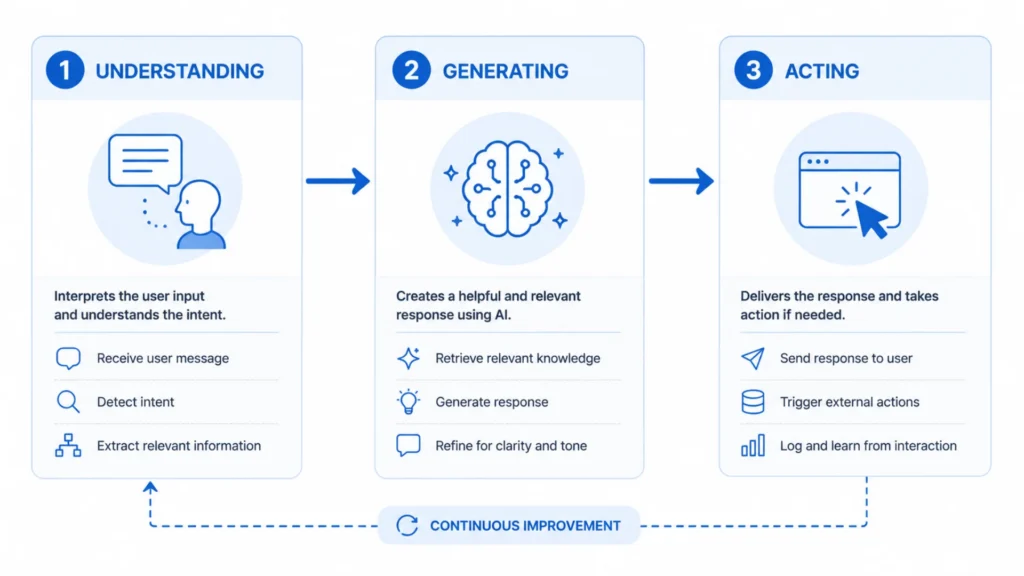
Underneath the conversation window, a modern AI chatbot runs through a processing pipeline that happens in milliseconds. Understanding the basic stages makes it much easier to evaluate any chatbot tool you’re considering using or building.
Natural Language Understanding
The first stage, natural language understanding (NLU), figures out what the user actually wants. This typically involves intent classification, mapping a message to a category like “check order status” or “cancel subscription,” and entity extraction, pulling out specific structured details like dates, product names, or account numbers from free-form text.
Response Generation
Once the system understands the request, it generates a response. Earlier chatbots pulled from a limited set of pre-written replies. Modern chatbots built on large language models generate original text on the fly, which is why they can answer questions they weren’t explicitly programmed to handle. Once the system understands the request, it generates a response. Earlier chatbots pulled from a limited set of pre-written replies. Modern chatbots built on large language models generate original text on the fly, which is why they can answer questions they weren’t explicitly programmed to handle. To ensure your chatbot delivers accurate outputs over time, learn how to measure AI performance effectively without getting overwhelmed by metrics.
Action and Integration
Many chatbots don’t just talk; they act. A chatbot connected to a company’s booking system can actually reschedule an appointment. One connected to a CRM can update a customer record. This is the layer that turns a chatbot from a simple Q&A tool into something that can complete real tasks.
The Three Generations of Chatbot Technology
Chatbots have gone through a fairly clear evolution, and knowing where a specific tool falls on this spectrum tells you a lot about what it can and can’t do.
Rule-based chatbots follow fixed decision trees and strict keyword matching. They’re cheap to build and predictable, but they break the moment a user phrases something in a way the designer didn’t anticipate. These are the “press 1 for sales” bots most people associate with frustration.
NLU-based chatbots, common through the mid-2010s and still widely used today, use machine learning to classify intent and extract entities, letting them handle a much wider range of phrasing for a defined set of tasks. Platforms like Dialogflow and Rasa are built around this approach. They’re reliable within their trained scope but still struggle with anything genuinely outside it.
LLM-based chatbots of the current generation use large language models like GPT, Claude, or Gemini as their core reasoning engine. Rather than matching against a fixed list of trained intents, they draw on broad world knowledge learned during training, which lets them handle open-ended questions, ambiguous phrasing, and topics they weren’t explicitly programmed for.
Most production chatbots in 2026 actually use a hybrid of the last two: NLU for well-defined, high-volume tasks where precision matters, and an LLM as a fallback for anything more open-ended, combining the predictability of trained intents with the flexibility of generative AI.
Common Types of AI Chatbots
Customer service chatbots handle support tickets, order tracking, and FAQs, typically integrated directly into a company’s website or app.
Virtual assistants like Siri, Alexa, and Google Assistant handle voice-based requests ranging from setting timers to controlling smart home devices.
General-purpose conversational AI, like ChatGPT, Claude, and Gemini, isn’t built around one narrow business use case. They’re designed to help with a broad range of tasks: writing, research, coding, and general conversation.
Companion and social chatbots are designed primarily for open-ended conversation and engagement rather than task completion, a category that’s grown significantly alongside the broader rise of generative AI.
A practical example of the difference: ChatGPT is a general-purpose conversational interface built on an underlying language model. A company that licenses a similar model, then restricts it to answering questions about its own product catalog, connects it to its own order database, and gives it specific tone and escalation instructions has built a business chatbot, using the same underlying technology but shaped for one specific job.
Is Your Chatbot Conversation Private? Understanding Private AI
Once people start relying on AI chatbots for anything sensitive- work documents, health questions, financial details- a natural question comes up: where does that data actually go? This is where the term private AI becomes relevant.
Private AI refers to running an AI model on infrastructure you or your organization control, rather than sending prompts to a public cloud service, where a third party processes and may retain that data. There are a few common ways this works in practice:
A self-hosted or on-premises deployment runs an open-weight model, like Llama, Mistral, or Qwen, entirely on hardware you own, so no prompt ever leaves your network. This is the strictest form of private AI, common in defense, healthcare, and legal settings with strict compliance requirements, but it requires real infrastructure investment and technical staff to maintain.
A private cloud deployment runs a model within an isolated cloud tenant you control, offering similar data isolation without the burden of buying and maintaining physical servers yourself.
Zero data retention (ZDR) agreements with a cloud AI provider are a lighter-weight middle path: the provider processes your prompt in memory to generate a response, then discards it immediately without storing it or using it for model training, all governed by a specific contractual agreement rather than infrastructure changes.
Most consumer chatbot apps, the free version of ChatGPT, or a typical customer service widget don’t offer this level of data control by default, which is exactly why “private AI” matters as a distinct consideration for anyone handling genuinely sensitive information through a chatbot, whether that’s a business evaluating vendor contracts or an individual deciding what they’re comfortable typing into a chat window.
Is Chatbot Content AI Slop? A Different Problem Worth Understanding
Separately from privacy, there’s a quality concern that’s become impossible to ignore in 2026: AI slop. It was named Word of the Year by Merriam-Webster, Macquarie Dictionary, and the American Dialect Society in the same year, an unusual triple convergence that reflects just how mainstream the term has become.
AI slop refers to low-quality, mass-produced content, text, images, or video, generated by AI with little human effort, judgment, or verification. Researchers studying the phenomenon in 2026 describe it through three recurring traits: it looks superficially competent, it requires far less effort to produce than it appears to, and it can be generated at massive scale, flooding platforms with volume that overwhelms genuinely useful content.
This matters directly for chatbots, because a poorly built or poorly prompted chatbot can absolutely produce slop: generic, repetitive, factually shaky responses generated at scale with no human review. A well-built chatbot, by contrast, is grounded in accurate source data, scoped to what it actually knows, and designed with clear escalation paths to a human when it’s uncertain. The technology underlying both is identical; the difference is entirely in how carefully it’s implemented and overseen.
If you’re evaluating a chatbot, whether for personal use or for your business, the practical question worth asking isn’t just “is this AI-generated,” it’s whether the output shows real verification and judgment behind it, or whether it has the hallmarks of AI slop: generic phrasing, unverifiable claims, and answers that sound confident regardless of whether they’re actually correct.
Tips for Getting the Most Out of an AI Chatbot
Be specific about what you actually need. Vague prompts get vague answers. Naming your exact goal, constraints, and context up front produces noticeably better results than a one-line question.
Verify anything that matters. Even the best chatbots can confidently state incorrect information. For anything with real consequences- medical, legal, financial- treat the chatbot’s answer as a starting point to verify, not a final source.
Know what you’re comfortable sharing. Unless you’re using a tool with explicit zero data retention or private AI guarantees, assume anything you type could potentially be reviewed or used to improve the service, and adjust what you share accordingly.
Match the tool to the task. A general-purpose chatbot like Claude or ChatGPT is excellent for broad, open-ended work. A business-specific chatbot trained on a company’s own data will usually outperform a general model on narrow, company-specific questions.
Common Misconceptions About AI Chatbots
Assuming every chatbot uses the same technology. A basic website widget that answers FAQs and a general-purpose assistant like Claude are built very differently, even though both are called “AI chatbots.”
Treating chatbot answers as automatically fact-checked. Language models generate statistically plausible text, not verified truth by default. Accuracy depends heavily on how the chatbot is built, what data it’s grounded in, and whether it’s designed to say “I don’t know” when appropriate.
Assuming all chatbot conversations are private by default. Unless a service specifically offers zero data retention or a private AI deployment, assume your conversation could be stored, reviewed, or used to improve the underlying model.
Confusing AI-generated with automatically low-quality. Not all AI output is AI slop. The distinction is about the effort, verification, and judgment applied to the output, not simply whether AI was involved in its production.
Frequently Asked Questions
What is an AI chatbot?
An AI chatbot is a program that uses artificial intelligence to understand what you’re asking in flexible, natural language and generate a relevant response, rather than matching your message against a fixed list of pre-written replies.
What’s the difference between a chatbot and a virtual assistant?
A chatbot is typically text-based and often scoped to a specific website or task. A virtual assistant, like Siri or Alexa, usually handles voice input and controls devices or services beyond just conversation. In practice, the terms overlap significantly.
What is AI slop, and how does it relate to chatbots?
AI slop is low-quality, mass-produced AI content created with little human oversight or verification. A poorly designed or poorly monitored chatbot can generate slop-like responses- generic, unverified, low-value answers, while a well-built one, grounded in accurate data and human oversight, avoids that problem entirely.
What is private AI, and do I need it?
Private AI means running an AI model on infrastructure you control or under a strict data-retention agreement, so your prompts and data aren’t stored or used by a third party. It matters most for anyone handling sensitive business, legal, health, or financial information through an AI chatbot.
Are AI chatbots the same as ChatGPT?
ChatGPT is one specific example of a general-purpose AI chatbot, built on OpenAI’s GPT models. “AI chatbot” is the broader category that also includes customer service bots, virtual assistants, and other conversational AI tools built on different underlying models.
Can AI chatbots replace human customer service entirely?
Not entirely, at least not yet. AI chatbots handle high-volume, well-defined questions efficiently, but most well-designed systems still include an escalation path to a human for complex, sensitive, or emotionally charged situations that a model isn’t equipped to fully resolve on its own.
For a deeper look at the low-quality content problem discussed above, Wikipedia’s entry on AI slop traces the term’s origin and its rapid adoption across major dictionaries in 2025 and 2026.
Conclusion
What Is an AI Chatbot? An AI chatbot, at its core, is just a program built to understand and respond to natural language, but the gap between a frustrating rule-based bot and a genuinely useful LLM-powered assistant comes down to what’s happening underneath the conversation: how well it understands intent, how it’s grounded in accurate information, and how transparently it handles your data.
If you take one thing from this guide, let it be a habit rather than a fact: before you trust a chatbot with something that matters, whether that’s a business decision or personal information, take a moment to consider what’s actually happening to your data and how carefully that particular tool’s answers are grounded in something real.