
Why Does AI Use Water? The Alarming Truth Behind Every Prompt
You’ve probably seen the claim: one ChatGPT prompt equals a bottle of water. It’s been repeated so many times on Reddit and social media that it’s become a kind of shorthand for AI’s environmental cost. It’s also, depending on what you’re actually measuring, both true and wildly misleading at the same time.
Why Does AI Use Water? The story is more interesting than a single scary number, and understanding it matters because AI water use is shaping infrastructure decisions in American communities right now. This guide explains why AI uses water in the first place, walks through the actual per-prompt numbers with their sources, and covers what’s happening at the scale that matters most: the data center campuses being built across the country. That’s why you get a limited number of AI tokens in the free version: it costs AI companies a lot. What is a token in AI?
Why Does AI Use Water? The Quick Answer
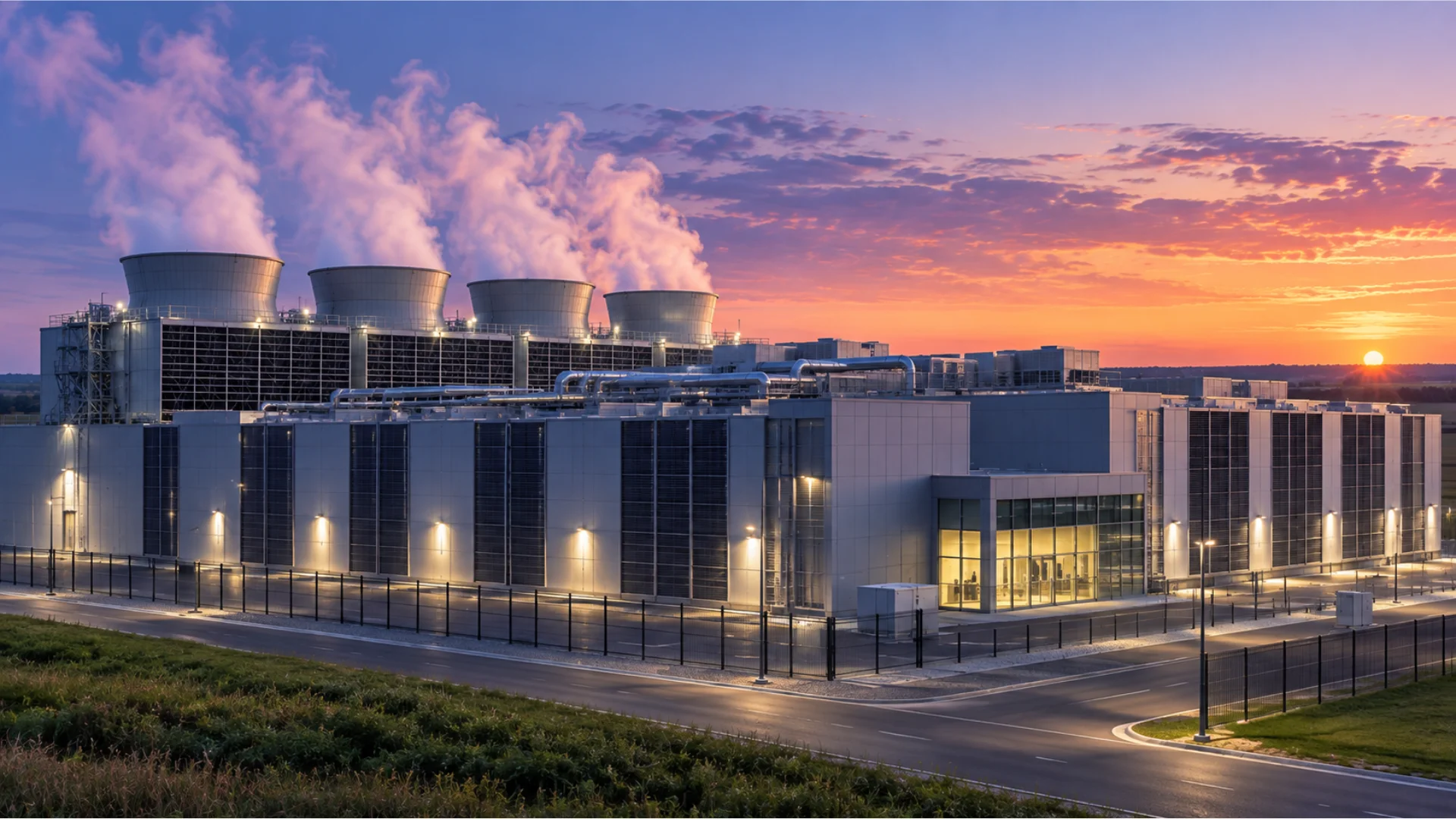
Why Does AI Use Water? AI uses water primarily to cool the data centers that run it. Racks of GPUs generate enormous heat, and many data centers rely on evaporative cooling, a system that uses water in the same way sweat cools your skin, to keep that hardware from overheating.
The per-prompt water figure you’ve seen depends entirely on what’s being counted. Google’s own 2025 disclosure estimated the median Gemini text prompt at about 0.26 milliliters of on-site water. The widely cited “bottle of water” figure, roughly 519 milliliters, comes from a 2023 University of California, Riverside study estimating a 100-word GPT-4 response and includes indirect water used to generate the electricity, not just cooling at the data center itself. Both numbers are legitimate. They’re just measuring different things.
Zoom out from individual prompts, though, and the aggregate picture is genuinely significant. Berkeley Lab found that U.S. data centers directly consumed 17.4 billion gallons of water in 2023, with an estimated 211 billion gallons more consumed indirectly through the power plants generating their electricity, and that the direct figure is projected to reach 38 to 73 billion gallons annually by 2028.
Why Does AI Use Water in the First Place?
Why Does AI Use Water? Every time a GPU processes a prompt, it converts electricity into computation, and almost all of that electricity eventually becomes heat. A single AI data center can pack thousands of high-performance chips into one building, running at full load nearly around the clock, which generates an enormous, concentrated heat load that has to go somewhere.
Water is simply a very efficient way to move that heat out of the building. It has a far higher thermal capacity than air, meaning it can absorb and carry away more heat per unit volume, which is why so much data center cooling infrastructure is built around it rather than relying solely on fans and air conditioning.
How Data Centers Actually Cool Their Servers
There are three broad approaches, and the choice between them is really a trade-off between water use and electricity use.
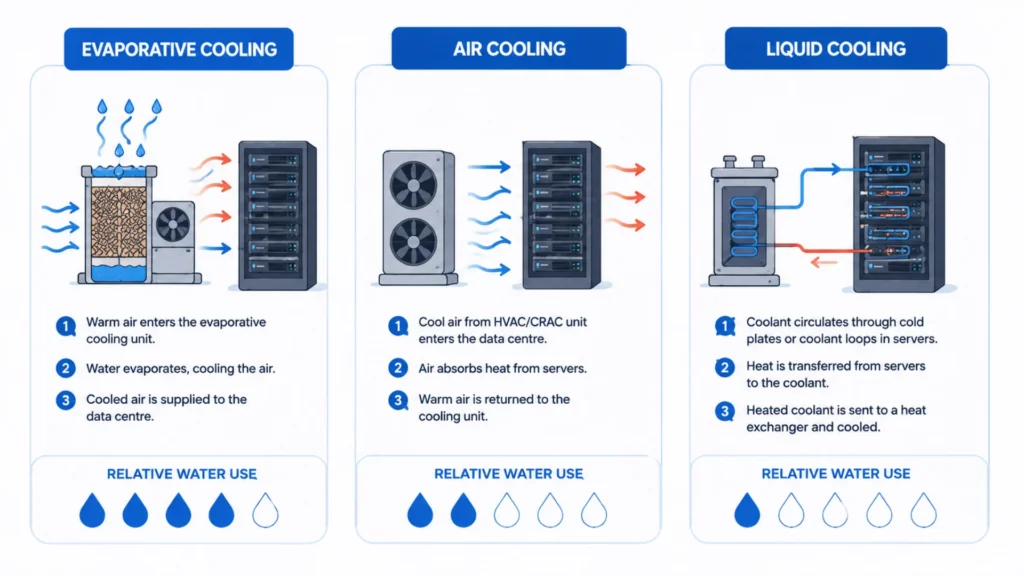
Evaporative cooling works like a giant swamp cooler. Warm water passes through a cooling tower; some of it evaporates, and that evaporation removes heat from the remaining water, which is then recirculated to absorb more heat from the servers. This method is energy-efficient, but the water that evaporates is genuinely gone from the local water supply. Operators also periodically drain a portion of the concentrated, mineral-heavy water, a process called blowdown, and replace it with fresh water to prevent scale buildup and corrosion in the pipes.
Air cooling, also called dry cooling, avoids evaporation almost entirely by using fans and heat exchangers instead. It uses dramatically less on-site water, which is why some operators use it specifically in water-stressed regions. The tradeoff is that it requires more electricity to move the same amount of heat, shifting the water cost upstream to the power plant generating that extra electricity, since power generation itself typically consumes water.
Liquid cooling, including direct-to-chip and immersion cooling, is becoming increasingly common for the newest, densest AI hardware. This method circulates coolant, often water, in a closed loop directly across or near the chips themselves. It’s worth being clear about a common point of confusion here: liquid cooling is not the same as evaporative cooling. Because the coolant stays in a sealed loop rather than evaporating into the air, liquid cooling doesn’t inherently increase water consumption the way evaporative systems do, and it’s increasingly the preferred method for high-density AI training clusters specifically because it handles concentrated heat loads more efficiently than air alone.
How Much Water Does AI Use Per Prompt
This is where most online debate gets stuck, so it’s worth breaking down clearly using the framework researchers actually use: Scope 1, Scope 2, and Scope 3 water use.
- Scope 1 is on-site water, the cooling tower water used directly at the data center.
- Scope 2 is the off-site water consumed to generate the electricity the data center draws from the grid.
- Scope 3 covers embodied water in the supply chain, including the roughly 2,200 gallons of ultra-pure water required to manufacture a single semiconductor chip, according to OECD.AI’s analysis.
Why Does AI Use Water? Here’s how that plays out in real published figures:
- Google’s official 2025 measurement, based on production data, found that a median Gemini text prompt uses 0.24 watt-hours of energy and consumes 0.26 milliliters of water, roughly five drops, counting on-site cooling.
- OpenAI CEO Sam Altman has stated that a typical ChatGPT query uses about 0.3 milliliters of water, in the same range as Google’s figure, and has argued that many data centers have moved away from water-heavy evaporative cooling.
- The UC Riverside estimate, roughly 519 milliliters per 100-word response, or about 500 milliliters across a session of 10 to 50 prompts under certain conditions, includes Scope 2 electricity-generation water in addition to cooling.
- A 2025 benchmarking study called “How Hungry Is AI?” found that efficient models can run at under 2 milliliters per query, reinforcing that both model efficiency and cooling method substantially affect the number.
The honest takeaway: a single ordinary chatbot prompt likely uses somewhere in the low single-digit milliliters when you count cooling and electricity generation together, with heavier reasoning-model queries running higher. The “bottle of water per prompt” framing isn’t fabricated, but it represents a specific, higher-end scenario rather than a universal per-query constant, and citing it without that context is where a lot of otherwise well-meaning coverage goes wrong.
How Much Water Is Used for AI Overall
Per-prompt numbers matter less than aggregate numbers, because billions of prompts happen daily across ChatGPT, Gemini, Claude, Grok, and other platforms, and because training itself carries its own separate water cost.
Training a single large model is a substantial one-time expense. UC Riverside researchers estimated that training GPT-3-scale models in U.S. data centers consumed roughly 700,000 liters (about 185,000 gallons) of water. That’s a large number, but it’s a one-time cost spread across the model’s entire operational lifetime. As of 2026, inference- the ongoing cost of answering everyday user prompts- is the dominant and fastest-growing share of total AI water demand, simply because of sheer query volume.
At the company level, disclosures vary in scope and completeness, but the public figures give a sense of scale:
- Google reported 10.9 billion gallons of water consumed company-wide in 2025, the largest disclosed figure among major AI providers.
- Microsoft withdrew approximately 2.7 billion gallons in 2024.
- AWS withdrew 2.5 billion gallons.
A medium-sized data center can consume up to roughly 110 million gallons of water annually for cooling, comparable to the yearly water use of about 1,000 households, according to the Environmental and Energy Study Institute. Larger hyperscale facilities can use up to 5 million gallons per day during peak demand, comparable to the water use of a town of 10,000 to 50,000 people.
Does AI Waste Water, or Is This How Cooling Works?
“Waste” is a loaded word, and it’s worth separating two distinct concerns that are often lumped together in online debate.
The first is efficiency: is the water being used well, or could the same cooling be achieved with less? This is where the industry has made real, measurable progress. Liquid cooling systems, better siting decisions, and closed-loop designs are all reducing the water needed per unit of computing power, even as total AI compute continues to grow.
The second, more contentious concern is location and timing: even efficiently used water can be a real problem if it’s drawn from a water-stressed community. About two-thirds of new U.S. data centers built or under development since 2022 are located in areas experiencing high water stress, according to a 2025 Bloomberg analysis. In The Dalles, Oregon, Google’s data center water use reached about 550 million gallons in 2025, nearly 40% of the city’s total water consumption, according to municipal records reported by Latitude Media.
There’s also a technical nuance that fuels a lot of confusion: most cooling-tower water doesn’t get returned to the local watershed the way water from a sink or shower eventually does. It evaporates, which is why researchers measure it as “consumption” rather than simple withdrawal, and why it functionally leaves the local water cycle even though it’s not destroyed in any chemical sense.
Peak demand adds another layer that researchers increasingly flag as the real infrastructure risk. Research from UC Riverside and Caltech estimates that U.S. water systems may need $10 to $58 billion in new infrastructure investment by 2030, driven substantially by data center growth, because peak-day cooling demand can run 6 to 30 times higher than the annual daily average, a burden that often falls on local ratepayers and municipal utilities rather than the data center operators themselves.
What Companies Are Actually Doing About It
The larger AI and cloud providers have real reputational and operational incentives to reduce their water footprint, and several concrete shifts are underway:
- Shifting toward reclaimed and non-potable water sources rather than treated drinking water for cooling, where local infrastructure allows it.
- Choosing air cooling over evaporative cooling in water-stressed regions, accepting a higher electricity cost in exchange for a lower local water footprint.
- Expanding liquid cooling adoption, now used in roughly a quarter of data centers overall and increasingly standard for new AI training clusters specifically, since it handles high-density GPU heat loads more efficiently than air while running in a closed loop rather than evaporating.
- Publishing more detailed water disclosures, following Google’s 2025 methodology, which gave outside researchers and journalists something more precise to work with than earlier industry-wide estimates.
Common Mistakes People Make When Talking About AI Water Use
Comparing per-prompt numbers without checking what scope they include. A 0.26 mL figure and a 519 mL figure aren’t contradictory; they’re measuring different boundaries around the same underlying process.
Treating “consumption” and “withdrawal” as the same thing. Consumption means water that’s evaporated or otherwise removed from the local water cycle. Withdrawal includes water that’s used and then returned. Company disclosures don’t always specify which one they’re reporting, which makes apples-to-apples comparisons harder than they should be.
Assuming all data centers use the same cooling method. Evaporative cooling, air cooling, and liquid cooling have meaningfully different water profiles, and the right choice depends heavily on local climate and water availability, not a fixed industry standard.
Ignoring the electricity-generation water cost entirely. Even air-cooled data centers that use minimal on-site water still draw electricity from power plants that often consume water themselves, particularly in regions relying on thermoelectric power generation.
Frequently Asked Questions
Why Does AI Use Water?
AI uses water primarily to cool the data centers that run the GPUs processing AI queries. Many facilities use evaporative cooling, which relies on water evaporation to remove heat, similar to how sweat cools the human body.
How much water does AI use per prompt?
Estimates range from about 0.26 milliliters, Google’s 2025 on-site figure for a median Gemini prompt, to roughly 519 milliliters for a 100-word response, according to a 2023 UC Riverside estimate that also includes water for electricity generation. A typical prompt likely falls in the low single-digit milliliters when both are counted together.
How much water is used for AI overall?
U.S. data centers directly consumed an estimated 17.4 billion gallons of water in 2023, according to Berkeley Lab, with roughly 211 billion gallons more consumed indirectly through electricity generation. That direct figure is projected to reach 38- 73 billion gallons annually by 2028.
How does AI waste water?
The bigger concern isn’t inefficiency so much as location: about two-thirds of new U.S. data centers since 2022 have been built in water-stressed regions, and peak cooling demand can spike 6 to 30 times above the daily average, straining local water infrastructure even when the underlying cooling technology itself is reasonably efficient.
Does training an AI model use more water than everyday use?
Training is a large one-time cost, roughly 185,000 gallons for a GPT-3-scale model, but inference, the ongoing process of answering billions of daily user prompts, is now the larger and fastest-growing share of total AI water demand.
Can AI data centers avoid using water entirely?
Not entirely, but water-free or near-water-free designs using air cooling exist and are increasingly deployed in water-stressed regions. The trade-off is higher electricity consumption, which shifts the water cost to power generation instead of eliminating it outright.
For a broader look at how researchers measure water use across products and industries generally, Wikipedia’s entry on water footprint is a useful primer on the direct-versus-indirect measurement approach that shows up throughout this topic.
Conclusion
Why Does AI Use Water? It’s because computing generates heat, and water remains one of the most efficient ways to remove that heat at scale. The “bottle of water per prompt” statistic isn’t a myth, but it’s also not the whole picture, since the real number depends heavily on which company, which cooling method, and which scope of water use you’re actually measuring.
The more meaningful story isn’t about any single prompt. It’s about where new data centers get built, which cooling method gets chosen for that specific location, and how transparent companies are willing to be about the trade-offs. Those decisions, not any individual chatbot query, are what will determine whether AI’s water footprint becomes a genuine strain on American communities or a manageable cost of a technology that keeps scaling.