

Is AI a Bubble Ready to Burst, or Just the Start of Something Bigger
Every few months, someone asks the same question in a different tone of voice. Sometimes it sounds worried. Sometimes it sounds smug, like they already know the answer. Is AI a bubble?
The honest response is that nobody knows for certain, not even the people running the companies at the center of it. But we can look at the numbers, compare them to past bubbles, and understand exactly what would need to happen for this one to pop. That’s what this article does.
We’ll walk through the bull case, the bear case, what happened during the dot-com crash for context, and a term you’ll likely run into while researching this topic called AI arbitrage. By the end, you’ll have a clear framework for judging the AI bubble question yourself instead of just borrowing someone else’s opinion.
What People Actually Mean When They Ask “Is AI a Bubble”
An economic bubble happens when the price of an asset rises far above what its actual earnings or usefulness can justify, usually fueled by hype and momentum rather than fundamentals. Eventually, reality catches up. Prices fall hard and fast.
When people ask if AI is a bubble, they’re usually really asking one of three separate things.
- Are AI stock valuations too high compared to actual profits and revenue?
- Is AI infrastructure spending, the hundreds of billions going into chips and data centers, going to pay for itself?
- Will most AI startups eventually fail once the hype settles, leaving only a few winners?
These are related, but distinct questions, and much of the confusion in this debate stems from conflating them. A company can have an inflated stock price while still building something genuinely useful. A market can have too many startups chasing the same idea, even as the underlying technology continues to improve. Keep these three questions separate as you read on, because the answer isn’t the same for all of them.
The Case That AI Is a Bubble
Valuations Look Historically Stretched
Some of the numbers here are hard to ignore. Nvidia’s market capitalization has crossed $5 trillion, and the stock has surged more than 880% over the past three years. Palantir Technologies has traded at more than 100 times sales, a level that historically has preceded sharp corrections in other companies. The Shiller cyclically adjusted price-to-earnings ratio for the broader market exceeded 40 in 2025, a level reached only once before in market history, right before the dot-com crash.
Market concentration adds to the concern. The top ten stocks in the S&P 500, most of which are AI-linked, now account for roughly 35% of the index’s total value. That’s a higher concentration than the peak of the dot-com bubble in 2000, when the top ten made up about 25%.
Capital Spending Is Enormous and Growing
The four biggest hyperscalers, Google, Amazon, Microsoft, and Meta, have guided toward roughly $725 billion in combined capital expenditure for 2026 alone, an increase of about 77% from the prior year. Add Oracle, and the number climbs past $750 billion just among a handful of companies. That’s an extraordinary amount of money being poured into chips, data centers, and power infrastructure, all on the bet that future AI revenue will justify it.
Some of that spending is starting to worry credit markets too. Corporate bond spreads for a few major AI infrastructure players have widened to levels that some analysts compare to those of sovereign debt from smaller, less stable economies, a sign that bond investors are demanding a larger premium for the risk.
Circular Financing Raises Eyebrows
One pattern critics point to often is circular revenue. A chunk of Microsoft’s reported AI revenue traces back to OpenAI’s own spending on Azure, meaning some of the money changing hands is really one closely linked pair of companies paying each other, not new external demand. Deals structured this way can make growth numbers look stronger than the underlying market actually is.
History Doesn’t Look Kind to “Sure Thing” Technologies
Financial historians William Quinn and John Turner have documented how transformative technologies repeatedly create speculative bubbles. Early profits from an emerging technology attract momentum investors, valuations climb faster than fundamentals, and more companies rush to go public to catch the wave. The pattern shows up in the railway mania of the 1840s, the Roaring Twenties, and the dot-com era. AI, by this reading, is simply the latest chapter in a familiar story.
The Case Against an AI Bubble
Today’s AI Leaders Actually Make Money
This is the argument you’ll hear most often from AI bubble skeptics, and it holds up under scrutiny. Nvidia isn’t a speculative story stock propped up on promises. It generated over $215 billion in revenue in its most recent fiscal year, a 65% increase year-over-year, with trailing profit margins around 53%. That’s a fundamentally different financial profile than the profitless dot-com darlings of 1999, many of which had no real revenue at all, just a business plan and a stock ticker.
Capex Is Funded by Cash, Not Debt
Fidelity’s research team, along with several other analysts, points out a critical difference from the dot-com era. Before that bubble burst, tech companies had been spending more than they generated in cash for nearly a decade, funding growth with debt and stock offerings. Today, the opposite is largely true. Microsoft, Alphabet, Meta, and Amazon are funding the bulk of their AI infrastructure spending out of operating cash flow, not by taking on risky debt. That doesn’t eliminate risk, but it does mean a downturn wouldn’t trigger the same kind of forced fire sales and bankruptcy wave that followed 2000.
Real Enterprise Demand Keeps Showing Up
Skeptics have called an AI bubble burst at least a dozen times over the past three years, after every Nvidia dip or pricing shakeup. Each time, enterprise demand for AI tools and infrastructure has continued to climb rather than collapse. Global AI investment is projected to exceed $2.5 trillion in 2026, and the broader AI market is forecast to grow between 28% and 37% annually through 2030, according to multiple industry estimates. A tool-tracking census run by one AI directory found that as of early August 2026, only about 9.3% of tracked AI products had shut down or been acquired, a much lower failure rate than the 80 to 90% figures that circulate in bubble-focused headlines.
Prediction Markets Aren’t Betting on a Crash
On Polymarket, contracts asking when the AI bubble will burst have shown the probability of a burst by the end of 2026 drifting down over the summer, from roughly 26% in June to somewhere between 18% and 19% by late July. That’s not proof of anything; prediction markets can be wrong, but it does suggest that people willing to put money on the line aren’t convinced a collapse is imminent.
What History Teaches Us About the Dot-Com Comparison
The dot-com crash of 2000 to 2002 wiped out roughly $5 trillion in market value and took the Nasdaq down nearly 78% from its peak. It’s the comparison everyone reaches for, and it’s useful, but the parallels only go so far.
In 1999, plenty of internet companies had no clear path to profit and no real product beyond a flashy website. Investors bought the story, not the balance sheet. Today’s largest AI companies, by contrast, are among the most profitable businesses in the world, generating enormous free cash flow even while spending heavily on new infrastructure.
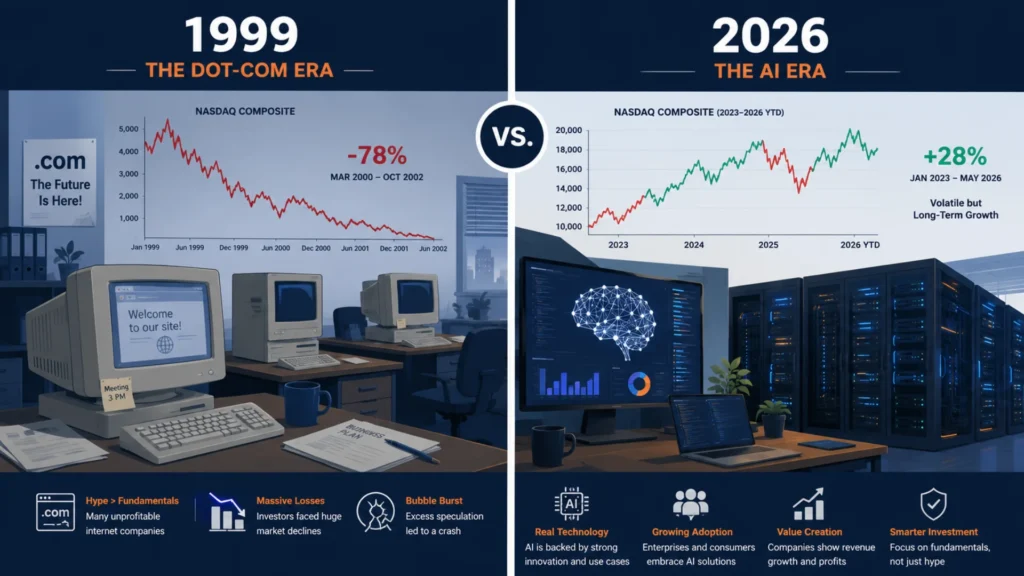
That said, the dot-com era also produced permanent, transformative change. Amazon, Google, and eBay all survived the crash and became some of the most valuable companies on earth. A bubble popping doesn’t mean the underlying technology was worthless. It usually means the market got ahead of itself on timing and pricing, not that the technology itself was a mistake. If AI follows a similar arc, a correction wouldn’t necessarily mean AI was hype all along. It could simply mean prices needed to reset before the next stage of growth.
What Would Actually Trigger a Burst
Most analysts who study this space closely point to the same handful of triggers rather than a random popping of a soap bubble.
Capex is not converting to revenue. If the hundreds of billions spent on chips and data centers don’t eventually translate into enterprise revenue and profit, investors will stop rewarding that spending. This is the single most-cited trigger across nearly every serious analysis.
Rising interest rates. Economist Ruchir Sharma and others have warned that a bubble like this depends partly on cheap capital. If borrowing costs rise sharply, some of the more speculative, debt-funded corners of the AI ecosystem would feel it first.
A slowdown in enterprise ROI. Companies are still in the early stages of figuring out how to measure the return on their AI investments. If you are evaluating your own deployment, learning how to measure AI performance effectively without getting overwhelmed by metrics is crucial before scaling budgets. If productivity gains don’t materialize fast enough, that pressure would ripple back through the vendors selling AI tools and infrastructure.
Chip oversupply. Right now, demand for AI chips outpaces supply, which is helping prop up valuations for companies like Nvidia and Broadcom. If manufacturing catches up and scarcity pricing fades, margins across the sector could compress.
The consensus among many analysts isn’t a sudden detonation. It’s closer to a gradual deflation, something like a 20 to 30% correction in AI-heavy stocks spread across 2026 and 2027, rather than a single crash event.
Understanding AI Arbitrage
While researching whether AI is a bubble, you’ll likely come across the term AI arbitrage, and it’s worth understanding because it explains part of why so much money keeps flowing into this space.
AI arbitrage refers to the gap between the cost of producing a piece of work with AI tools and what a business or client is still willing to pay for the same outcome. Someone using AI to write, design, code, or analyze data faster than a traditional team can charge close to the old market rate while their own costs drop sharply. That gap is the arbitrage, and it’s currently very real across freelancing, agency work, and internal enterprise operations.
This matters for the bubble conversation because AI arbitrage is one of the clearest, most measurable forms of value AI is already creating, separate from speculative stock pricing. A marketing agency that cuts content production costs in half while charging clients close to the same rate isn’t participating in hype. It’s capturing a genuine efficiency gain.
The catch is that AI arbitrage tends to shrink over time as more competitors adopt the same tools. Early movers capture outsized margins. As the tools become standard practice across an entire industry, the arbitrage narrows, and prices adjust downward to reflect the new, lower cost of production. That’s a healthy, normal market dynamic, not a sign of collapse, but it does mean the easy money available today from AI arbitrage won’t last indefinitely.
Common Mistakes People Make When Evaluating the AI Bubble Question
Treating “AI is transformative” and “AI stocks are fairly valued” as the same claim. They’re not. A technology can genuinely change the world while its stocks are still priced for perfection in the short term.
Ignoring which companies are actually profitable. Lumping Nvidia, which has real earnings, in with early-stage AI startups burning cash isn’t a fair comparison. Valuation risk looks very different depending on whether a company already generates strong free cash flow.
Assuming a correction means the technology failed. The dot-com crash didn’t erase the internet. It corrected prices while the technology continued to advance, eventually producing some of the most valuable companies in history.
Relying on a single data point. Whether it’s one analyst’s price target or one viral social media post, no single number tells you whether AI overall is a bubble. Look at earnings, capex funding sources, enterprise adoption data, and credit market signals together.
Frequently Asked Questions
Is AI a bubble like the dot-com crash?
There are real similarities, especially in valuation multiples and market concentration, but a key difference is profitability. Major dot-com companies mostly lacked real earnings, while today’s largest AI companies generate substantial profits and fund their spending mostly through cash flow rather than debt.
What would happen if the AI bubble popped?
Most analysts expect a valuation correction in AI-heavy stocks rather than a systemic financial crisis, largely because spending is funded by cash rather than debt. That said, a sharp correction could still slow hiring, reduce startup funding, and pressure companies that took on debt to expand data centers.
Are AI startups a bigger bubble risk than big tech companies?
Generally yes. Early-stage AI startups often lack the revenue and profit margins that companies like Nvidia, Microsoft, and Alphabet already have. A shakeout among smaller, less differentiated AI startups is considered more likely than a collapse of the largest, most profitable players.
How can I protect my investments if I’m worried about an AI bubble?
This isn’t financial advice, and you should talk to a licensed financial advisor about your specific situation, but common approaches people discuss include diversifying beyond AI-heavy indexes, avoiding concentrated bets on single high-multiple stocks, and paying attention to earnings reports rather than just price momentum.
Is AI arbitrage a scam?
Not inherently. AI arbitrage describes a real, measurable business efficiency, using AI to deliver work at lower cost while charging closer to traditional rates. Scams exist around this term, with people marketing unrealistic, guaranteed income claims, so treat any “get rich fast with AI arbitrage” pitch with skepticism.
Conclusion
Is AI a bubble? The fair answer is that parts of the market almost certainly are, and parts aren’t. Valuations for some AI-linked stocks look stretched by almost any historical measure, and the sheer scale of capital spending, over $2.5 trillion projected globally in 2026, creates real risk if enterprise revenue doesn’t catch up fast enough to justify it.
At the same time, the biggest players in this space are nothing like the profitless dot-com companies of 1999. They generate real cash, fund their own expansion, and serve enterprise demand that keeps showing up quarter after quarter, even after repeated predictions of collapse.
The most useful way to think about this isn’t to pick a side and defend it forever. It’s watching the specific signals that matter, whether capex spending eventually turns into real revenue, whether interest rates stay manageable, and whether enterprise ROI on AI tools keeps improving. Those three threads will tell you more about where this is headed than any single hot take ever could.
For more background on how economists formally define and study this kind of pattern, the Wikipedia entry on economic bubbles offers a useful historical overview of past examples and the warning signs researchers typically look for.