
Is We Are Charlie Kirk AI, and Why the Viral Gospel Song Fooled So Many Listeners
A song called “We Are Charlie Kirk” showed up on Spotify’s viral chart in late 2025 and immediately split listeners into two camps. Some treated it as a sincere tribute. Many more treated it as something else entirely, an oddly robotic power ballad that felt manufactured rather than performed.
So is We Are Charlie Kirk AI? The short answer is yes. This article walks through exactly how we know that, who actually made it, why it spread so fast, and what it says about a much bigger trend: the flood of AI-generated musicians, singers, and video clips now showing up across every major platform. Along the way, we’ll also answer a few closely related questions people keep searching for, including whether singers like Sienna Rose and Inga Rose are AI, and what actually separates AI from CGI.
What Is We Are Charlie Kirk, and When Did It Come Out
Charlie Kirk, the conservative activist and founder of Turning Point USA, was fatally shot while speaking at Utah Valley University in September 2025. His death set off an enormous wave of tributes, news coverage, and online commentary.
Six days later, on September 16, 2025, an anonymous project called Spalexma released “We Are Charlie Kirk” on Spotify and other streaming platforms. Structured as a swelling, gospel-style power ballad, the song frames Kirk as a martyr for his Christian faith, echoing the emotional style of 1980s Christian power ballads that scholars have linked to conservative evangelical music traditions.
The track sat mostly unnoticed for about two months. That changed in November 2025 when a TikTok user posted a clip mocking the song, calling it one of the worst pieces of music they had ever heard. That single post pulled in more than 7 million views, and from there the song exploded. It topped Spotify’s Viral 50 chart in both the United States and globally, racked up over a million streams, and became the audio behind tens of thousands of TikTok videos, many of them mocking rather than honoring the track.
The Evidence That We Are Charlie Kirk Is AI
Several independent signals point in the same direction, and they line up with each other in a way that leaves little room for doubt.
Deezer Flagged It Directly
Deezer, a streaming platform that runs its own AI music detection system, confirmed to multiple outlets that “We Are Charlie Kirk” and other Spalexma releases were flagged and tagged as AI-generated content on its platform. Deezer’s detection tool works by analyzing subtle mathematical artifacts left behind during AI audio generation, patterns that are effectively invisible to the human ear but easy for software to detect.
The Artist Behind It Has No Real-World Footprint
Spalexma has no social media presence, no interviews, no live performance footage, and no verifiable identity behind the name. Within just a few months of appearing on streaming platforms, the project had released more than a dozen full albums, almost entirely centered on Christian and political themes. That pace of output is far beyond what a single human songwriter and vocalist could realistically produce, but it lines up exactly with how quickly AI music generation tools can churn out new tracks.
The Vocal and Production Quality Match Known AI Artifacts.
Listeners repeatedly pointed to the same red flags. The vocals sound overly smoothed and robotic, particularly in the chorus. The production leans heavily on autotune, masking the voice rather than enhancing it. Independent lyric analysis using GPTZero found an extremely high probability that the lyrics themselves were also AI-generated, not just the vocal performance.
It Fits a Documented Pattern
“We Are Charlie Kirk” was not an isolated case. Fact-checking outlets and tech reporters documented a wave of AI-generated tribute songs and videos honoring Kirk in the weeks following his death, including AI-generated clips depicting political figures singing tribute songs that never actually happened. One widely viewed video, for example, showed an AI-generated depiction of Vice President JD Vance performing the song, something that never occurred in real life. This kind of content is often produced by accounts that specialize in AI-generated depictions of public figures to go viral.
Why This Particular Song Spread So Fast
A few factors combined to turn an obscure track into a viral moment.
First, the timing mattered. Releasing the song just days after Kirk’s death meant it landed in a moment of heightened attention and emotion, when tribute content of all kinds was already circulating widely.
Second, the reaction itself became the content. Most of the videos using the song weren’t earnest tributes. They were reaction clips, parodies, and commentary about how strange and artificial the track sounded, which meant the song’s own weirdness became the engine driving its spread.
Third, it fed directly into meme culture. The song helped fuel what became known online as “Kirkification,” a trend of photoshopping Kirk’s face onto other public figures and celebrities. That crossover between music, memes, and political commentary pushed the song into far more feeds than a typical tribute track would ever reach on its own.
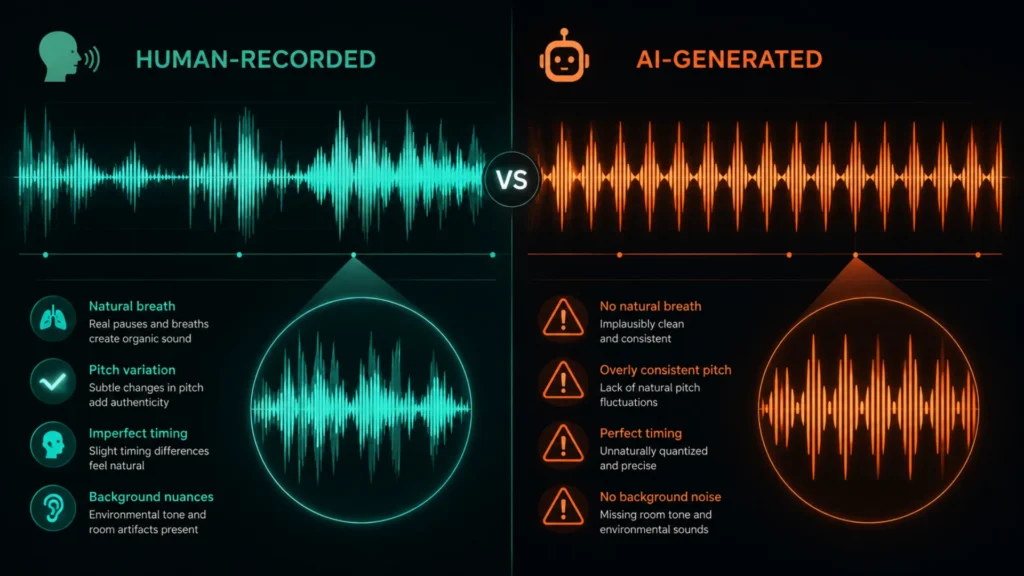
How to Tell If a Song or Singer Is AI-Generated
You don’t need specialized software to catch most of the obvious signs. A few practical checks work surprisingly well.
Check the artist’s history. A real, working musician almost always has a trail. Interviews, live show footage, a consistent social media presence, and a release history that makes sense for one working artist. An account with no biography beyond a vague genre description and dozens of albums released in a matter of months is a strong warning sign.
Listen for vocal artifacts. AI-generated vocals often sound too smooth, with an odd, even quality in pitch and tone that a real human voice rarely produces naturally, especially during emotional or dramatic passages.
Look at lyric quality. AI-written lyrics tend to lean on generic, broadly emotional phrasing rather than specific, personal detail. They also frequently repeat structural patterns because the underlying model favors familiar, high-probability word choices.
Use a detection tool when you need certainty. Platforms like Deezer have built-in detection systems. Standalone tools such as GPTZero can also analyze lyrics for AI-generated text patterns, though no detector is perfect and results should be treated as one signal among several rather than absolute proof.
Sienna Rose and Inga Rose, More AI Singers Fooling Streaming Charts
“We Are Charlie Kirk” is far from the only case of an AI-generated musical act climbing the charts. Two other names come up constantly in this same conversation.
Is Sienna Rose AI
Yes. Sienna Rose is a neo-soul act that gained millions of monthly Spotify listeners and landed three tracks on Spotify’s Viral 50 USA playlist. Deezer confirmed to multiple outlets, including Rolling Stone and the BBC, that the majority of Sienna Rose’s catalog is detected and flagged as AI-generated. The profile describes her only as an anonymous singer, despite the account racking up millions of streams, and she has never performed live, appeared in an interview, or shown up in any verifiable public setting. Fans first raised suspicions roughly a year before the debate reignited when a celebrity Instagram post used one of her tracks, drawing wider scrutiny to the account.
Is Inga Rose AI
Yes, and in this case, the creator has been more openly identified. Inga Rose’s song “Celebrate Me” reached number one on iTunes charts in several countries, including the United States, the United Kingdom, and Canada. Reporting traced the project to a South Carolina content creator who built the track using Suno, a widely used AI music generation platform. Unlike Spalexma, whose identity remains unconfirmed, the person behind Inga Rose has spoken publicly about the project, making this one of the more transparent examples of an AI music act achieving real chart success.
Both cases point to the same underlying shift. Streaming charts, which used to serve as a rough proxy for genuine listener demand for human artists, are now regularly influenced by AI-generated acts that can produce and release music far faster than any person could. As generative tools rapidly reshape creative industries and traditional roles, many are left asking what jobs are safe from AI automation in the years ahead.
Is CGI AI? Understanding a Common Mix-Up
Since AI-generated video content, including fake tribute clips, is often lumped together with computer-generated imagery, it’s worth clarifying the difference.
CGI, short for computer-generated imagery, is built by human artists using specialized 3D software. Every element, lighting, texture, character movement, and camera angle, is deliberately constructed and controlled by a person. It’s precise and repeatable; the same input will produce the same result every time.
AI-generated visuals work differently. Instead of manual construction, an AI model predicts likely visual output based on patterns learned from massive training datasets. The same prompt can produce noticeably different results each time, since the process is probabilistic rather than fixed.
So is CGI AI? No, they’re distinct technologies, though the line between them is blurring. Many modern visual effects studios now use AI tools to speed up parts of a traditionally CGI-driven workflow, and some AI video tools borrow techniques originally developed for CGI rendering. But traditional CGI still relies on direct human craftsmanship, while AI generation relies on a trained model that makes its own predictions, with far less direct human control over every detail.
Common Mistakes People Make When Judging AI Content
Assuming a low view count means it’s not viral. Viral chart placement, like Spotify’s Viral 50, measures momentum and recent spikes, not total listens. A song can top a viral chart with far fewer total streams than an established hit.
Treating AI detection tools as infallible. Detection tools like those used by Deezer and GPTZero provide useful signals, not absolute proof. False positives and false negatives both happen, so context and multiple signals matter more than any single tool’s verdict.
Confusing AI-generated content with fake news. An AI-generated tribute song isn’t automatically a hoax or misinformation. Many creators are upfront about using AI tools, even if the platform metadata isn’t. The concern usually isn’t that AI was used; it’s when AI-generated content is presented as authentic human work without disclosure.
Assuming all AI music sounds obviously robotic. Early AI vocals were easy to spot. Newer tools have closed that gap significantly, which is exactly why cases like Inga Rose and Sienna Rose managed to reach real chart success before widespread scrutiny caught up with them.
Frequently Asked Questions
Is We Are Charlie Kirk AI-generated?
Yes. Deezer has confirmed the song is flagged by its AI detection system, and independent lyric analysis, vocal characteristics, and the anonymous artist’s implausible release pace all point to the same conclusion.
Who created We Are Charlie Kirk?
The song is credited to Spalexma, an anonymous project with no confirmed real-world identity, social media presence, or public interviews.
Is Sienna Rose a real person?
Available evidence strongly suggests Sienna Rose is not a real, verifiable person. Deezer has confirmed that most of her catalog is flagged as AI-generated, and no interviews, live shows, or verifiable public appearances exist.
Is Inga Rose AI or a real singer?
Inga Rose is an AI-generated musical project built using Suno, an AI music platform. The creator behind the project has been identified as a content creator based in South Carolina.
Is CGI considered a form of AI?
No. CGI relies on manual, human-directed construction in 3D software, while AI relies on a trained model that generates output based on learned patterns. They’re often used together in modern production, but they are fundamentally different processes.
Conclusion
The story behind “We Are Charlie Kirk” isn’t really about one strange viral song. It’s an early, obvious example of something that’s about to become much harder to spot. AI-generated music, artists, and video are getting better fast, and the gap between an obvious fake and something genuinely convincing is shrinking every few months.
Knowing what to look for, an implausible release schedule, an anonymous profile with no real-world presence, and vocals that feel a little too polished gives you a real head start. It won’t catch everything, especially as the technology keeps improving, but it puts you ahead of most listeners scrolling past without asking the question at all.
For readers who want a deeper technical breakdown of how AI detection tools actually work, the Wikipedia entry on synthetic media offers useful background on the broader category this song belongs to.