

AI Transformation Is a Problem of Governance: Fatal Flaw
Most companies do not fail at AI because the model is weak. They fail because nobody decided who owns the model, what data it can touch, and what happens when it gets something wrong. That is why AI transformation is a problem of governance far more often than it is a problem of technology.
The numbers back this up. McKinsey’s 2026 AI Trust Maturity Survey found that only about 30 percent of organizations reach maturity level three or higher in strategy, governance, and agentic AI controls. Spending keeps climbing, but the rules and the people who enforce them are not keeping pace.
This guide explains what AI governance is, why it breaks so often, what US and EU rules mean for you, and how to build a program that works without slowing everyone down.
What Is AI Governance?
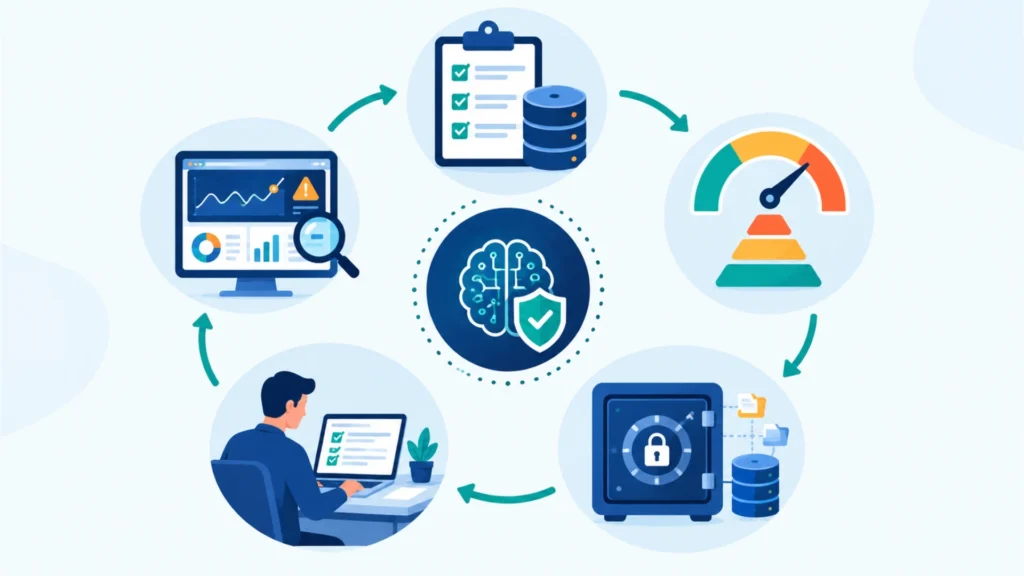
AI governance is the set of policies, roles, and controls that decide how an organization builds, buys, approves, monitors, and retires AI systems. Think of it as the rulebook and the referee for every model your company touches.
AI Governance Definition in Plain English
A good AI governance definition has three parts.
- Decision rights. Who can approve a new AI use case, and who can shut one down.
- Controls. The data rules, access limits, testing, and human review that keep a system inside safe boundaries.
- Evidence. The records that prove you did what you said you did, which matters when an auditor, regulator, or customer asks.
If any one of these is missing, you have a policy document and not a governance program.
How AI Governance Differs From Data Governance and Responsible AI
Data governance covers the quality, lineage, and security of data. Responsible AI is the set of values, such as fairness and privacy, that guide design. AI governance is the operating system that turns those values and data rules into enforceable decisions. It sits on top of both.
Why AI Transformation Is a Problem of Governance
A technology problem gets solved by better tools. A governance problem gets solved by clearer ownership, better rules, and consistent follow-through. Most stalled AI programs look like the second kind.
Pilots Work and Production Breaks
A pilot is a controlled bubble with a small team, clean data, and close supervision. Production is messy. Transformation stalls when ownership of decisions, access control, and lifecycle monitoring are missing once the experiment ends.
Zapier’s own survey of 835 leaders points the same way. Thirty-eight percent said their longest-running pilot had been in evaluation for over a year. That is a vendor survey, so treat it as a directional signal. Still, it matches what many US teams report. The model worked, but nobody could say who was allowed to put it into the real workflow.
Shadow AI Quietly Expands the Risk
Shadow AI means employees using unapproved AI tools with company data. It is the AI version of shadow IT, and it is hard to see until something leaks.
IBM’s 2025 Cost of a Data Breach Report put numbers on it. Only 13 percent of organizations reported breaches involving AI models or applications, but 97 percent of those lacked proper AI access controls. In terms of cost, high levels of shadow AI added 670,000 dollars to the average breach cost. You can read the details in IBM’s report summary.
The same research found that only 37 percent of organizations had policies to manage AI or detect shadow AI, and shadow AI incidents exposed more personal data and intellectual property than the global average.
Agentic AI Raises the Stakes
Chatbots suggest. Agents act. They can book, approve, send, and change records without a person clicking each step. That shift turns a quality problem into a liability problem.
Gartner expects trouble ahead. It predicts more than 40 percent of agentic AI projects will be cancelled by the end of 2027, citing rising costs, unclear business value, and weak risk controls. A later forecast adds that 40 percent of enterprises will demote or shut down autonomous agents by 2027 after governance gaps appear in production.
The same logic applies outside the office. When AI moves into physical machines, as covered in our look at AI for robots from Skild AI, a bad decision does not stay on a screen. A similar autonomous coordination approach is transforming logistics hubs, as detailed in our review of Unbox Robotics Builds Warehouse Automation Powerhouse.
The AI Governance Problem Nobody Wants to Own
Here is the uncomfortable part. Most AI governance issues are not technical. They are organizational.
Legal wants caution. Product wants speed. Security wants control. IT wants fewer tools. Each team is right from its own seat, and none of them owns the whole picture. So the work falls into the gaps between them.
Clear ownership changes the picture. McKinsey found that organizations with a function explicitly accountable for responsible AI averaged a maturity score of 2.6, compared with 1.8 for those without one. One named owner beats a committee that meets quarterly.
Confidence is also low. Grant Thornton’s 2026 survey found that 78 percent of executives lack strong confidence they could pass an independent AI governance audit within 90 days. If that sounds like your company, you are in the majority, and you have room to move before regulators force the issue.
AI Governance Transparency Is More Than a Policy Page
AI governance transparency means being able to show, in plain terms, where AI is used, what it does, what data feeds it, and who is accountable. It is the difference between saying you are responsible and proving it.
Practical transparency usually includes four things.
- A central inventory of every AI system, including tools bought by individual teams.
- A short model record for each system covering purpose, data sources, known limits, and owner.
- Clear disclosure to customers or employees when AI shapes a decision about them.
- Logs that let you reconstruct what happened after a bad outcome.
Legal teams feel this first. A startup such as GC AI shows how fast legal work is moving into AI-assisted tools, which means the people reviewing contracts now need to ask how those tools handle confidential data.
Transparency also reaches the physical world. Data centers consume real resources, and our explainer on the water footprint of AI shows why disclosure about infrastructure belongs in a mature governance conversation too.
The US and EU Rules Leaders Should Know
Rules are moving fast, and they are not consistent. That makes an internal framework more valuable, not less.
What Is Happening in the United States
There is still no single federal AI law. In December 2025, President Trump signed an executive order titled Ensuring a National Policy Framework for Artificial Intelligence, which created a Justice Department task force to challenge state AI laws. An executive order does not erase state law by itself, so state rules still matter until courts or Congress say otherwise.
Colorado is the clearest example of the churn. Enforcement of its original AI Act was stayed in April 2026 after a lawsuit and federal intervention. The state then rewrote the law, and the new framework takes effect on January 1, 2027. If you operate in several states, plan for a patchwork. You can see the broader picture on the Wikipedia page for regulation of artificial intelligence.
What Is Happening in the European Union
The EU AI Act is the other big reference point for US companies selling into Europe. Obligations for general-purpose AI model providers have applied since August 2025. The harder rules for high-risk systems have slipped. Under the Digital Omnibus agreement, stand-alone high-risk obligations move to December 2, 2027, and obligations for AI embedded in regulated products move to August 2, 2028. Lawyers at Gibson Dunn describe it as a delay and not a dismantling, and their analysis of the Omnibus deal is a good place to confirm the latest dates.
Standards That Give You a Head Start
Two frameworks keep coming up, and they work well together.
- NIST AI Risk Management Framework. It is a voluntary framework from NIST, published in January 2023, built around four functions called Govern, Map, Measure, and Manage. The official NIST AI RMF page has the full playbook.
- ISO/IEC 42001. It is an AI management system standard published in December 2023 that an accredited body can audit. That makes it useful when customers ask for proof.
A simple way to think about it is that NIST tells you how to think about risk, while ISO 42001 lets you get certified.
A Practical AI Governance Playbook
You do not need a five-year roadmap. You need a few decisions made this quarter and enforced consistently.
Start With an AI Inventory
List every AI tool and model in use, including the ones nobody approved. Ask each department directly, then check expense reports and browser extensions. You cannot govern what you cannot see.
Name One Accountable Owner
Pick a person with real authority, not a rotating committee. Give them a small cross-functional group from legal, security, data, and the business. Their job is to approve, pause, and retire AI use cases.
Sort Use Cases by Risk
Not every tool deserves the same scrutiny. Here is a simple example.
Picture a regional bank. An internal tool that summarizes meeting notes is low risk. A chatbot that answers customer questions is medium risk. A model that helps decide loan approvals is high risk because it affects people’s finances and may trigger fair lending rules. The first needs a basic data policy. The last needs testing for bias, human review, documentation, and ongoing monitoring.
Set Data and Access Rules
Decide what data can go into which tools. Use role-based access so only approved people can connect AI to sensitive systems. Treat AI agents like employees with limited permissions, because that is effectively what they are.
Keep a Human in the Loop Where It Counts
Require human review for anything that affects hiring, credit, health, housing, or legal outcomes. Write down who reviews, what they check, and what they are allowed to override.
Monitor, Learn, and Retire
Models drift. Vendors change terms. Rules shift. Review performance and risk on a schedule, and shut down systems that no longer earn their place. Governance that only runs at launch is a checkbox.
AI Governance Opportunity and Theory of Impact
Governance is not only a defensive move. Researchers have long argued it is also a chance to shape how a powerful technology develops.
One of the best-known framings comes from Allan Dafoe, who wrote about the opportunity and theory of impact for the field. He describes AI governance as a new and relatively neglected area, and he argues its value holds whether you care most about near-term policy challenges or long-term risks. His GovAI paper is worth reading. GovAI itself was founded in 2018 by Dafoe.
For a business, the theory of impact is easier to see. Clear rules shorten approval cycles, reduce rework, and let teams ship with confidence. Good governance often makes AI faster, not slower, because people stop guessing what is allowed.
Why You See This Debate on X
High volume of searches like “AI transformation is a problem of governance twitter” show that people are looking for the live conversation on X, the platform formerly known as Twitter. The topic travels well there because it fits a short, sharp claim. Practitioners, compliance leads, and founders trade war stories about stalled pilots and surprise audits. Treat those threads as signals, not sources. Check any statistic you see against the original report before you repeat it.
Common Questions About AI Governance
What is AI governance?
It is the system of policies, roles, and controls that guides how an organization designs, deploys, and monitors AI. It covers risk, data, accountability, and compliance across the full life of each system.
Is AI governance only for large companies?
No. Smaller teams face the same risks, including shadow AI and customer data exposure. A small business can start with an inventory, a one-page policy, and a named owner.
Who should own AI governance?
One accountable executive or lead, supported by legal, security, data, and business stakeholders. Ownership matters more than the exact title.
Does governance slow down AI adoption?
Poor governance does. Clear and proportionate governance usually speeds things up because approvals, data rules, and review steps are already defined.
Where to Start This Quarter
Governance is not a brake on progress. It is the thing that lets AI move from a clever demo to a dependable part of the business.
Begin with three moves. Build the inventory, name the owner, and sort your use cases by risk. Those steps alone put you ahead of most organizations. Then pick a framework, such as NIST or ISO 42001, and let it guide the rest.