
Garuda Aerospace Uncovered Powerful Insights on What It Does
Garuda Aerospace doesn’t fit the usual Silicon Valley drone-startup mould, and that’s exactly why it shows up in so many U.S. investor searches. It’s an Indian company, backed at various points by cricket legend MS Dhoni and personally championed by Prime Minister Narendra Modi, that grew from a small agri-tech idea into one of India’s largest drone manufacturers and is now filing paperwork for a public listing on Indian stock exchanges.
If you’re researching the “Garuda Aerospace share price” from the U.S., keep one important distinction in mind up front: it’s not a U.S.-listed stock; it isn’t traded on the NYSE or Nasdaq. It’s an Indian pre-IPO company whose shares currently change hands on unlisted share marketplaces, priced in Indian rupees, ahead of a planned listing on India’s BSE or NSE exchanges.
This guide breaks down what Garuda Aerospace actually builds, where it’s headquartered, its full funding and ownership picture, and what “share price” really means for a company that hasn’t gone public yet.
What Is Garuda Aerospace?
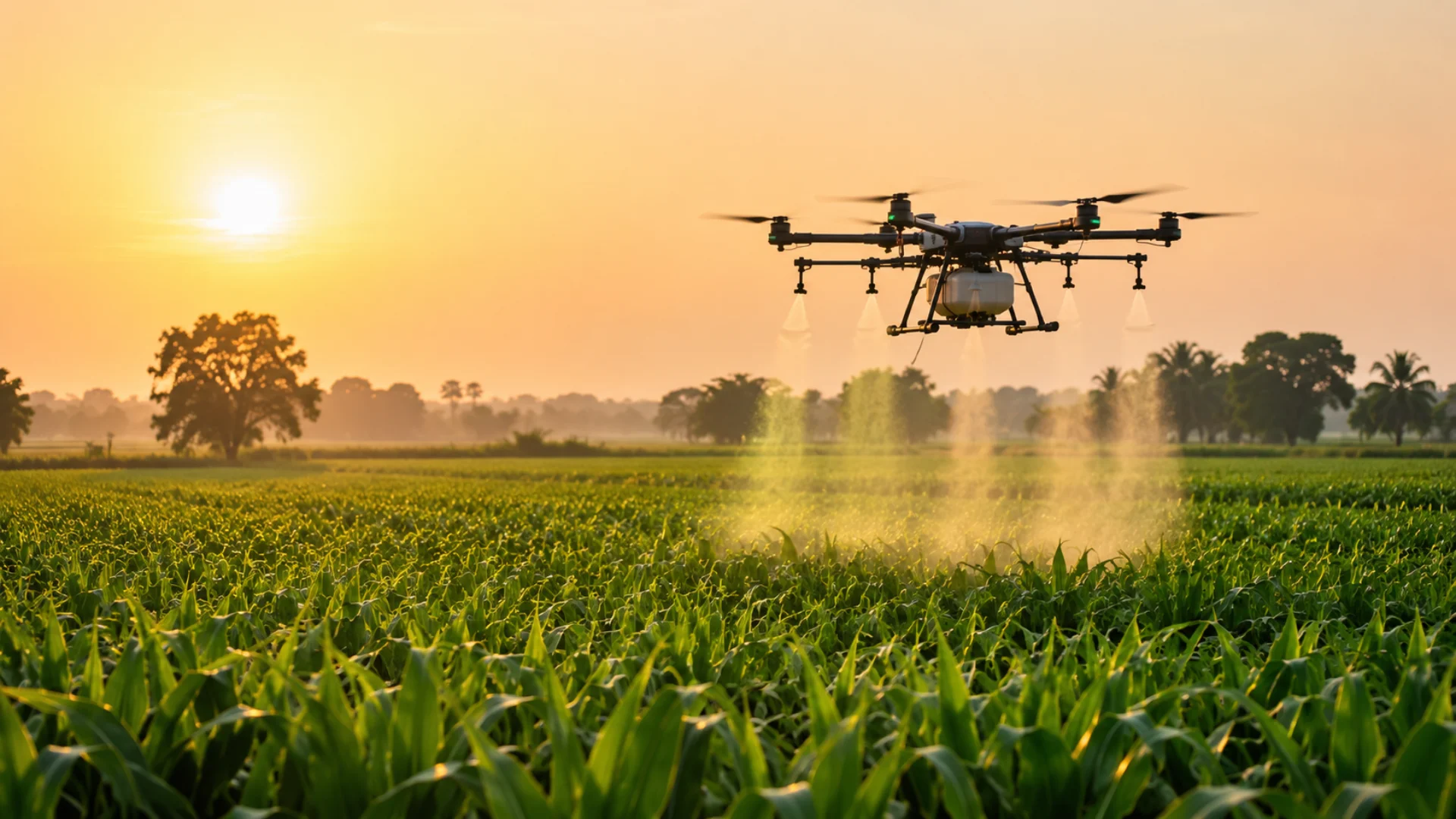
Garuda Aerospace is a drone technology company that designs, manufactures, and deploys unmanned aerial vehicles (UAVs) for agriculture, defense, infrastructure inspection, mapping, and logistics. The company started in agriculture and has since become one of the more visible names in India’s fast-growing domestic drone industry.
Founded in 2015 by Agnishwar Jayaprakash and Rithika Mohan, the company built its early reputation on agri-drones, machines designed to spray pesticides and fertilizer over farmland with far greater precision and efficiency than manual labor. That agricultural focus remains central to the business, and Garuda holds roughly 55% of the market share in India’s agri-drone segment.
Jayaprakash, a former competitive swimmer who represented India internationally before turning to entrepreneurship, has become one of the more publicly recognizable founders in India’s drone sector, partly through frequent government partnerships and partly through high-profile moments like a 2022 event where Prime Minister Modi personally launched 100 Garuda drones across 100 villages simultaneously, part of a program tied to the company’s “Jai Jawan, Jai Kisan, Jai Hind” branding (a patriotic phrase honoring soldiers and farmers).
Garuda Aerospace Headquarters and Operations
Garuda AAerospace’sheadquarters is located in Chennai, Tamil Nadu, India. The company has expanded its manufacturing footprint well beyond that original base, though. It operates additional manufacturing facilities in Manesar, in the northern state of Haryana, positioning the company with production capacity on both ends of the country.
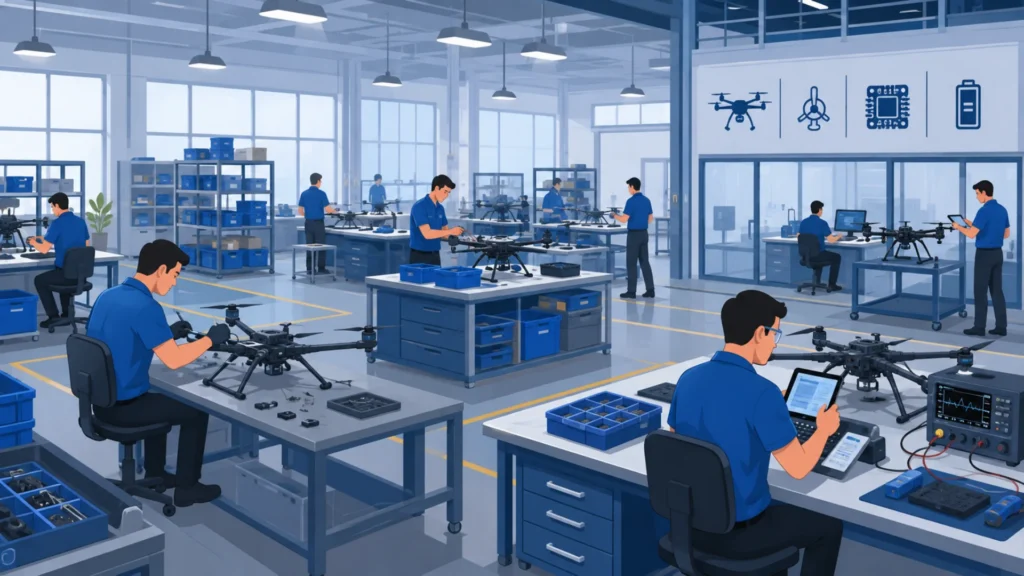
In January 2026, the company opened a dedicated drone battery manufacturing facility in Chennai, as part of a broader push to build more of its supply chain domestically rather than rely on imported components, a priority that aligns with India’s “Make in India” manufacturing policy. The company has said it’s scaling annual production from roughly 8,000 units toward a longer-term target of 50,000 drones per year.
Garuda reports a workforce of between 470 and 500 employees, according to data from PitchBook and other private-company trackers, and more than 750 clients across its agricultural, industrial, and government contracts.
Garuda Aerospace’s Technology and Products
Garuda’s product lineup spans hardware, software, and services, giving it a broader footprint than most drone manufacturers focused solely on hardware.
Drone Hardware
The company’s drones incorporate high-resolution cameras, thermal imaging, LiDAR (a laser-based mapping and distance-sensing technology), and multispectral sensors, the kind of imaging equipment that captures data across several light wavelengths beyond what a normal camera sees, useful for detecting crop stress or disease before it’s visible to the human eye. Garuda has also built quadcopter drones incorporating machine learning and AI for tasks like precision pesticide spraying and, in a notable case, one unit acquired by ISRO, India’s national space agency.
Drone-as-a-Service (DaaS)
Rather than only selling hardware, Garuda operates a service model in which the company deploys its own drones and pilots for clients who need aerial data, mapping, or spraying work done without owning the equipment themselves. This has become a meaningful part of the business alongside direct drone sales.
Pilot Training and Certification
Garuda was the first drone company approved by India’s Directorate General of Civil Aviation (DGCA) for both drone manufacturing and pilot training under one roof. The company says it has trained more than 2,500 drone pilots to date, which matters given how much of India’s drone economy depends on certified operators to legally fly commercial missions.
Defense and Surveillance Applications
More recently, Garuda has diversified well beyond agriculture into defense-adjacent work: surveillance drones, logistics support, and tactical systems. The company has partnered with major international defense and aerospace players, including Thales, Elbit Systems, and Airbus, whose Flexrotor UAV platform, Garuda, was selected to expand its own unmanned aircraft portfolio. This defense push accelerated noticeably after heightened regional security tensions in 2025, part of what press coverage referred to as a broader “defense drone surge” across India’s domestic manufacturers.
Garuda Aerospace Funding History
Garuda Aerospace has raised somewhere between $47.9 million and $49.5 million in total funding, depending on the data provider, across nine rounds and more than 170 investors, a notably large and fragmented investor base for a company at this stage.
Key funding milestones include:
- 2020–2021: Early rounds that helped Garuda scale beyond its original agri-drone focus, with backing from investors including EuraTechnologies, Claris Capital, and SAN Angels Network.
- MS Dhoni’s investment: Former Indian cricket team captain MS Dhoni became both an investor and brand ambassador for Garuda Aerospace, a partnership that significantly raised the company’s public profile in India.
- Series B (2025): A ₹100 crore round (roughly $12 million) led by Venture Catalysts, one of India’s more active early-stage venture firms.
- Pre-IPO strategic round (October 2025): An investment from the Narotam Sekhsaria Family Office, alongside renewed backing from existing investor We Founder Circle, was specifically raised to fund manufacturing expansion ahead of a planned public listing.
Company valuation estimates have varied considerably as the IPO process has progressed. Media reports placed the company’s valuation at roughly $250 million in 2023, while more recent pre-IPO estimates from unlisted share trackers put the figure closer to ₹2,581 crore, or approximately $300 million, as of mid-2026. Similar to other capital-intensive hardware innovators like Form Energy, securing strategic funding rounds has been critical for scaling production capacity ahead of long-term commercial goals.
Is Garuda Aerospace Publicly Traded? Understanding the Share Price
This is the most important thing to understand if you searched for “Garuda Aerospace share price”: the company is not yet publicly listed on any stock exchange, in India or anywhere else.
In April 2026, Garuda Aerospace pre-filed a confidential Draft Red Herring Prospectus (DRHP) with India’s Securities and Exchange Board of India (SEBI), the regulatory filing required before a company can list shares on Indian exchanges such as the BSE or NSE. The company is targeting an IPO of roughly ₹1,000 crore (about $115 million to $120 million), structured as a mix of a fresh share issue and an offer for sale from existing shareholders, with a listing expected by the end of 2026.
Until that listing happens, any “share price” quoted for Garuda Aerospace comes from India’s unlisted or pre-IPO share market, a secondary trading environment where existing shareholders, often early employees or angel investors, sell shares informally to interested buyers before a company goes public. Platforms like Unlisted Zone, Planify, and others that track this market have shown indicative pre-IPO share prices in the range of ₹400 to ₹450 per share as of mid-2026, though these prices are not exchange-regulated and can shift quickly based on limited supply and demand.
For U.S.-based investors specifically, it’s worth being direct about a practical limitation: India’s unlisted share market is built around Indian residency, PAN card registration (India’s version of a tax ID), and rupee-denominated transactions. Most U.S. retail brokerage accounts do not have direct access to this market, and U.S. investors interested in Garuda Aerospace post-IPO exposure would typically need to wait for the public listing and then evaluate whether their brokerage supports trading on Indian exchanges, which many do not without a specialized international account.
Garuda Aerospace’s Financials
Public filings related to the IPO process show that Garuda’s revenue from operations grew from roughly ₹109.9 crore in fiscal year 2024 to about ₹117.7 crore in fiscal year 2025, a year-over-year growth of around 7%. Profit after tax rose more modestly over the same period, moving from roughly ₹15.8 crore to about ₹17.3 crore.
Those growth numbers are worth noting because they’re more measured than the kind of triple-digit percentage growth some venture-backed hardware startups claim. For a manufacturing-heavy business scaling toward tens of thousands of units annually, steadier, audited revenue growth ahead of an IPO filing is generally viewed as a healthier signal than aggressive, unverified projections.
How Garuda Aerospace Compares to Other Drone Companies
Within India’s drone sector, Garuda’s closest publicly discussed competitors include ideaForge, which listed on Indian exchanges in 2023 and focuses more heavily on defense and surveillance UAVs, and ClearTax has noted DroneAcharya Aerial Innovations, which listed in 2022 and later faced a SEBI order in late 2025 over financial misrepresentation, a cautionary data point worth knowing if you’re comparing the sector’s IPO track record.
Garuda’s differentiation largely comes down to breadth: agriculture, defense, mapping, and pilot training under one company, plus a services model layered on top of hardware sales, versus competitors that tend to specialize more narrowly in one segment.
Common Mistakes to Avoid When Researching Garuda Aerospace
Assuming U.S. brokerage access. Garuda Aerospace shares, whether pre-IPO or post-listing, are not accessible on typical U.S. brokerage platforms in the same way domestic stocks are. Confirm your specific brokerage’s access to Indian exchanges before assuming you can buy in.
Treating unlisted market prices as fixed or regulated. Pre-IPO share prices on Indian unlisted platforms are indicative estimates based on limited private transactions, not a regulated exchange price. They can move significantly based on thin trading volume.
Confusing valuation figures from different years. Garuda’s reported valuation has shifted from roughly $250 million in 2023 to newer pre-IPO estimates around $300 million in 2026. Always check the date attached to any figure you’re citing.
Overlooking currency conversion. Prices and financials for Garuda Aerospace are reported in Indian rupees. Converting to USD at the time you’re reading matters, since the INR/USD exchange rate shifts and older articles may use outdated conversion rates.
Frequently Asked Questions
Is Garuda Aerospace a public company?
Not yet. Garuda Aerospace pre-filed a confidential Draft Red Herring Prospectus with India’s SEBI in April 2026 and is targeting a public listing on Indian stock exchanges by the end of 2026.
Where is Garuda Aerospace headquartered?
Garuda Aerospace’s headquarters is in Chennai, Tamil Nadu, India, with additional manufacturing operations in Manesar, Haryana.
What is Garuda Aerospace’s current share price?
Since the company isn’t publicly listed, there’s no official exchange-traded share price. Pre-IPO estimates for India’s unlisted share market have placed indicative prices between ₹400 and ₹450 per share as of mid-2026, though these figures aren’t exchange-regulated.
Who founded Garuda Aerospace?
Agnishwar Jayaprakash and Rithika Mohan founded Garuda Aerospace in Chennai in 2015, initially focusing on agricultural drone applications.
Is MS Dhoni actually connected to Garuda Aerospace?
Yes. Former Indian cricket captain MS Dhoni is both an investor in and a brand ambassador for Garuda Aerospace, a relationship that has helped raise the company’s public profile in India.
Can U.S. investors buy Garuda Aerospace shares?
Realistically, not easily right now. India’s pre-IPO unlisted share market is built primarily around Indian residents with local tax IDs, and most standard U.S. brokerage accounts don’t offer direct access to it. Once Garuda lists on an Indian exchange, U.S. access would depend on whether an investor’s brokerage supports international or Indian equity trading.
Conclusion
Garuda Aerospace has built a genuinely broad drone business, spanning agriculture, defense, mapping, and pilot training, on the back of a decade of steady growth and some unusually high-profile backing for an Indian startup. The IPO filing marks a real turning point, but the company isn’t public yet, and U.S. investors face practical hurdles in gaining exposure even after it lists.
Anyone tracking Garuda Aerospace’s share price should treat every pre-IPO figure as an estimate rather than a fixed number, keep an eye on the confidential DRHP process as it moves toward disclosure, and understand that any current buying activity is occurring in India’s unlisted market rather than on a regulated public exchange.