

Ayar Labs Breaks Through AI’s Brutal Data Bottleneck With Light
If you follow AI hardware news, you’ve probably seen the name Ayar Labs pop up next to Nvidia, AMD, and some of the biggest funding numbers in Silicon Valley. This San Jose startup has quietly become one of the most closely watched companies in the chip world, and its 2026 funding round turned quite a few heads.
You would get to know what the company actually does, who’s behind it, how much money it has raised, whether you can buy its stock, and what the company’s future might look like. No jargon overload, just a clear picture of one of the most important startups in AI infrastructure right now.
Introduction
Ayar Labs, Inc. is a semiconductor company that builds optical interconnect technology. In plain English, it makes chips that move data using light instead of electrical signals through copper wires.
The company was founded in 2015 and is headquartered in San Jose, California, with additional offices in Santa Clara and an expanding presence in Hsinchu, Taiwan, and Bengaluru, India. Its core mission is solving a problem that has become a massive headache for the entire AI industry: getting data to move fast enough between chips without burning through huge amounts of power.
Modern AI clusters can contain tens of thousands of GPUs working together. Copper wiring, which has moved data inside computers for decades, is starting to hit its physical limits. It gets hot, it wastes power, and it slows down as distances increase. Ayar Labs’ answer is to replace those copper connections with light, using a technology field called silicon photonics.
The Technology Behind Ayar Labs
Ayar Labs didn’t invent silicon photonics, but it found a practical way to bring it into everyday chip manufacturing. Its two flagship products work together to form what the industry now calls co-packaged optics, or CPO.
TeraPHY Optical I/O Chiplet
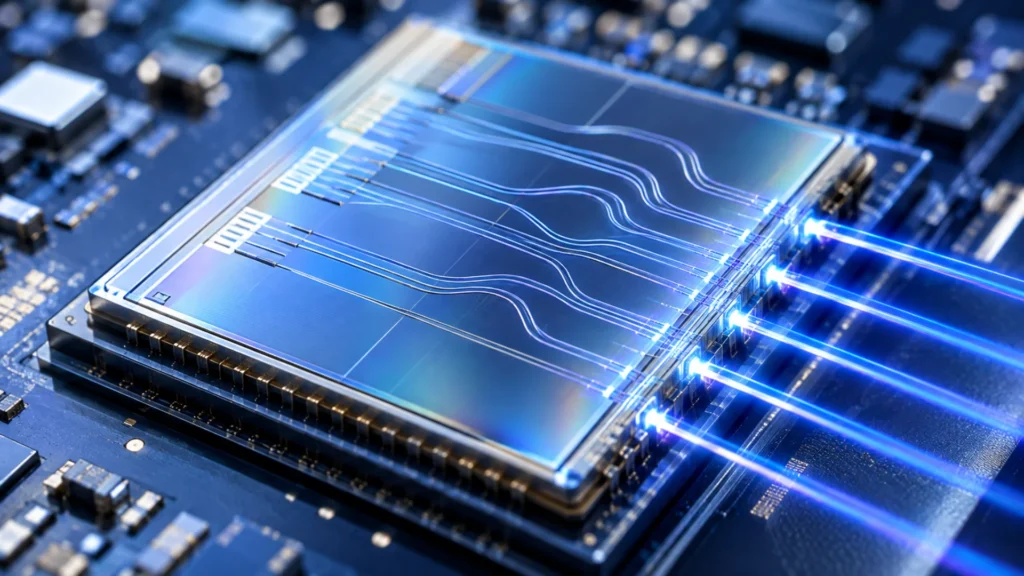
TeraPHY is the company’s optical input and output chiplet. It sits right next to a processor inside the chip package and converts electrical signals into light for high-speed data transfer. According to the company’s own technical claims, TeraPHY can move data at multi-terabit speeds with latency as low as a few nanoseconds, all while using a fraction of the power that copper interconnects require.
SuperNova Light Source
SuperNova is Ayar Labs’ external multi-wavelength laser source. Instead of building a laser into every single chip, which would be expensive and inefficient, Ayar Labs designed SuperNova as a shared light source that feeds several chips at once. It was developed in partnership with MACOM and is manufactured by Sivers Photonics in the UK.
Together, TeraPHY and SuperNova let chipmakers push data between processors, memory, and entire server racks without the power and heat penalties that come with copper. The company says this approach can cut energy use in chip-to-chip communication by roughly 95 percent compared to traditional wiring, while increasing bandwidth by a wide margin.
Why This Matters for AI
Training and running large AI models depends on getting thousands of GPUs to act like one giant computer. The bottleneck isn’t always compute power anymore. It’s often how fast information can travel between chips. Industry analysts sometimes call this the “memory wall” or the “interconnect wall.” Ayar Labs positions itself as a company built specifically to knock that wall down, which is exactly why chip giants like Nvidia, AMD, and Intel have all invested in it.
Founders and Leadership
Ayar Labs was founded by six people, most of whom met through research at MIT and UC Berkeley between 2010 and 2015.
The founding team includes Mark Wade, Chen Sun, Vladimir Stojanovic, Alex Wright-Gladstein, Milos Popovic, and Rajeev Ram. Wade, Sun, and Stojanovic worked on the original photonics research project that became the foundation of the company. Wright-Gladstein joined after meeting the technical founders at MIT’s Sloan School of Management, bringing business and go-to-market experience the technical team needed to actually commercialize the research.
Who Is the Ayar Labs CEO
Mark Wade is the current CEO of Ayar Labs. He originally served as Chief Scientist and later CTO before stepping into the CEO role in December 2023. Wade holds a PhD in electrical engineering from the University of Colorado Boulder, where he helped build one of the first CPU-to-memory photonic interconnects.
Between 2018 and 2023, the company was led by Charles Wuischpard, a former Intel executive and CEO of Penguin Computing, who helped scale Ayar Labs through its early commercialization phase before departing to join another venture.
Ayar Labs Funding History and Valuation
The company has raised money at an unusually fast pace, even by Silicon Valley standards.
Here’s a rough timeline based on public funding announcements:
- 2020 to 2021: Early Series B rounds supporting product development
- April 2022: $130 million Series C, backed by NVIDIA and HPE’s Pathfinder venture arm
- December 2024: $155 million Series D, pushing the company’s valuation past the $1 billion mark for the first time and officially making it a unicorn
- March 2026: $500 million Series E led by Neuberger Berman, raising the company’s valuation to $3.75 billion and bringing total funding to roughly $870 million
- September 2026: An additional $150 million raised, bringing total primary capital raised in 2026 alone to $650 million
Different data providers report slightly different lifetime totals, with figures ranging from around $870 million to nearly $965 million depending on how earlier smaller rounds are counted. What’s consistent across every source is the trajectory. Ayar Labs went from a research spinout to a multibillion-dollar company in about a decade.
Who Has Invested in Ayar Labs
The investor list reads like a who’s who of AI infrastructure. Strategic backers include NVIDIA, AMD Ventures, Intel Capital, GlobalFoundries, Lockheed Martin Ventures, MediaTek, and Hewlett Packard Enterprise’s Pathfinder fund. Financial investors include Sequoia, Advent Global Opportunities, Light Street Capital, Playground Global, ARK Invest, and Insight Partners, which has publicly listed Ayar Labs as part of its portfolio.
Having both Nvidia and AMD as investors is notable, since those two companies are usually fierce rivals in the GPU market. Their shared bet on Ayar Labs signals just how seriously the chip industry is taking the interconnect bottleneck problem.
Does Ayar Labs Have a Stock Price
If you searched for “ayar labs stock” or “ayar labs stock price,” here’s the direct answer. Ayar Labs is a privately held company. It does not trade on any public stock exchange, so there is no ticker symbol and no public stock price to check.
Shares in the company are currently only available to institutional investors, venture capital firms, and accredited investors participating in private funding rounds. If you’re not part of one of those rounds, you cannot buy Ayar Labs stock through a brokerage account the way you would with a public company like Nvidia or AMD.
Some employee benefit reviews on Glassdoor mention that Ayar Labs offers stock options to staff, with a strike price reportedly near or above $10 per share. Whether those options ever become valuable depends entirely on what happens next for the company, whether that’s an IPO or an acquisition.
Is Ayar Labs Planning an IPO
There is no confirmed IPO date for Ayar Labs, so anyone searching “ayar labs stock ipo date” won’t find a scheduled listing yet. The company has not filed publicly for an initial public offering as of this writing.
That said, the signs point toward a company preparing for eventual public market access. A $3.75 billion valuation, a growing roster of institutional investors like Neuberger Berman and Qatar Investment Authority, and rapid expansion into high-volume manufacturing are all typical steps companies take before considering a listing. The involvement of firms like ARK Invest, known for holding disruptive technology stocks, has also fueled speculation among investors watching the space.
For now, the realistic path to owning a piece of Ayar Labs before any IPO would be through pre-IPO share marketplaces that connect accredited investors with private company stock, though availability and pricing on those platforms can vary widely and carry real risk.
Ayar Labs Careers and Company Culture
For job seekers researching “Ayar Labs careers,” the company has been actively hiring throughout 2026, with dozens of open roles typically listed at any given time across engineering, manufacturing, and operations.
According to Glassdoor data, employees rate career development opportunities highly, around 4.7 out of 5 stars, while compensation and benefits sit closer to 3.9 out of 5. Reviewers consistently describe the culture as fast-paced with a genuine startup feel, praising the mission and the technical challenge of the work. Health benefits are frequently mentioned as strong, with the company covering a large share of premiums for employees and dependents.
On the downside, some reviews note that total compensation leans heavily on base salary rather than equity grants like RSUs, which is common at private companies that haven’t gone public yet. A few reviewers also mentioned a noticeable amount of influence from Intel given its early strategic investment, along with growing pains typical of a company scaling quickly.
If a career in semiconductor engineering or photonics interests you, it’s worth comparing how Ayar Labs stacks up against other fast-growing AI infrastructure companies covered on PurelyTechHub’s Tech Companies page, where we track hiring trends, culture, and growth across the sector.
How Ayar Labs Compares to Competitors
Ayar Labs isn’t the only company working on optical interconnects, but it has positioned itself as an early leader. Competitors in the co-packaged optics and photonics space include Celestial AI, Lightmatter, SiFotonics, and Ranovus, along with established semiconductor players like ON Semiconductor exploring adjacent technology.
What sets Ayar Labs apart, at least according to industry analysts, is its head start in funding and its deep partnerships with the two biggest GPU makers in the world. Total funding among its competitors trails significantly behind what Ayar Labs has raised, giving it more runway to reach high-volume manufacturing first.
For context on how competitive and well-funded this niche has become, our coverage of Skild AI and other capital-intensive AI infrastructure startups shows a similar pattern of massive early funding chasing a specific technical bottleneck.
Common Questions People Get Wrong
A few mistakes come up repeatedly when people research Ayar Labs online.
- Assuming Ayar Labs stock is publicly tradable. It isn’t. Confusing pre-IPO share marketplaces with actual public trading is a common error, and it’s worth double-checking any platform claiming to sell shares before sending money.
- Mixing up valuation with revenue. A $3.75 billion valuation reflects what investors believe the company could be worth, not what it currently earns in sales. Ayar Labs, like most pre-IPO deep tech startups, has not published detailed public revenue figures.
- Confusing Ayar Labs with Celestial AI. Both companies work in optical interconnects and both have raised large rounds, but they are separate businesses with different technology approaches and different investor bases. Celestial AI was acquired by Marvell in 2025, while Ayar Labs remains independent.
Frequently Asked Questions
What does Ayar Labs actually make?
Ayar Labs makes optical interconnect chips, primarily the TeraPHY chiplet and SuperNova light source, which use light instead of electrical signals to move data between processors, memory, and servers in AI data centers.
Who founded Ayar Labs?
Ayar Labs was founded in 2015 by Mark Wade, Chen Sun, Vladimir Stojanovic, Alex Wright-Gladstein, Milos Popovic, and Rajeev Ram, based on photonics research from MIT and UC Berkeley.
How much is Ayar Labs worth?
As of the March 2026 Series E funding round, Ayar Labs was valued at approximately $3.75 billion, making it a well-established unicorn in the semiconductor space.
Can I buy Ayar Labs stock?
No, not through a normal brokerage account. Ayar Labs is privately held with no public listing, so shares are only accessible to institutional and accredited investors through private funding rounds or limited pre-IPO marketplaces.
Is Ayar Labs going public soon?
There is no confirmed IPO date. The company’s rapid fundraising and manufacturing scale-up suggest it could be preparing for a future listing, but nothing has been officially announced.
Where is Ayar Labs headquartered?
Ayar Labs is headquartered in San Jose, California, with additional facilities in Santa Clara, an office in Hsinchu, Taiwan, and a newer design center opening in Bengaluru, India.
Final Thoughts
Ayar Labs has gone from a small MIT-born research project to a multibillion-dollar company backed by nearly every major name in AI hardware. Its bet on optical interconnects addresses a real and growing problem in AI infrastructure, and the size of its recent funding rounds shows just how seriously the industry is taking that bet.
Whether Ayar Labs eventually goes public, gets acquired, or stays private for years to come is still an open question. For now, it remains one of the most well-funded and closely watched private companies in the entire semiconductor industry, and one worth keeping an eye on if you follow AI infrastructure, chip technology, or startup investing.