

Periodic Labs Is Racing to Build the World’s First AI Scientist
Periodic Labs has gone from a stealth startup to one of the fastest-rising names in artificial intelligence in less than a year. Founded by two researchers who helped build ChatGPT and Google DeepMind’s most famous materials-discovery model, the company wants to pair AI with real robotic laboratories so machines can run actual physics and chemistry experiments, not just predict answers from text.
If you searched for Periodic Labs because you saw the funding headlines, wondered about Periodic Labs careers, or just want to understand what this company actually does, you’re in the right place. This guide covers the founders, the technology, the money behind it, the Menlo Park lab, and what comes next.
What Is Periodic Labs
Periodic Labs is an AI research company based in the San Francisco Bay Area that builds what it calls “AI scientists.” These are AI models trained not on internet text but on data generated by autonomous robotic laboratories running real experiments.
The core idea is simple to explain even though the engineering is not. Large language models learn from things humans already wrote down. That works well for language and code, but it runs into a wall in physical science, because the internet only contains a small slice of all possible chemistry and materials experiments, and it rarely contains the failed ones.
Periodic Labs builds physical labs where robots mix, heat, and test material samples around the clock. The results, including the failures, become new training data no other lab possesses. Its algorithms operate autonomous powder synthesis labs, facilities where materials are turned into powder, heated, and mixed to develop new compounds, and a single materials science experiment can produce several gigabytes of data.
The Founders Behind Periodic Labs
Liam Fedus, CEO and Co-Founder
Liam Fedus leads Periodic Labs as chief executive officer. Before starting the company, he spent years at the center of two of the most important AI labs on earth.
Fedus served as vice president of research for post-training at OpenAI from 2022 through March 2025, and was previously a senior research scientist at Google Brain from 2020 through 2022. He published his early academic work under the name William Fedus and led the team behind the Switch Transformer, a widely cited paper on scaling AI models efficiently. At OpenAI, he was known as one of the company’s most respected researchers and worked as data flywheel lead and co-creator of ChatGPT.
Fedus holds a physics degree from MIT, a master’s in physics from UC San Diego, and a PhD in computer science co-advised by Yoshua Bengio, one of the most influential figures in modern deep learning.
Ekin Dogus Cubuk, Co-Founder
Ekin Dogus Cubuk, who goes by Dogus, co-founded Periodic Labs alongside Fedus. He previously worked at Google Brain and DeepMind, where he led the materials-discovery work behind Google DeepMind’s GNoME project, a system credited with identifying 2.2 million candidate inorganic crystal structures.
The two had known each other for years before starting the company. Periodic Labs began when Fedus had a conversation with Cubuk about combining large language models with real scientific experimentation, roughly seven months before the company came out of stealth. Cubuk told TechCrunch that a few specific developments in the LLM field, experimental science, and simulation technology made this the right moment to try it.
How Periodic Labs Actually Works
Understanding Periodic Labs AI requires understanding the loop the company built its whole strategy around. The company describes building a physical reward function where the ground truth is the experiment, and nature is the reinforcement learning environment.
Here is the cycle in plain terms:
- An AI model reads existing scientific literature and proposes a hypothesis.
- It runs quantum-mechanical simulations to narrow down which materials look promising.
- A robotic lab physically synthesizes the most promising candidates.
- Instruments characterize the resulting material and measure its real properties.
- The measured outcome feeds back into the model, correcting it when reality disagrees with the prediction.
When a simulator’s prediction diverges from what the furnace actually produces, the experiment wins, and the system error-corrects toward reality rather than toward what the model expected.
Why Powder Synthesis Comes First
Periodic Labs starts at the quantum mechanical energy scale, building powder synthesis labs where robots mix precursor materials and heat them to discover new superconductors, magnets, and heat shields. Powder synthesis is a deliberate starting point because it is a general-purpose method that covers a large share of how solid materials get made, and it is cheap enough to run at high volume.
This approach echoes earlier academic work like the A-Lab project, an autonomous lab that used robotics and active learning to synthesize dozens of new inorganic compounds over just a couple of weeks. Periodic Labs is effectively taking that concept and scaling it commercially with frontier AI models behind it.
The Superconductor North Star
Periodic Labs’ first stated goal is developing superconductors that work at higher temperatures than the ones available today, since current superconductors mostly only function at subfreezing temperatures, which limits their use in AI chip strategy and high-performance hardware. A practical, room-temperature-friendly superconductor would be a landmark discovery with implications for data centers, power transmission, and electronics.
The company has been clear that this is a hard, long-shot goal. It functions more as a forcing mechanism, a single ambitious target that requires solving autonomous synthesis, autonomous characterization, and reliable experimental design along the way.
Early Commercial Work
Periodic Labs isn’t purely a research bet. The company already builds custom agents that help semiconductor manufacturers interpret their own experimental data, and reporting indicates it has paying pilot customers in the semiconductor space tackling problems like chip heat dissipation. That early commercial traction is unusual in a field where most AI-for-science startups are still pre-revenue.
Periodic Labs Funding and Valuation
The Periodic Labs funding story is one of the fastest valuation climbs in recent startup history.
The $300 Million Seed Round
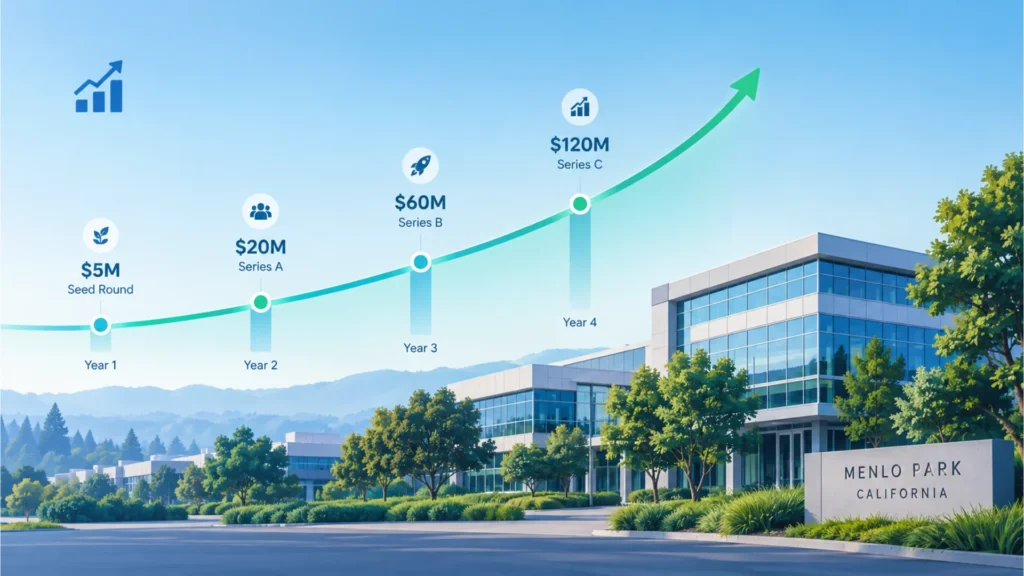
Periodic Labs emerged from stealth with $300 million in funding from some of the biggest names in tech. The round was led by a16z, alongside NVIDIA, Jeff Bezos, former Google CEO Eric Schmidt, and Jeff Dean. Other participants named in reporting include Accel, Felicis, DST Global, Elad Gil, Khosla Ventures, Lightspeed Venture Partners, and Radical Ventures. Investors valued the company at roughly $1.3 billion at the time.
The Push Toward a $7.5 Billion Valuation
By March 2026, Bloomberg reported Periodic Labs was in discussions with investors about raising at least hundreds of millions more at a valuation of about $7 billion, a massive jump from its September seed price.
That figure kept climbing. By May 2026, Forbes reported Periodic Labs was in advanced talks to raise at least $500 million in a round led by AMP, an investment vehicle founded by former a16z general partner Anjney Midha, valuing the company at $7.5 billion. Sources described the round as significantly oversubscribed, with talks already underway for a follow-on round at an even higher valuation.
As of the most recent independent analysis, that $500 million round had not been publicly confirmed as fully closed, though the company’s trajectory and investor demand suggest it is likely to land near the reported terms. If it does close near $7.5 billion, periodic labs valuation will have grown roughly sixfold in under eight months, an extraordinary pace even by current AI-industry standards.
Who Is Investing and Why
The interest lines up with a broader pattern. Investors are backing multiple “neolab” style startups that combine foundation models with physical robotic experimentation, including competitors chasing similar autonomous-lab visions. What sets Periodic Labs apart in pitches to investors is its founding pedigree and early paying customers, rather than a demonstrated scientific breakthrough, since the superconductor goal remains unmet.
Andreessen Horowitz partner Anjney Midha summarized the underlying thesis simply: you can reread the textbook, but eventually you need to run the experiment.
Periodic Labs Stock and Is It Publicly Traded
A lot of people searching for Periodic Labs stock want to know if they can buy shares. The short answer is no, not on a public exchange. Periodic Labs is a privately held company and has not filed for an IPO.
Shares do occasionally show up on private secondary marketplaces like Forge Global, where accredited investors can attempt to buy or sell existing shareholder stakes before a company goes public. These platforms list a post-money valuation for reference, currently around $7.5 billion based on the reported round, but this is not the same as a listed stock price, and access is generally limited to institutional or accredited investors. There is no ticker symbol for Periodic Labs, and any site claiming otherwise is not describing a real public listing.
Periodic Labs Headquarters and Menlo Park Location
Periodic Labs started out working from a makeshift San Francisco facility while it built its dedicated laboratory space. The company laid the groundwork for a dedicated Menlo Park facility where physical robots run scientific experiments at large scale.
That Menlo Park lab is now the company’s operating hub. Current job listings confirm the lab is based in Menlo Park, California, with the company telling applicants it prefers employees located in Menlo Park or San Francisco, though it offers flexibility depending on the role. Menlo Park sits in the heart of Silicon Valley, close to Stanford University and many of the venture firms backing the company, which makes it a practical base for both technical hiring and fundraising.
Periodic Labs Careers
If you’re researching Periodic Labs careers, here’s what current listings and company materials show.
Periodic Labs has scaled quickly, growing from around two dozen researchers at launch to a team that different data providers estimate is between roughly 50 and 90 employees as of mid-2026. Job categories include research scientists, lab automation engineers, product engineers, recruiters, and business operations staff.
A few things stand out from listings and the company’s own careers messaging:
- The company describes itself as an AI and physical sciences lab where team members are expected to act as owners who solve problems without waiting for bureaucratic approval.
- Compensation for senior technical roles has been listed in the $200,000 to $250,000 range, with additional equity typical for early-stage AI companies at this valuation.
- The company states it sponsors visas for qualified candidates and will assist with the legal process.
- Roles span deep technical work, like building differentiable physics simulations in JAX or PyTorch, alongside hands-on lab roles in materials synthesis and characterization.
Because Periodic Labs is still a young company scaling two things at once, a research organization and a hardware-heavy lab operation, it tends to hire a mix of PhD-level scientists and hands-on lab engineers, which is a different hiring pattern than a typical software startup.
How Periodic Labs Compares to Other AI-for-Science Startups
Periodic Labs is not the only company chasing this vision, and understanding its competitors helps clarify what makes its approach distinct.
Lila Sciences, founded inside Flagship Pioneering, pursues a broader multi-domain approach spanning life sciences, chemistry, and materials, and has raised over $550 million in total funding as of mid-2026. Other well-funded entrants in adjacent AI-driven science spaces include ventures backed by prominent AI researchers, reflecting how competitive this category has become almost overnight.
What tends to separate Periodic Labs in comparisons is its narrow initial focus. Instead of spreading across many scientific domains at once, the company picked one demanding target, a high-temperature superconductor, and one general-purpose lab method, powder synthesis, as its proving ground before expanding further.
Common Misconceptions About Periodic Labs
- “Periodic Labs already discovered a room-temperature superconductor.” Not yet. The superconductor is the company’s stated long-term goal, not an announced result.
- “You can buy Periodic Labs stock on a stock app.” No public stock exists. Any listing claiming a ticker for direct retail purchase is not accurate.
- “Periodic Labs is a software-only AI company.” It is not. The company operates physical robotic laboratories, which makes it closer to a hybrid of an AI research lab and a hardware-heavy scientific facility.
- “The $7.5 billion valuation is confirmed and final.” As of the latest available reporting, this figure reflects advanced funding talks rather than a publicly finalized close, though momentum strongly favors the round landing near those terms.
Frequently Asked Questions
Who founded Periodic Labs?
Liam Fedus, a former OpenAI vice president of research and a key figure behind ChatGPT, and Ekin Dogus Cubuk, a former Google DeepMind materials science researcher, co-founded Periodic Labs in 2025.
Who is the CEO of Periodic Labs?
Liam Fedus serves as chief executive officer, with Ekin Dogus Cubuk as co-founder working alongside him on the company’s scientific direction.
How much funding has Periodic Labs raised?
The company raised $300 million in a seed round in September 2025 at roughly a $1.3 billion valuation, and was in advanced talks as of mid-2026 to raise at least $500 million more at a valuation near $7.5 billion.
Where is Periodic Labs located?
Periodic Labs is based in the San Francisco Bay Area, with its dedicated robotic laboratory operating out of Menlo Park, California.
Is Periodic Labs publicly traded?
No. Periodic Labs is a private company with no public stock ticker. Shares occasionally trade on private secondary markets accessible mainly to accredited investors.
What does Periodic Labs actually build?
It builds AI models trained using data from real, robotic scientific experiments rather than internet text alone, aiming to accelerate discoveries in materials science, starting with the search for a high-temperature superconductor.
Final Thoughts
Periodic Labs represents a real bet that the next leap in AI capability will not come from more internet text, but from giving models direct access to physical reality through robotic laboratories. The founding team’s track record at OpenAI and DeepMind, combined with unusually fast investor demand, has turned this into one of the most closely watched AI startups of the past year.
Whether the company actually finds its high-temperature superconductor is still an open question. But its rapid climb from a $1.3 billion seed valuation to talks near $7.5 billion in under eight months shows just how much confidence the venture world is placing in the idea that AI needs to run real experiments, not just read about them.