
Vannevar Labs Sparks a Bold Era in AI-Driven National Security
The Department of Defense collects roughly 22 terabytes of data every single day. Most of it sits unread, buried in languages, formats, and systems that don’t talk to each other. Vannevar Labs built a company around fixing that one problem, and it has turned that fix into a business now valued at $1.5 billion.
If you searched for this company, you’re probably trying to answer a handful of specific questions. What does it actually do, who is behind it, how much money has it raised, and is there any way to invest in it? This piece answers each of those in plain terms, without the jargon that shows up in a lot of defense tech coverage.
The Problem Vannevar Labs Was Built To Solve
Military and intelligence agencies gather an enormous volume of open-source and battlefield data every day. Much of it arrives in foreign languages, scattered across documents, intercepted communications, and public sources that no human team could realistically process at scale.
Before Vannevar Labs came along, a lot of this analysis still relied on manual translation and pattern spotting by trained analysts, a process that worked but could not keep pace with how fast modern conflicts generate information. The company’s answer was to apply natural language processing and generative AI directly to that bottleneck, turning weeks of manual review into something closer to real time.
That mission is baked into the company’s name. Vannevar Labs is named after Vannevar Bush, the American engineer who helped direct the Manhattan Project and later argued for stronger ties between government and scientific research. It’s a pointed choice of namesake for a company trying to rebuild that same bridge between Silicon Valley and the defense establishment.
Two Stanford Classmates Behind the Company
Vannevar Labs was founded in 2019 in Palo Alto by Brett Granberg and Nini Hamrick, who met as classmates at Stanford’s Graduate School of Business.
Granberg’s path into defense tech ran through In-Q-Tel, the CIA’s venture capital arm that funds technology useful to the intelligence community, and later Lilt, a deep learning translation company. That combination gave him a front-row seat to both how government funding works and how machine translation technology actually gets built.
Hamrick brought a very different kind of experience to the table. She spent seven years as a counterterrorism officer inside the intelligence community before co-founding the company, which means she had lived through the exact data problem Vannevar Labs was designed to solve. Granberg serves as CEO, while Hamrick holds the title of President.
A third co-founder, Danny Goodman, is also listed on the company’s early cap table and formation records, rounding out a founding team split between operators who understood the mission and builders who understood the technology.
What Vannevar Labs Actually Builds
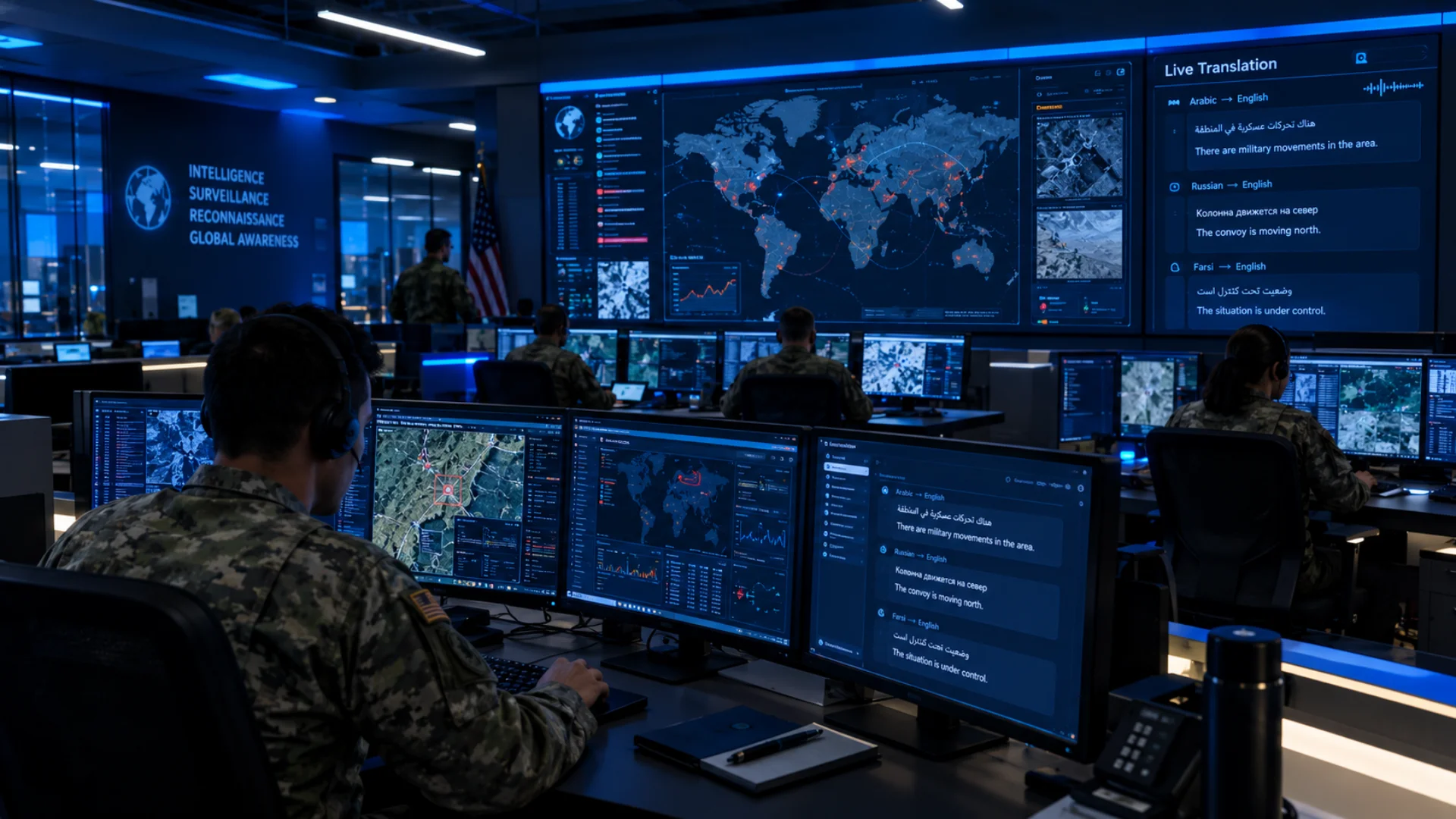
The company’s flagship product is called Decrypt, a foreign language workflow platform that helps intelligence officers translate documents, spot patterns across huge datasets, and surface the handful of items that actually matter out of an overwhelming pile of raw data.
Decrypt uses generative AI models to process open-source intelligence, commonly shortened to OSINT, alongside more sensitive battlefield data. It has reportedly been deployed at 15 American military bases, and the U.S. Air Force has used it to study the technical specifications of Russian anti-aircraft systems, according to reporting cited on the company’s Wikipedia page.
The technology has also seen real-world use during joint military exercises, including Balikatan 2025 and Talisman Sabre 2025, two major multinational training exercises conducted with allied Pacific militaries. Marine Corps units have reportedly described the tools as a force multiplier during deployments in the Pacific, and MIT Technology Review reported in April 2025 on how generative AI systems like Vannevar’s are becoming a standard part of how the Pentagon plans and executes missions.
In October 2024, the company partnered with Databricks to strengthen the AI infrastructure behind its platform, improving capabilities like sentiment analysis across the huge volumes of foreign language text its systems process daily.
Vannevar Labs Revenue and Growth Numbers
Vannevar Labs ended 2024 with approximately $80 million in revenue, according to research compiled by Contrary Research. That is a meaningful number for a company that was only reporting itself as profitable back in early 2023, which suggests revenue has scaled considerably faster than headcount or funding rounds alone would suggest.
Part of that growth traces back to a specific contract. In November 2024, the company signed a production agreement worth up to $99 million with the Pentagon’s Defense Innovation Unit, aimed at expanding Decrypt’s reach to additional military units. Contracts of that size are unusual for a company this young, and they explain a lot about why investors have been willing to keep writing checks.
How the Funding Actually Built Up
Vannevar Labs has raised roughly $91.5 million total, spread across three disclosed rounds.
The company started with a $4.5 million seed round in 2020, led by General Catalyst and Costanoa Ventures. That was followed by a $12 million Series A in August 2021, and then its largest round to date, a $75 million Series B closed in January 2023 led by Felicis Ventures. Point72 Ventures, DFJ Growth, Shield Capital, Aloft VC, and additional participation from General Catalyst and Costanoa Ventures rounded out that Series B.
That Series B round reportedly valued the company at $575 million at the time. It has not raised a new priced round publicly since, though founder commentary and third-party valuation trackers now point to a figure closer to $1.5 billion, which the next section breaks down.
Vannevar Labs Valuation Explained
CEO Brett Granberg has publicly discussed a $1.5 billion valuation figure for the company, most notably in a company blog post reflecting on his journey from dropping out of a prior venture to building Vannevar Labs into a defense tech name of that size.
That number lines up with research estimates as well. Contrary Research calculated that Vannevar’s roughly $80 million in 2024 revenue against a $575 million Series B valuation would already put the company at a 7.2x revenue multiple by the end of 2025, and a jump to $1.5 billion implies investors are pricing in continued fast growth rather than current revenue alone.
It’s worth being direct about what this means. A privately discussed valuation like this is not the same as an audited, formal appraisal, and it has not been confirmed through a newly announced funding round. Treat it as the best available signal rather than a locked-in figure.
Working at Vannevar Labs
Vannevar Labs employs around 195 people, most of them based out of its Palo Alto headquarters, with a workforce made up of a mix of software engineers and former defense and intelligence officers.
Glassdoor reviews paint a mixed but informative picture. As of recent data, 68 to 69 percent of reviewers said they would recommend working there to a friend, with the company scoring 3.6 out of 5 for work-life balance and 3.7 for culture and values. Compensation and benefits scored notably higher, around 4.1 to 4.2 out of 5, and multiple reviews mention a genuinely unlimited PTO policy along with a stipend incentive for employees who take more than three weeks off a year.
That said, the reviews aren’t uniformly glowing. Several mention intense hours, a fast pace that can create disorganization, and a round of layoffs and executive changes during 2025 that some employees described as difficult to navigate. More recent reviews, from around April 2026, suggest the leadership team has stabilized since then.
What to Know Before Applying
Roles at Vannevar Labs tend to fall into two broad camps: engineering positions building the AI and data infrastructure behind Decrypt, and mission or program roles staffed by people with backgrounds in the military or intelligence community. Given the nature of the work, expect that many roles require U.S. citizenship and the ability to obtain a security clearance.
Open positions are listed on the company’s official careers page and its Greenhouse job board, and the company appears to hire on a rolling basis rather than in large scheduled batches.
Does Vannevar Labs Have a Stock Price
No, and this is one of the most common points of confusion for anyone researching the company. Vannevar Labs is privately held, has never filed for an IPO, and has no ticker symbol on any public exchange.
Private market data platforms like Caplight and PitchBook track secondary market signals and estimated valuations for companies like Vannevar Labs, but these are not the same thing as a tradable stock price. They reflect limited transactions among existing shareholders, employees, and select investors, not open market trading available to the public.
If you’re an accredited investor curious about how private company shares actually work before an IPO, the SEC publishes plain language guidance on accredited investor requirements that’s worth reading before pursuing any secondary market deal. For everyone else, the honest answer is that there is currently no way to buy Vannevar Labs stock through a normal brokerage account, and there may not be for years, if ever.
How Vannevar Labs Stacks Up Against Other Defense AI Companies
Vannevar Labs gets compared most often to Palantir, given the shared focus on turning messy government data into usable intelligence. The difference is scope and scale. Palantir is a publicly traded company worth hundreds of billions of dollars with a sprawling product suite across defense and commercial clients, while Vannevar has stayed narrowly focused on language processing and open-source intelligence for military and intelligence customers specifically.
It’s also frequently mentioned alongside hardware-focused defense startups like Anduril, even though the comparison isn’t quite apples to apples. Vannevar builds software and AI models rather than physical weapons systems, which means its path to revenue looks more like a traditional enterprise software business layered on top of extremely sensitive government contracts.
Within the broader AI and defense landscape, companies are increasingly blending software intelligence with autonomous systems, a pattern also visible in AI-driven platforms like Skild AI, even though Skild’s focus sits closer to robotics than intelligence analysis.
Places People Get This Company Wrong
- Assuming it makes physical hardware. Vannevar Labs builds software and AI models, not drones, missiles, or weapons systems. It’s easy to lump it in with hardware-focused defense startups, but its entire product line is digital.
- Treating the $1.5 billion figure as an official, audited valuation. It comes from founder commentary and third-party estimation models rather than a newly priced funding round, so it should be read as a strong signal rather than a locked-in number.
- Assuming the company only serves the U.S. military. While its primary customer is the Department of Defense and U.S. intelligence agencies, its technology has also been used in joint exercises with allied Pacific militaries.
- Searching for a ticker symbol. There isn’t one. Vannevar Labs remains private, and no public listing has been announced.
Frequently Asked Questions
Who founded Vannevar Labs?
Brett Granberg and Nini Hamrick founded Vannevar Labs in 2019 after meeting at Stanford’s Graduate School of Business. Granberg serves as CEO and Hamrick as President.
What is Vannevar Labs’ current valuation?
CEO Brett Granberg has publicly referenced a $1.5 billion valuation figure, up from a $575 million valuation at its Series B round in January 2023.
How much revenue does Vannevar Labs generate?
The company reported approximately $80 million in revenue for 2024, according to research compiled by Contrary Research, alongside a $99 million Pentagon production contract signed that same November.
How much funding has Vannevar Labs raised?
Vannevar Labs has raised roughly $91.5 million across three disclosed rounds: a seed round, a Series A, and a Series B led by Felicis Ventures.
Is there a Vannevar Labs stock I can invest in?
No. The company is privately held with no ticker symbol and has not announced any IPO plans.
What does Vannevar Labs’ flagship product do?
Decrypt is its main platform, using AI to translate foreign language data, analyze open-source intelligence, and help military and intelligence analysts find patterns in massive datasets.
Where Vannevar Labs Goes From Here
Vannevar Labs turned a genuinely unglamorous problem, the sheer volume of unread military data, into a business generating real revenue and real Pentagon contracts. That is a harder trick to pull off than it sounds, especially in a sector where a lot of startups raise big rounds on promises rather than delivered software.
The company’s next stretch will test whether it can keep scaling Decrypt across more military branches and allied partners while managing the kind of growing pains that come with any fast-moving startup, something its own employee reviews openly acknowledge. For now, Vannevar Labs remains one of the more substantive names in AI-driven national security, with real deployments backing up its valuation rather than just investor optimism.