
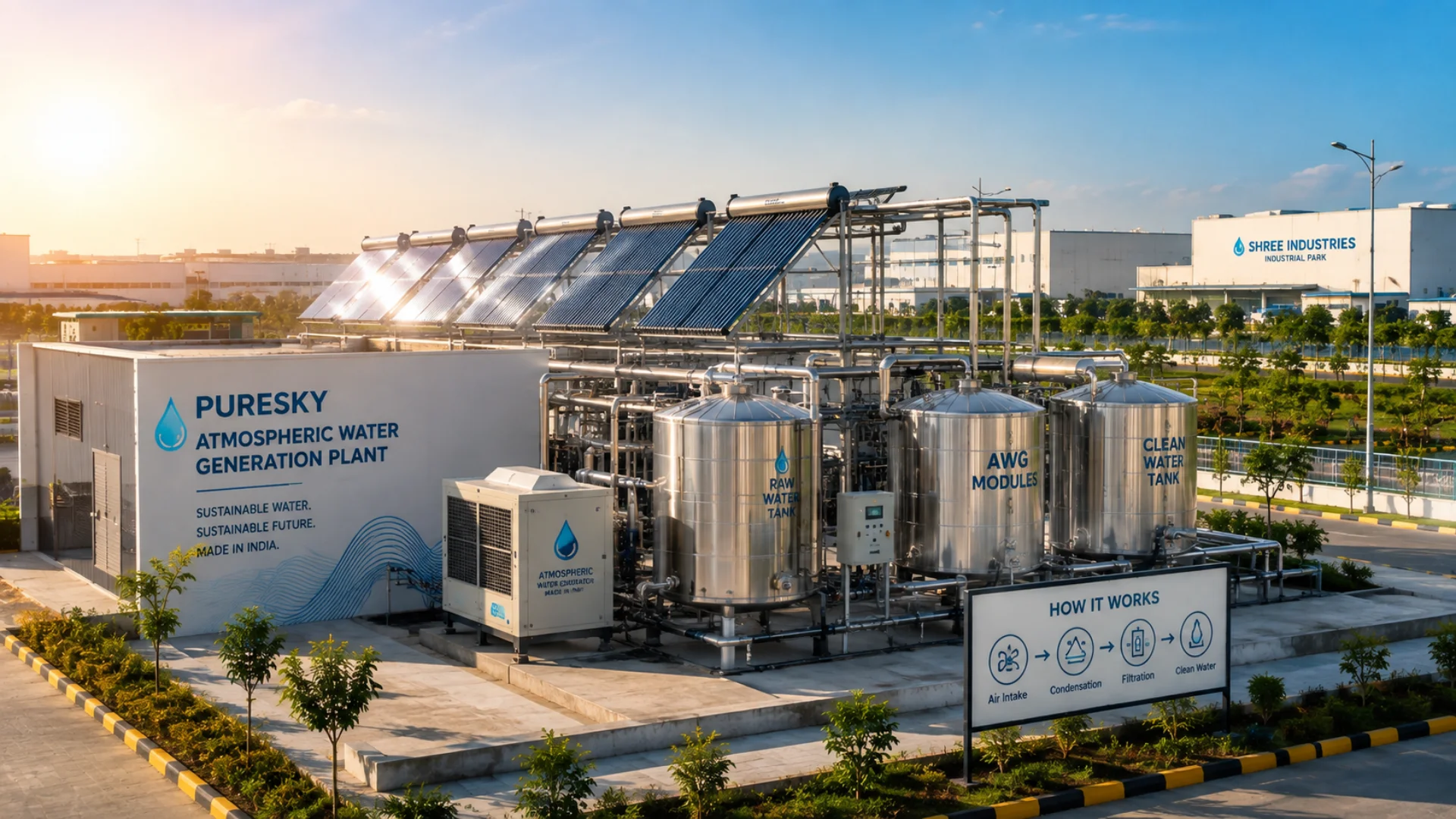
Uravu Labs Reveals a Powerful New Way to Beat the Water Crisis
Water shortages used to feel like a problem for distant, dry countries. That changed once cities like Bengaluru started rationing water during the summer months. Against that backdrop, Uravu Labs built a business around a strange-sounding idea: pulling drinking water straight out of the air.
The company has grown from a college dorm experiment into a Bengaluru-based climate tech startup that supplies hotels, cafes, and beverage brands with water made from atmospheric moisture instead of groundwater or rivers. This guide breaks down what Uravu Labs actually does, who started it, how the technology works, what it has raised in funding, and whether there is a Uravu Labs share price you can actually buy into.
What Is Uravu Labs
Uravu Labs is an Indian climate tech company based in Bengaluru, Karnataka. It builds atmospheric water generators, machines that pull moisture out of the surrounding air and turn it into drinking water, using renewable heat sources instead of grid electricity.
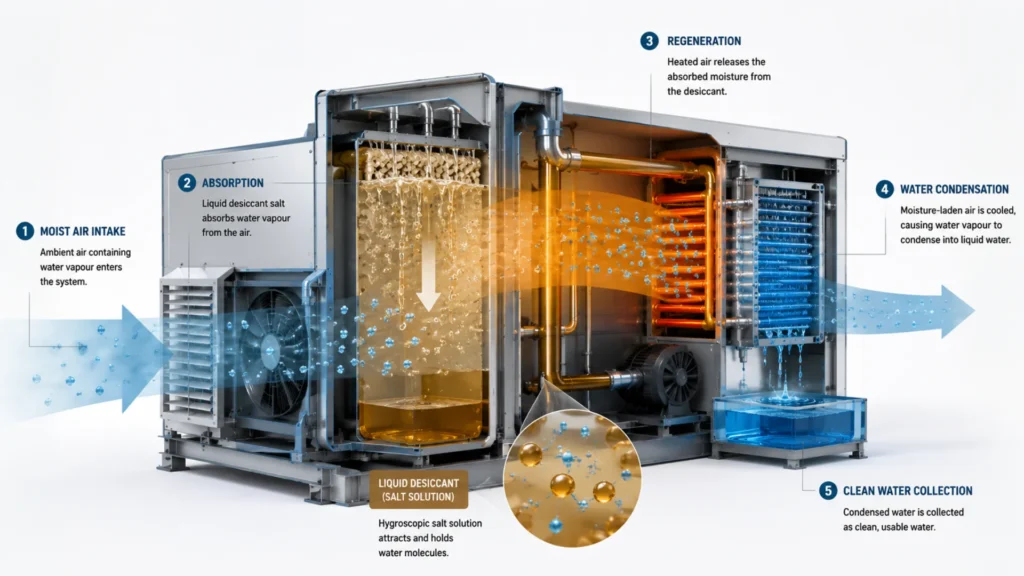
Its branded technology, called FromAir, uses a proprietary liquid salt to absorb water vapor from the air. Solar thermal energy, biomass, or industrial waste heat is then used to release that moisture and condense it into clean, mineral-rich water. The company sells this water directly to hotels, restaurants, and beverage brands, and it also licenses the underlying atmospheric water generation systems.
Uravu Labs sits inside a small but growing global category of atmospheric water generation companies, alongside names like Zero Mass Water and Watergen. What sets Uravu apart is that it decouples the heating step from the moisture absorption step, which lets the system scale up far more cheaply than machines that rely on refrigerant-based condensation.
Uravu Labs Founder and the Origin Story
The Uravu Labs founder story starts with a drought, not a business plan. Swapnil Shrivastav and Venkatesh RY met as engineering students at NIT Calicut. A severe water shortage hit their campus and left students rationed to a single bucket of water a day. That experience stuck with both of them long after graduation.
In 2019, Shrivastav and Venkatesh teamed up with Pardeep Garg, an Indian Institute of Science and MIT graduate with a background in thermal sciences, and Govinda Balaji, an engineer from the Coimbatore Institute of Technology, to formally launch Uravu Labs. The four founders split responsibilities across business, operations, technology, and production.
Early funding came from a $50 thousand Water Abundance XPRIZE grant, along with support from NIDHI PRAYAS, the Karnataka government’s ELEVATE program, and a Danish innovation fund. That early money let the team build a working prototype that produced about five liters of water a day at a two-square-meter footprint, long before the company had any paying customers.
Shrivastav now serves as CEO and remains the public face of the company, while Garg leads technology strategy as CTO. Balaji continues to oversee engineering and production.
How Uravu Labs Technology Actually Works
Most atmospheric water generators on the market use refrigeration, essentially running a dehumidifier and collecting the condensate. That approach is power-hungry and expensive to scale. Uravu Labs took a different route.
The Absorption and Desorption Cycle
The FromAir system pumps ambient air through a liquid desiccant, a salt solution that naturally attracts and holds water vapor even in fairly dry conditions, down to around 30 percent relative humidity. Once the desiccant is saturated, low-grade heat, usually 35 to 60 degrees Celsius, drives the moisture back out of the salt solution. That released vapor is then condensed and filtered into finished drinking water.
Why Decoupling the Heat Source Matters
Because the heating unit and the desiccant unit are only connected through the fluid itself rather than built into one sealed machine, each part can be scaled independently. A facility can add more desiccant capacity without needing a matching jump in heating capacity, and vice versa. That is a big part of why Uravu Labs claims it uses roughly 40 percent less energy than conventional condensing systems to produce the same volume of water.
The company has more recently applied the same core technology to a product called Clausius, aimed at data centers and industrial facilities. Instead of using solar heat, Clausius runs on waste heat that servers and chillers already generate, turning a cooling byproduct into a water source rather than letting it go to waste.
Uravu Labs Funding History
Uravu Labs has raised money in stages rather than one large round, which is typical for a hardware-heavy climate tech company that needs to prove its unit economics before scaling.
- Pre-seed grants: roughly $50 thousand from the Water Abundance XPRIZE, plus government and innovation fund grants, used to build the first working prototype
- Pre-seed round, 2021: an undisclosed amount led by Speciale Invest, with participation from angel investors including Peter Yolles of EchoRiver Capital
- Seed round, March 2023: $2.3 million led by Anicut Capital, with JITO Angel Network, Rocketship.VC, Vesta, Spectrum Impact, ZNL Growth Fund, VERSO, and Echo River Capital also joining
- Later strategic investment, 2025: additional funding from Enrission India Capital to expand commercial deployments and grow its climate-resilient water infrastructure business
Across these rounds, total disclosed Uravu Labs funding sits at roughly $4.3 million, according to company statements and Indian business press coverage. Crunchbase lists a longer count of funding events, including grant and non-equity assistance rounds, but does not publish exact totals for a private company like this one. You can see the full round-by-round breakdown on Uravu Labs’ Crunchbase profile, though several figures there are only visible to paid subscribers.
For context on how other climate hardware startups have approached fundraising and scaling, our coverage of Form Energy’s funding history and EnergyX’s path from lab to commercial deals shows a similar pattern of grant funding followed by staged venture rounds as the technology moves from prototype to factory.
Uravu Labs Revenue
People searching for Uravu Labs revenue are usually looking for a specific number, and the honest answer is that one is not publicly available. Uravu Labs is a privately held company, and it does not publish its annual revenue, profit margins, or unit economics.
What is publicly known comes from company statements and interviews rather than filed financial statements. Uravu Labs has said it has delivered more than one million units of packaged drinking water and works with more than eighty brands and around one hundred outlets in Bengaluru alone. Its water sells at a production cost the company has quoted at roughly four to five rupees per liter, though retail pricing to hospitality clients differs from that raw production figure.
Crunchbase estimates the company’s headcount at between 51 and 100 employees, which gives a rough sense of scale even without a revenue figure attached. If Uravu Labs eventually raises a larger growth round or moves toward an IPO, expect more detailed financial disclosures to follow, but for now this remains a private company that keeps its numbers close.
Does Uravu Labs Have a Share Price
No. Uravu Labs share price searches turn up nothing because the company is not publicly traded on any stock exchange, in India or anywhere else. It remains a privately held, venture-backed startup, which means its equity is only available to institutional investors, accredited angels, and employees through option grants.
Some of the confusion likely comes from listings on pre IPO or startup discovery platforms that show funding data and sometimes valuation estimates, which can look like stock market information at a glance. Those listings are not a real-time trading price, and you cannot buy shares through a regular brokerage account the way you would with a public company on the NSE or BSE.
If Uravu Labs ever files for an IPO, that would be significant news given how few atmospheric water generation companies have gone public anywhere in the world, and it would be worth tracking through standard Indian market news sources rather than crowdfunding-style platforms.
Where Uravu Labs Water Actually Gets Used
Uravu Labs currently focuses on business-to-business sales rather than selling directly to households. Its main customers fall into a few groups.
Hospitality and dining. Hotels and restaurant groups, including brands like The Leela and craft dining venues such as Roxie, use Uravu-supplied water to cut down on plastic bottle waste and reduce dependence on trucked-in or groundwater-sourced supply.
Beverage brands. Companies that need high-purity water as a raw ingredient work with Uravu Labs to source water without adding pressure to local aquifers, which matters in a city like Bengaluru where groundwater levels have dropped sharply over the past decade.
Industrial and data centre clients. Through the newer Clausius product line, Uravu Labs is pitching data centres on a way to offset the enormous water demand tied to server cooling, a topic our own breakdown of why AI data centres use so much water covers in more depth. Turning waste heat into a water source rather than a disposal problem is a genuinely different angle on that issue.
Uravu Labs Compared to Other Atmospheric Water Companies
Uravu Labs is not the only company chasing water from air. Zero Mass Water, now part of Source Global, sells solar panel-style units aimed more at individual buildings and homes, backed in part by Breakthrough Energy Ventures. Watergen, an Israeli company, focuses on refrigerant-based systems for both consumer and defense applications.
Uravu Labs differentiates itself in two ways. First, its liquid desiccant approach is built for industrial-scale output rather than single-building use, which fits its business model of supplying hospitality and beverage clients in bulk. Second, its reliance on low-grade waste heat rather than grid electricity or dedicated solar panels gives it a lower operating cost in facilities that already generate excess heat, such as data centers or manufacturing plants.
Common Mistakes People Make Researching Uravu Labs
A few mix-ups come up often enough to flag directly.
Confusing Uravu Labs with Zero Mass Water or Watergen. All three make water from air, but they use different technology and target different customers.
Assuming a founding year of 2017. Some databases list 2017 because that is when the founders began early prototyping and grant work, but Uravu Labs was formally incorporated in 2019.
Expecting a stock ticker or share price. As covered above, there is not one, since the company has not gone public.
Treating pre IPO or startup discovery sites as live market data. These platforms often show estimated valuations rather than tradable prices.
Frequently Asked Questions
Who founded Uravu Labs?
Swapnil Shrivastav, Pardeep Garg, Venkatesh RY, and Govinda Balaji founded Uravu Labs in 2019 in Bengaluru, India.
What does Uravu Labs actually make?
It manufactures atmospheric water generators that use liquid desiccants and renewable heat to extract drinking water from humid air, sold under the FromAir brand.
How much funding has Uravu Labs raised?
Roughly $ 4.3 million in disclosed venture funding across a pre-seed round, a $ 2.3 million seed round in 2023, and a later strategic investment in 2025, plus early grant funding.
Is Uravu Labs a public company?
No. It remains privately held, so there is no Uravu Labs share price or stock ticker available to retail investors.
What is Uravu Labs’ annual revenue?
The company has not disclosed a specific revenue figure. Public information is limited to unit and customer counts rather than financial statements.
Where is Uravu Labs based?
Bengaluru, Karnataka, India, with its main facility incubated in connection with the Indian Institute of Science.
Conclusion
Uravu Labs turned a personal experience with drought into a working business that now supplies real hotels, cafes, and beverage brands with water pulled straight from the air. It has not gone public and does not release detailed financials, so treat any Uravu Labs share price or revenue claim you see elsewhere with skepticism unless it traces back to the company or a credible funding announcement.
For readers tracking climate hardware startups more broadly, Uravu Labs is a useful case study in how a small, grant-funded prototype can grow into a venture-backed company serving real commercial customers, one staged funding round at a time. For background on how atmospheric water generation as a category works and where it came from, Wikipedia’s overview of the atmospheric water generator is a solid starting point.