
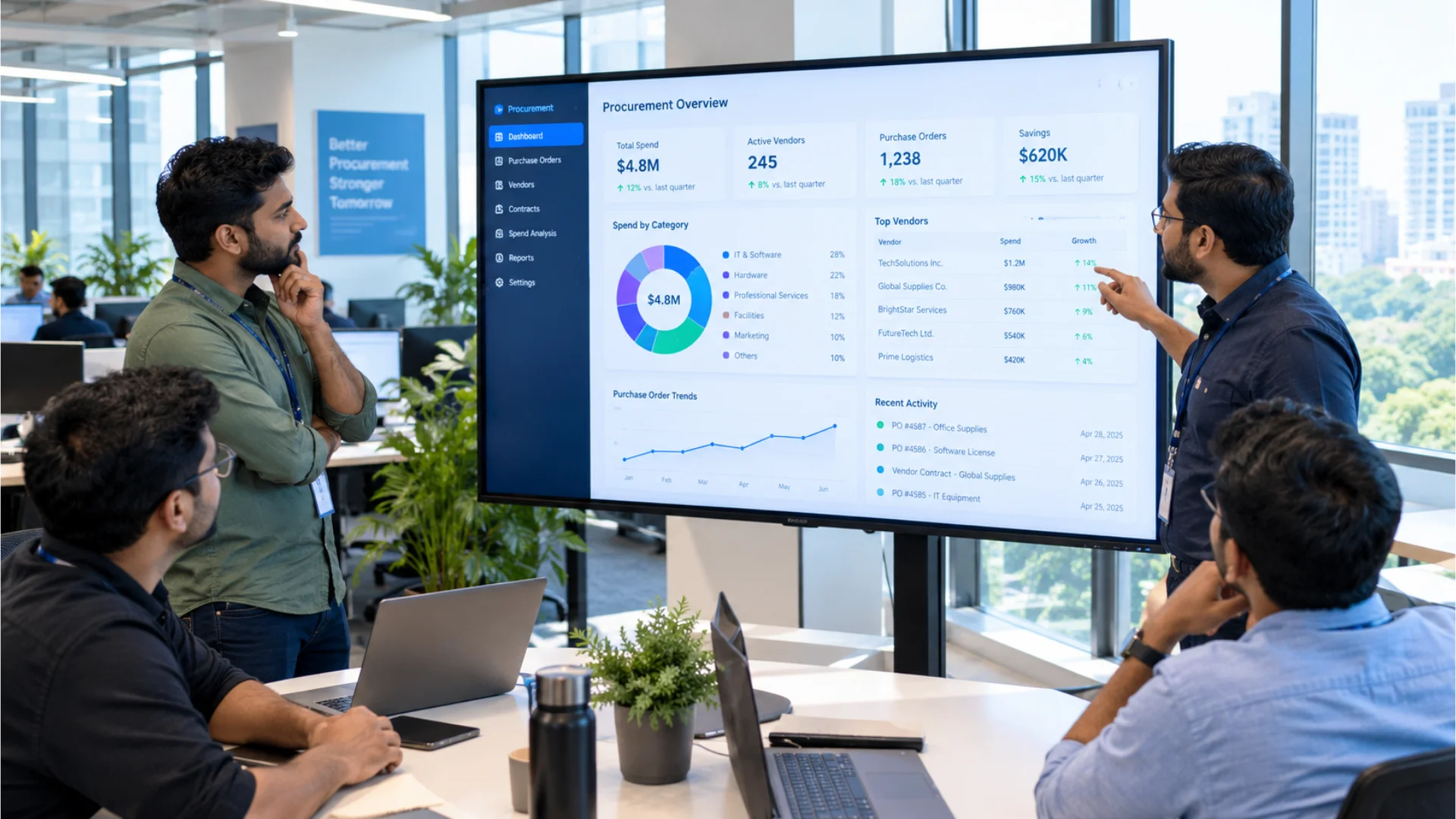
Aerchain Fixes a Costly Blind Spot in Enterprise Procurement
Procurement teams at large companies spend most of their week doing things nobody hired them to do. Chasing email threads. Updating spreadsheets. Waiting on approvals stuck in someone’s inbox. Aerchain was built specifically to take that grind off their plate.
The Bengaluru-based company has grown from a small pre-seed startup into a platform trusted by enterprise buyers across more than 30 countries, and its recent funding round put it back in the spotlight. Here’s a full breakdown of what it does, who built it, how it makes money, and what working there is actually like.
Where Aerchain Came From
Aerchain launched in 2019, founded by Harsha Kadimisetty and Himavanth Jasti. Both had already spent years building a different B2B company together, so Aerchain wasn’t a first attempt at entrepreneurship for either of them.
Kadimisetty studied mechanical engineering at BITS Pilani and started his career at Bosch, moving through roles as a project trainee, a technical management trainee, and eventually an international business development manager. In 2016, he co-founded SupplyBasics, a B2B e-commerce platform focused on industrial indirect purchasing, which is essentially procurement software’s earlier ancestor.
Jasti, also a BITS Pilani graduate with a degree in electronics and instrumentation, spent time as a software engineer at Bank of America, the health tech platform Practo, and the HR software company Belong before joining Kadimisetty at SupplyBasics as the technical lead.
That earlier venture gave the pair a direct, close-up view of exactly where procurement software falls short for large buyers, which is what they set out to rebuild from scratch when they started Aerchain three years later.
What Aerchain Actually Does
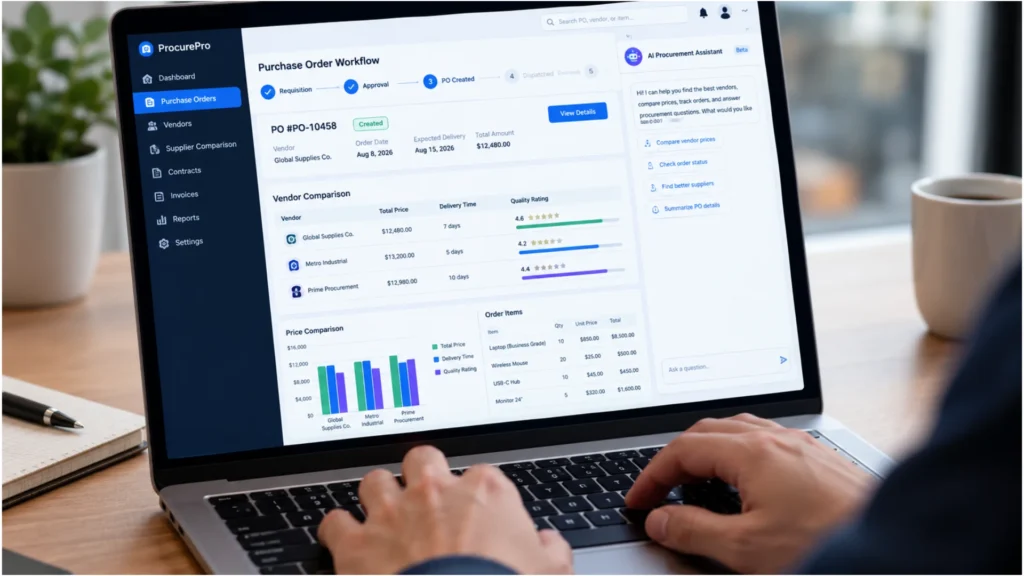
At its core, Aerchain is a source-to-pay platform, meaning it covers the full journey of a purchase from the moment someone requests something internally to the point the vendor gets paid.
The company describes its product as a Spend Operating System built around a set of AI agents rather than a single static tool. Those agents handle a wide range of jobs across the buying process.
- Conversational intake, where an employee can describe what they need in plain language instead of filling out a rigid form
- Vendor discovery and management, matching buyers with the right suppliers from existing catalogs or market data
- RFQ and auction automation, running competitive bidding without a procurement manager chasing quotes manually
- Autonomous negotiation, where the system prepares counteroffers and negotiation playbooks based on market benchmarks
- Contract management and invoice processing, tying the paperwork back to what was actually agreed
- Spend Intelligence, a module that continuously watches spend patterns, commodity price movements, contract expiration dates, and vendor consolidation opportunities, then surfaces recommendations before a human even asks
Put simply, a lot of procurement software just digitizes paperwork. Aerchain is trying to make the software actually think through the decisions that used to eat up a buyer’s afternoon.
The company says it now works with more than 50 enterprise customers across over 30 countries, managing somewhere between $45 billion and over $1 billion in tracked spend depending on which figure and reporting period you look at, and claims to have cut procurement cycle times by more than half for its customers. Reported clients include names like Marico, Puma, Britannia, AB InBev, WeWork India, and Cars24.
How Aerchain Makes Money and Who Uses It
Aerchain runs on a subscription-based SaaS model, charging enterprise customers based on usage, features, and procurement volume processed through the platform. Pricing is not publicly listed and is handled through direct sales conversations, which is standard for enterprise procurement software sold to companies with complex buying needs.
Its customer base spans manufacturing, retail, fast-moving consumer goods, and logistics, serving everyone from mid-market companies with $50 million to $1 billion in revenue up through large enterprises above that range. That range matters because procurement pain looks different at each size. A mid-market manufacturer might just need faster vendor onboarding, while a global enterprise is trying to consolidate spend across dozens of business units and currencies at once.
Aerchain Funding Explained
Aerchain’s funding history has been reported slightly differently across trackers, which is common for private companies where investors don’t always confirm every number publicly. Here’s the clearest picture available.
The company first raised a pre-seed round of roughly $3.2 million in 2020, followed by a pre-Series A round of about $3 million in September 2021, co-led by IndiaMART and Season Two Ventures. In March 2026, Aerchain closed a $13 million Series A round led by Pavestone VC, with continued backing from IndiaMART.
Total disclosed funding sits somewhere between $15.8 million and $19.5 million depending on the source, with Inc42 citing the higher figure and most other trackers landing closer to $16 to $17 million. The company has said the fresh capital from its Series A will go toward global expansion and building out more AI capability inside its Spend Operating System.
Aerchain has not published an official valuation figure for its Series A, which several trackers list as undisclosed. That’s a normal choice for a company this size, since disclosing a valuation publicly can complicate later negotiations with future investors.
Careers at Aerchain
Aerchain employs somewhere between 57 and 85 people depending on the tracking source and the time of year, based out of its Bengaluru headquarters in Bellandur. The company hires for roles across software engineering, AI and product, sales and customer success, and strategy and operations.
Glassdoor reviews from Aerchain employees land in a fairly typical range for a growth-stage startup. The company holds a 3.6 out of 5 overall rating from 57 reviews, with 64 to 67 percent of employees saying they would recommend working there to a friend. Work-life balance scores around 3.5, culture and values sit near 3.4 to 3.5, and career opportunities score a bit higher at 3.6 to 3.7. Compensation and benefits came in around 3.3 to 3.4, with that figure reportedly dipping slightly over the past year.
Reviewers commonly point to approachable, accessible leadership as a strength. Like most fast-growing startups, some reviews also reference a round of adjustments to headcount in 2025, which is worth knowing going in if you’re weighing an offer there.
Open roles are typically posted on the company’s careers page as well as third-party job boards like NodeFlair, and interview difficulty on Glassdoor averages around 3.1 out of 5, with roughly half of candidates describing their interview experience as positive.
Where Aerchain Fits Against Its Competitors
Aerchain competes most directly with platforms like Taulia, Zip, and PayEm, all of which sell some version of automated procurement or spend management software to enterprise buyers. Taulia leans heavily into supply chain financing, Zip is known for its intake and workflow orchestration for procurement requests, and PayEm focuses more on spend management for finance teams specifically.
Aerchain’s pitch stands apart mainly through how far its AI agents reach into the actual decision-making, not just the paperwork. Running autonomous negotiation and continuously surfacing spend intelligence recommendations is a step beyond simply routing a purchase order through an approval chain, which is closer to what a lot of legacy procurement tools still do.
For a broader look at how AI-powered enterprise platforms are reshaping traditionally manual business functions, our AI company profile format breaks down a similar company working from a different angle, and the Tech Companies hub rounds up more profiles like this one across industries.
Getting the Most Out of a Platform Like Aerchain
- Start with your highest volume spend category first. Companies that see the fastest returns tend to roll out AI-powered procurement tools on categories with frequent, repeatable purchases rather than trying to automate everything at once.
- Keep a human in the loop for high-value negotiations. Autonomous negotiation tools are strong at benchmarking and drafting playbooks, but complex, high-dollar vendor relationships still benefit from a person making the final call.
- Audit your vendor data before onboarding. AI agents can only match buyers to suppliers as well as the underlying vendor data allows, so messy or outdated vendor records will limit how useful the automation actually is on day one.
A Few Misunderstandings Worth Clearing Up
- Assuming Aerchain only serves large multinational corporations. Its customer base actually spans mid-market companies as well as large enterprises, not just the biggest global brands.
- Treating every funding figure you find as equally accurate. Because different trackers report slightly different totals for Aerchain’s raised capital, it’s worth checking the date on any figure you see rather than assuming the highest number is the most current one.
- Confusing “AI agents” with full automation that needs no oversight. Aerchain’s tools are designed to prepare analysis, draft negotiation strategies, and surface recommendations, with human buyers still making the final calls on most decisions.
Frequently Asked Questions
Who founded Aerchain?
Harsha Kadimisetty and Himavanth Jasti founded Aerchain in 2019. Both had previously built SupplyBasics together, a B2B e-commerce platform for industrial procurement.
How much funding has Aerchain raised?
Aerchain has raised between roughly $16 million and $19.5 million depending on the source, most recently closing a $13 million Series A in March 2026 led by Pavestone VC.
What does Aerchain’s platform actually do?
It automates the full procurement cycle, from intake and vendor discovery through negotiation, contracts, invoicing, and ongoing spend analysis, using a set of AI agents rather than a single static tool.
Where is Aerchain headquartered?
Aerchain is based in Bengaluru, India, with its main office in the Bellandur area.
How can I apply for Aerchain careers?
Open positions are listed on Aerchain’s own careers page and on job boards including NodeFlair, covering engineering, AI, sales, and operations roles.
Is Aerchain a publicly traded company?
No. Aerchain remains a privately held startup funded through venture capital, with no public stock or ticker symbol.
Conclusion
Aerchain took a problem that sounds boring on paper- procurement paperwork and vendor chasing- and turned it into a genuinely useful AI product that enterprise buyers are paying for at scale. Its growth from a $3 million pre-Series A round to a $13 million Series A backed by Pavestone VC and IndiaMART shows real investor confidence in that bet.
The next stretch for the company is proving it can keep expanding globally while its AI agents take on more of the actual decision-making, not just the busywork. For procurement teams drowning in spreadsheets and approval chains, that’s exactly the kind of shift worth watching.