

The Aerospace Corporation: Powerful Legacy Protecting America’s Space Future
Almost every major national security satellite the United States has ever launched passed through the hands of one organization most Americans have never heard of. The Aerospace Corporation does not build rockets or sell hardware. It does something quieter and, in a lot of ways, more important. It makes sure the systems the country depends on in orbit actually work.
If you searched for The Aerospace Corporation because you are considering a job there, applying for an internship, or just trying to understand what this company actually does, you are in the right place. This guide covers its history, how it gets funded, what a typical career path looks like, and what current employees and interns actually say about working there.
What Is The Aerospace Corporation
The Aerospace Corporation is a nonprofit organization that operates the only federally funded research and development center, or FFRDC, dedicated entirely to the space enterprise. An FFRDC is a special category of research organization set up by the U.S. government to get independent, unbiased technical advice without the conflicts of interest that come from hiring a company that also builds and sells the hardware being evaluated.
In practice, that means Aerospace does not manufacture satellites, rockets, or ground systems. Instead, it provides systems engineering, integration, and technical oversight for the organizations that do. Its primary sponsor is the United States Space Force, and it also supports the National Reconnaissance Office, NASA, the National Oceanic and Atmospheric Administration, and a growing list of commercial space companies.
Today the organization employs more than 4,800 scientists and engineers, generates roughly 1.29 billion dollars in annual revenue according to its most recent public filings, and touches a large share of the national security satellites launched by the United States each year.
The History Behind The Aerospace Corporation
A Cold War Conflict Of Interest Problem
The story of The Aerospace Corporation starts with a genuine dilemma. In the mid 1950s, the Air Force’s Western Development Division needed deep technical expertise to manage its fast-growing ballistic missile and space programs. It turned to a private engineering firm, Ramo-Wooldridge, for that advice.
The problem was obvious once people thought about it. Ramo-Wooldridge was also building missile hardware. Having the same company advise the government on technical decisions while competing for contracts to build the systems it was evaluating created a conflict of interest that made both industry competitors and government overseers uncomfortable.
The solution was to create something new: an independent, nonprofit organization with no manufacturing arm and no products to sell, whose only job was to give the government objective technical advice. That organization was announced on June 25, 1960, in El Segundo, California, and incorporated in the state of California as The Aerospace Corporation.
Ivan Getting And The Early Years
Dr. Ivan Getting became the corporation’s first president, and he set a tone that has largely stuck for more than six decades. Getting pushed hard on technical rigor and independence, insisting that Aerospace’s value came from being trusted, not from being liked by any single customer or contractor.
Early projects included converting military missiles into space launch vehicles and supporting the earliest American human spaceflight programs. Over the following decades, Aerospace’s fingerprints ended up on GPS, missile warning satellites, reconnaissance systems, and nearly every major national security space program the country has run.
How The Aerospace Corporation Is Funded
This is one of the most misunderstood parts of the organization, so it is worth explaining clearly.
The Aerospace Corporation is not publicly traded and does not compete for contracts the way a typical defense contractor does. As an FFRDC, it operates under a long-term sponsoring agreement, primarily with the Space Force, on a cost reimbursement basis plus a small, capped fixed fee. That fee is intentionally modest, since Aerospace is structured to prioritize independence over profit.
Contract awards give a sense of scale. In one fiscal year alone, the Air Force’s Space and Missile Systems Center exercised a contract modification worth 1.08 billion dollars for systems engineering and integration support, part of a multi-year agreement with a cumulative value north of 2 billion dollars. Public nonprofit filings put total annual revenue at roughly 1.29 billion dollars as of fiscal year 2023.
Because it is registered as a nonprofit, Aerospace also files public tax documents, so unlike a privately held company, its top-line financials are a matter of public record rather than guesswork.
What The Aerospace Corporation Actually Does
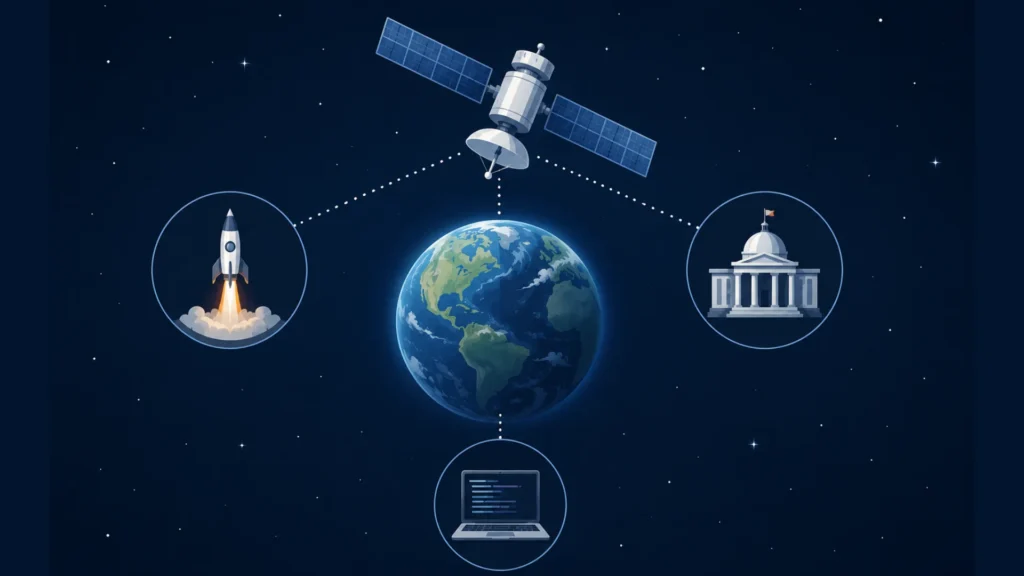
Aerospace’s core discipline is called systems engineering and integration, often shortened to SE&I. In plain terms, that means making sure all the different pieces of an enormously complex space program actually work together: the satellite, the rocket that launches it, the ground stations that control it, and the software that ties it all together.
Some concrete examples of where this shows up:
- GPS. Aerospace has been involved in the Global Positioning System since its earliest days and continues supporting new GPS III satellites as they join the constellation.
- Missile warning and defense. Aerospace provides technical assessments for the satellite systems that detect missile launches around the world.
- Civil space. Through its Civil Systems Group, Aerospace supports NASA’s Artemis program, contributing launch systems expertise, along with work for NOAA on weather and climate satellites.
- Commercial and international support. Aerospace also advises private space companies and allied governments, applying decades of institutional knowledge to newer, faster-moving programs.
- Digital engineering and AI. More recently, Aerospace has invested in modeling, simulation, and artificial intelligence tools to speed up how quickly satellite systems can be designed, tested, and fielded. This mirrors a broader trend across the aerospace and defense sector, where specialized AI tools, similar to the applied AI work covered in PurelyTechHub’s profile of GC AI, are being used to compress engineering timelines that used to take years.
Leadership And Where The Aerospace Corporation Is Based
Tanya Pemberton became president and CEO of The Aerospace Corporation in October 2025, succeeding Steve Isakowitz, who led the organization for nine years. Pemberton previously served as executive vice president, where she focused on building out Aerospace’s modeling, simulation, and AI capabilities, a background that lines up closely with where the organization is investing next. General Paul Selva, a retired U.S. Air Force officer, chairs the board of directors.
Aerospace’s headquarters moved from El Segundo, California, to Chantilly, Virginia, in 2024, putting the organization closer to the Pentagon, the Space Force, and its other government customers in the Washington, D.C. area. El Segundo remains a major regional office, alongside Colorado Springs and more than a dozen other locations across the country, including Huntsville, Cape Canaveral, and Los Angeles.
The Aerospace Corporation Careers Explained
The Aerospace Corporation careers page lists openings across systems engineering, software development, cybersecurity, data science, and specialized physics and materials science roles. Because nearly all of its work touches national security space programs, most technical roles require the ability to obtain and maintain a U.S. government security clearance, which generally means applicants need to be U.S. citizens.
Aerospace has been named one of Forbes’ America’s Best Midsize Employers for 2026, marking the tenth time it has received that recognition. On Glassdoor, the organization holds an overall rating of about 3.4 out of 5 across more than 600 reviews, with roughly 55 percent of employees saying they would recommend working there to a friend. Commonly cited strengths include job security, strong retirement benefits, tuition reimbursement, and the chance to work directly with decision-makers at agencies like NASA and NOAA.
The most consistent criticism in recent reviews centers on compensation that some employees feel lags the commercial space and tech sector, along with frustration over stricter in-office work policies introduced in 2025. Several reviewers also describe the culture as more bureaucratic and slower-moving than a typical startup, which tracks with its identity as a mission-focused nonprofit rather than a fast-scaling private company.
The Aerospace Corporation Internships
The Aerospace Corporation internships program is one of the most consistently well-reviewed parts of the organization. Interns work directly alongside senior engineers and scientists on real technical problems, not busywork, and many report receiving return offers for future internships or full-time roles.
A few patterns show up repeatedly across intern reviews:
- Competitive pay relative to other internship programs in the aerospace and defense sector
- Hands-on exposure to labs, simulation tools, and live satellite programs
- A relatively hands-off management style, where interns are given an assignment and trusted to work through it
- Interview processes that tend to be casual and behavior-based rather than heavily technical, often centered on a candidate’s resume and motivation for applying
The average hiring timeline for an internship role runs a bit longer than the company average, so students should plan to apply early, particularly for competitive summer programs tied to specific technical groups.
The Aerospace Corporation Reviews From Employees And Interns
Reading through The Aerospace Corporation reviews on sites like Glassdoor, a clear pattern emerges. Interns and early career employees tend to rate the experience very highly, often citing mentorship, meaningful project work, and a welcoming culture. Longer tenured employees are more mixed, with some praising decades-long career stability and others citing pay that has not kept pace with the broader industry and leadership that can feel disconnected from day-to-day work.
This split is not unusual for large, mission-driven organizations, and it is worth weighing both perspectives if you are deciding whether to apply. A summer internship experience and a ten-year career at Aerospace are genuinely different jobs with different tradeoffs.
How The Aerospace Corporation Compares To Other FFRDCs
The Aerospace Corporation is one of a small number of FFRDCs operating in the United States, alongside organizations like MITRE, RAND, Lincoln Laboratory at MIT, and the Jet Propulsion Laboratory managed by Caltech. What sets Aerospace apart is its singular focus. Where MITRE spans cybersecurity, air traffic, and healthcare, and RAND focuses on broad policy research, Aerospace exists for one purpose: making sure the country’s space systems work.
This is a similar model to how other federally supported research institutions operate, including biomedical research bodies like NIAID, which functions as a government-funded research engine for a different but equally specialized mission. The common thread across all of these organizations is independence from commercial pressure, funded specifically so their technical judgment cannot be bought.
For readers interested in how other companies across the broader aerospace industry are funded and structured, PurelyTechHub’s profile of Garuda Aerospace offers a useful contrast, covering a venture-backed drone company operating under a completely different ownership and funding model than a nonprofit FFRDC like Aerospace.
Frequently Asked Questions
What does The Aerospace Corporation actually do?
It provides independent systems engineering, integration, and technical advice for U.S. national security space programs, along with support for NASA, NOAA, and commercial space companies. It does not manufacture rockets or satellites itself.
Who owns The Aerospace Corporation?
No one. It is a nonprofit corporation, not a publicly traded or privately owned company. It operates under a sponsoring agreement primarily with the U.S. Space Force.
How much money does The Aerospace Corporation make?
Public nonprofit filings report annual revenue of approximately 1.29 billion dollars as of fiscal year 2023, funded almost entirely through cost reimbursement contracts with government agencies.
Is it hard to get an internship at The Aerospace Corporation?
Glassdoor data rates the internship interview difficulty as moderate, and the hiring process runs roughly two months on average. Applying early for summer positions improves your odds significantly.
Do you need a security clearance to work at The Aerospace Corporation?
Most technical roles require the ability to obtain and hold a U.S. government security clearance, which typically requires U.S. citizenship.
Where is The Aerospace Corporation headquartered?
Its headquarters moved to Chantilly, Virginia in 2024. Major regional offices remain in El Segundo, California, and Colorado Springs, Colorado, with additional locations across the country.
Conclusion
The Aerospace Corporation occupies an unusual spot in the American space industry. It is not a household name like SpaceX or Lockheed Martin, and it never will be, since its entire purpose depends on staying out of the spotlight and out of the business of selling hardware. But almost every major national security satellite the country has launched in the last six decades has passed through its technical review at some point.
For students weighing an internship, engineers considering a career move, or anyone trying to understand how the less visible parts of the U.S. space program actually function, The Aerospace Corporation is worth understanding on its own terms: a nonprofit built specifically to keep the nation’s space systems honest, reliable, and independent of commercial pressure.