

Bluefish AI Company Emerges as a Powerful Force in Agentic Marketing
Search engines used to be the main place brands fought for visibility. That fight is shifting fast toward a new battleground: the answers generated by ChatGPT, Google’s AI Overviews, Perplexity, and Amazon’s Rufus, where a brand either gets mentioned favorably or doesn’t show up at all.
The Bluefish AI company was built specifically for that shift. Founded in 2024, it’s grown into one of the fastest-scaling startups in what’s now being called agentic marketing, closing a $43 million Series B in April 2026 and landing customers like Adidas, American Express, and LVMH along the way. This guide covers what the company actually does, who’s behind it, how its business model works, its funding history, and what it’s like to work there, all grounded in verifiable, current reporting rather than marketing copy.
What the Bluefish AI Company Actually Does
Bluefish built what it calls an Agentic Marketing Platform (AMP), designed to help large brands understand and influence how they’re represented across AI systems. Instead of optimizing a webpage for Google’s search algorithm, Bluefish helps marketing teams optimize how their brand is described, recommended, or overlooked when a customer asks ChatGPT, Claude, Gemini, or Perplexity a question related to their product category.
The platform tracks brand mentions and sentiment across major AI providers, including OpenAI’s ChatGPT, Google’s AI products, Anthropic’s Claude, Perplexity, and Amazon’s Rufus shopping assistant. According to the company, it processes millions of AI prompts and responses daily, covering billions of monthly active users across those platforms combined.
Core Product Modules
Bluefish organizes its platform into several distinct modules, each targeting a different part of how a brand shows up in AI-driven discovery.
AI Brand Insights tracks how consumers actually engage with a brand across AI channels, giving marketing teams visibility into conversations they previously couldn’t monitor.
AI Measurement connects specific marketing campaigns to their measurable impact on AI visibility, offering a practical framework for measuring AI performance without being overwhelmed by complex analytics dashboards.
AI Brand Safety monitors for problematic, inaccurate, or damaging content about a brand appearing in AI-generated responses.
Citation Impact analyzes which sources and data points AI models pull from when discussing a brand, helping companies understand what’s actually shaping the narrative.
Brand Data Verification flags factual errors or AI hallucinations about a company and reports them back to the relevant AI provider for correction, a genuinely novel feature given how new this problem is for most marketing teams.
Agentic Commerce focuses specifically on shopping-related AI surfaces, including Amazon Rufus, an area almost no other competitor in this space currently covers in depth.
Why Agentic Marketing Became a Real Category
To understand why a company like Bluefish exists at all, it helps to understand how fast consumer behavior has shifted. AI platforms have reportedly reached over a billion combined monthly active users within roughly a year of some of these tools scaling up, a pace of adoption that outstrips the early growth curves of both mobile and social media.
That shift matters enormously for brands because AI-generated answers behave differently from search engine results. A search result gives a user ten blue links to evaluate themselves. An AI answer often gives a single, confident recommendation, with no guarantee that the brand paying for traditional search advertising will even be mentioned.
Bluefish and its backers estimate the total addressable market for agentic marketing at roughly $500 billion, reflecting how much budget could eventually shift from traditional search engine optimization and paid search toward this emerging discipline, sometimes referred to more broadly as generative engine optimization, or GEO.
Bluefish AI Company Business Model
Bluefish operates as an enterprise software-as-a-service company, selling directly to large brands and their marketing agencies rather than offering a self-serve consumer product. This is a deliberate choice that shapes almost everything about how the company operates.
The platform is priced and sold at enterprise scale, targeting Fortune 500 companies and major agencies. Modern enterprises are adopting similar automated tools across operational workflows, such as how Aerchain automates enterprise procurement to remove supply chain friction. Reported customers span more than a dozen verticals, including financial services, pharmaceuticals, beauty, luxury goods, consumer packaged goods, real estate, and advertising. Named clients include Adidas, American Express, Hearst, LVMH, Ulta Beauty, Tishman Speyer, and Omnicom.
This enterprise-first approach also explains the makeup of the company’s investor base. Beyond traditional venture capital firms, Bluefish has attracted strategic investment from Amex Ventures, TIAA Ventures, and Salesforce Ventures, corporate investors whose parent companies are themselves large potential customers or complementary technology partners.
The company reported achieving tenfold revenue growth over six months in 2025, a pace that helped justify its rapid progression from seed funding to a $43 million Series B in under two years.
Bluefish AI Company Funding History
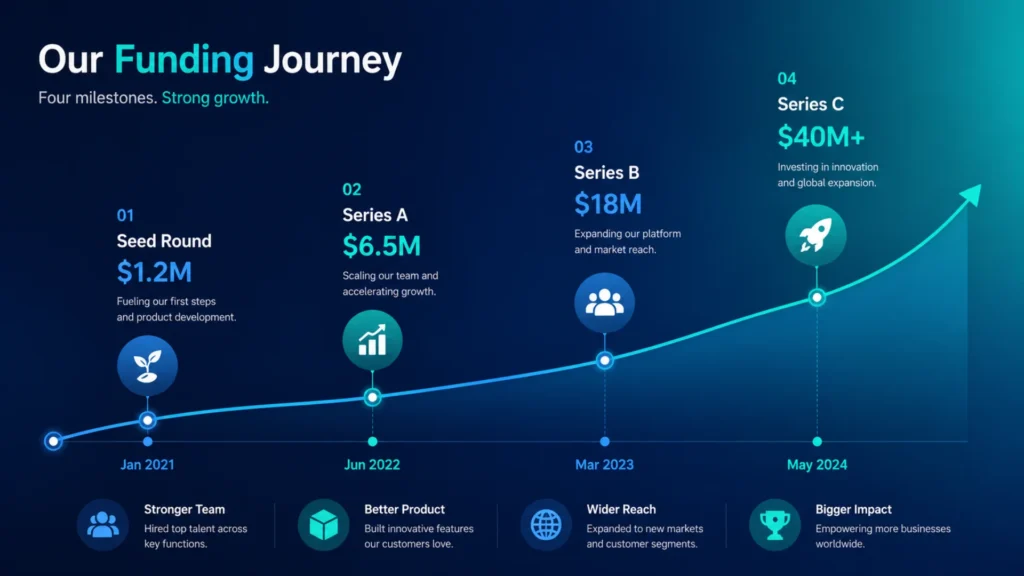
Bluefish’s fundraising trajectory has been unusually fast, even by the standards of a hot AI category.
Pre-seed, 2024. The company raised approximately $3.5 million from investors, including Crane Venture Partners, Bloomberg Beta, and Laconia Capital.
Series A, August 2025. Bluefish closed a $20 million round led by NEA, with continued participation from Salesforce Ventures and its earlier backers. At the time of this round, the company reported having already achieved significant enterprise traction and tenfold revenue growth over the prior six months.
Series B, April 2026. The company closed a $43 million round, co-led by Threshold Ventures and NEA, with participation from Amex Ventures, TIAA Ventures, Salesforce Ventures, and Bloomberg Beta, and continued backing from Crane Venture Partners, Laconia, and Swift Ventures.
Combined, Bluefish has raised approximately $68 million across its pre-seed, Series A, and Series B rounds in under two years since its launch. The company has not publicly disclosed its current valuation.
Who Founded the Bluefish AI Company
Bluefish was founded in 2024 by three martech and adtech veterans, each bringing a notable acquisition to their resume before starting this company together.
Alex Sherman, the company’s CEO and co-founder, previously co-founded PromoteIQ, a retail media platform that Microsoft acquired in 2019. That deal gave Sherman direct experience scaling a marketing technology company through a major enterprise acquisition, background that shows up clearly in how Bluefish approaches enterprise sales.
Andrei Dunca, the company’s CTO and co-founder, previously co-founded LiveRail, a video advertising platform that Facebook, now Meta, acquired in 2014 for more than $400 million. Dunca brings deep engineering leadership experience from scaling that platform through its own acquisition.
Jing Feng, the company’s COO and co-founder, held senior operating roles across PromoteIQ, LiveRail, and Microsoft before joining Sherman and Dunca to launch Bluefish.
This combination matters for anyone researching Bluefish AI company acquisitions, since the founding team’s own history of building and selling companies to Microsoft and Meta is frequently cited by investors as a core reason they backed Bluefish so aggressively and so early. As of this writing, Bluefish itself has not been acquired and continues to operate as an independent, venture-backed private company.
Bluefish AI Company Careers
Bluefish is headquartered in New York City and has been growing its team quickly alongside its funding and customer growth. The company’s leadership team includes experienced marketers and engineers who previously worked at Microsoft, The Trade Desk, AppNexus, Publicis, and various consumer packaged goods brands, reflecting the kind of enterprise martech pedigree the founders themselves bring to the table.
For anyone interested in Bluefish AI company careers, the company’s official careers page at bluefishai.com/careers lists current openings directly, and it’s the most reliable source for up-to-date roles, since a fast-growing venture-backed startup like this one adds and fills positions quickly. Roles at companies in this stage typically span engineering, data science, enterprise sales, and customer success, though specific openings will vary depending on when you check.
Given the company’s enterprise focus and rapid scaling since its Series A, expect a fast-paced startup environment built around serving Fortune 500 clients directly, which tends to favor candidates comfortable with both technical AI systems and high-stakes enterprise relationships.
How Bluefish AI Company Compares to the Broader AI Marketing Space
Bluefish operates in a category that’s attracting a growing number of competitors, generally grouped under labels like generative engine optimization, AI search visibility, or answer engine optimization. What tends to differentiate Bluefish from smaller players is its enterprise-first focus and its unusually broad platform scope, covering not just monitoring but also measurement, brand safety, hallucination correction, and agentic commerce in a single suite rather than a single narrow tool.
That said, this is still a young, fast-moving category. Being an early enterprise leader doesn’t guarantee long-term dominance, particularly as larger martech incumbents and the AI platforms themselves, including OpenAI and Google, continue to build out their own brands and advertiser-facing tools that could eventually compete directly with third-party platforms like Bluefish.
Common Mistakes People Make Researching the Bluefish AI Company
Confusing Bluefish AI with unrelated companies of a similar name. Several other companies across different industries use variations of “Bluefish” in their branding. Make sure any research or job application specifically references Bluefish’s agentic marketing platform and its New York headquarters to avoid confusion.
Assuming the company has been acquired. As of this writing, Bluefish remains an independent, privately held company. Its founders have prior acquisition experience from earlier companies, PromoteIQ and LiveRail, but that history belongs to their previous ventures, not Bluefish itself.
Treat reported revenue growth as confirmed, audited figures. Startup funding announcements often cite growth percentages, such as a reported tenfold increase in revenue, that come directly from the company rather than from independently audited financials. These figures are useful directional signals but should be read in that context.
Overlooking the enterprise-only focus. Bluefish isn’t built for small businesses or individual marketers. Its pricing, sales process, and feature set are designed specifically for Fortune 500-scale complexity.
Frequently Asked Questions
What does the Bluefish AI company actually sell?
Bluefish sells an enterprise software platform called the Agentic Marketing Platform, which helps large brands monitor, measure, and influence how they’re represented across AI systems like ChatGPT, Google AI, Claude, Perplexity, and Amazon Rufus.
How much funding has Bluefish AI raised?
Bluefish has raised approximately $68 million in total funding as of April 2026, across a pre-seed round, a $20 million Series A, and a $43 million Series B.
Who founded the Bluefish AI company?
Bluefish was founded in 2024 by Alex Sherman, Andrei Dunca, and Jing Feng, all veterans of prior marketing technology companies acquired by Microsoft and Meta.
Has the Bluefish AI company been acquired?
No. Bluefish remains an independently operating, privately held, venture-backed company as of this writing.
Where is the Bluefish AI company headquartered, and does it offer careers?
Bluefish is headquartered in New York City. Current job openings are listed on the company’s official careers page at bluefishai.com/careers.
Who are Bluefish AI’s customers?
Reported customers include Adidas, American Express, Hearst, LVMH, Ulta Beauty, Tishman Speyer, and Omnicom, spanning industries including retail, financial services, luxury goods, real estate, and advertising.
Conclusion
Bluefish arrived at almost exactly the right moment. As AI platforms became a genuine discovery channel for consumers, the company built a platform squarely aimed at the problem that created them, helping large brands understand and shape how they show up in conversations they can’t directly control, unlike the way they once controlled a search results page or a social media feed.
The founding team’s track record of building and selling companies to Microsoft and Meta gave early investors real confidence, and the company’s rapid climb from a $3.5 million pre-seed round to a $43 million Series B in under two years reflects genuine enterprise demand rather than just market hype. Whether Bluefish becomes the lasting category leader in agentic marketing, or one of several strong players as the space matures, will depend on how well it keeps pace with the ongoing evolution of AI platforms.
For readers who want a broader understanding of how this discipline fits into digital marketing more generally, the Wikipedia entry on search engine optimization offers useful background on the traditional discipline that agentic marketing is now beginning to reshape.