

GC AI Uncovered Powerful Insights on What It Does
A three-time general counsel got early access to a pre-ChatGPT language model back in 2022, tried using it to draft contract language, and couldn’t stop thinking about it afterward. That’s the origin story behind GC AI, and it’s a more useful starting point than most company profiles bother with, because it explains why the product looks the way it does.
Most legal AI tools were built for law firms first, then repackaged for corporate legal departments as an afterthought. GC AI flipped that. It’s built specifically for in-house counsel: the lawyers who work inside a company rather than at a firm, juggling contracts, compliance questions, and employment law issues across every department that needs a legal sign-off.
Here’s what GC AI actually does, who’s behind it, how it’s funded, and what people say about working there.
Quick Facts
Full Name | GC AI (General Counsel AI, Inc.) |
Founded | November 2023, San Francisco |
Founders | Cecilia Ziniti (CEO) and Bardia Pourvakil (CTO) |
What it does | AI platform for in-house legal teams, contract drafting, review, & redlining |
Customers | 1,700+ companies, including News Corp, Vercel, Skims, & Liquid Death |
Total Funding | $73 million across Seed, Series A, and Series B rounds |
Latest Valuation | $555 million (as of the November 2025 Series B) |
Headquarters | San Mateo, California, with an additional office in Provo, Utah |
Who Built GC AI
Cecilia Ziniti spent more than 15 years as a lawyer, including three separate stints as general counsel at fast-growing companies. That’s a specific kind of experience: general counsel don’t just interpret the law; they sit in the room where product, sales, and leadership decisions get made, and they’re expected to move at the speed of the business rather than the speed of a law firm’s billing cycle.
Ziniti teamed up with Bardia Pourvakil, an AI engineer, and the two worked together at Replit before deciding to build GC AI full-time. They officially incorporated General Counsel AI, Inc. on November 8, 2023, about a week after committing to the idea. Before that, they’d spent time running a newsletter about AI in the legal industry and teaching prompting classes to lawyers, which shaped their read on what in-house teams actually needed versus what the rest of the legal AI market was building.
That distinction matters for understanding the product. Most legal AI tools of the era targeted litigation research or document review at law firms. GC AI focused narrowly on the in-house use case: company-specific playbooks, cross-functional stakeholders outside the legal department, and risk tolerance that shifts depending on the deal.
What GC AI Actually Does
GC AI is a chat-based assistant that connects to a company’s contracts, policies, and internal data, then answers questions or drafts documents using that context rather than generic legal knowledge from the open internet.
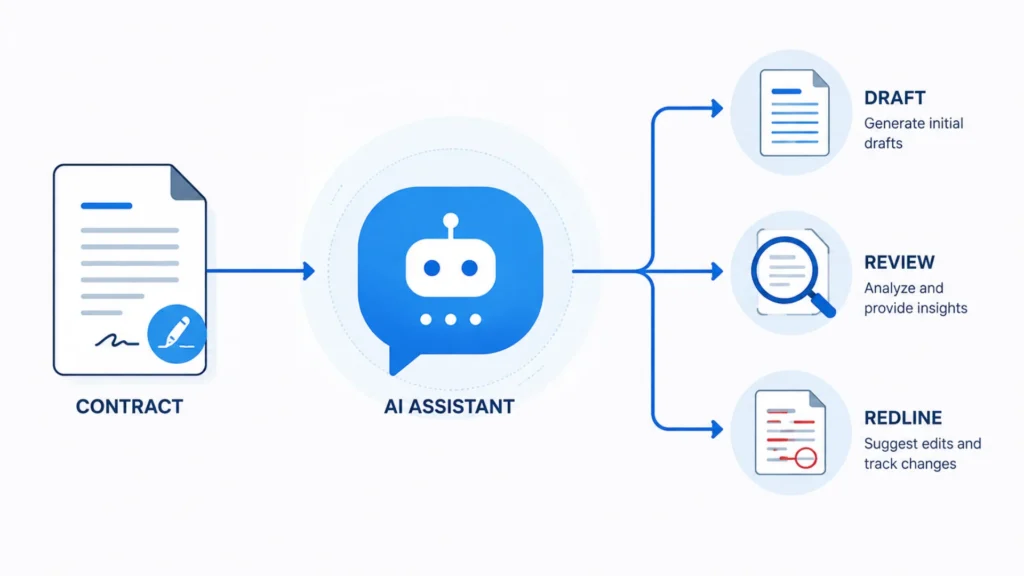
A few features come up repeatedly in how the company and its users describe the platform:
- Easy Prompt turns plain-language requests into more structured legal queries, which helps non-technical users get better output without learning prompt engineering.
- Exact Quote provides character-level citations back to the source document, so a lawyer reviewing an AI-generated summary can verify exactly where a claim came from instead of taking it on faith. This addresses one of the most common criticisms of legal AI tools generally: hallucinated case law or contract terms that sound plausible but aren’t actually in the document.
- GC AI for Word brings the platform directly into Microsoft Word, where it can redline documents, leave comments, and flag issues without forcing lawyers to copy and paste between a browser tab and their document. Given that the American Bar Association’s Legal Technology Survey has repeatedly found that the overwhelming majority of lawyers still draft primarily in Word, this integration point is practical rather than a nice-to-have.
- Playbooks let a legal team encode its standard positions on common contract terms, so the AI’s suggestions stay consistent with how that specific company already negotiates, rather than defaulting to generic market terms.
- Agent Connectors link GC AI to more than 20 external tools, including Gmail, Slack, Google Drive, and HubSpot, so it can pull context from where legal requests actually originate instead of requiring everything to be manually uploaded. (If you use AI assistants alongside your browser workflows, tools like the Merlin Chrome Extension can similarly streamline daily operations directly within Gmail.)
- API access allows companies to embed GC AI’s reasoning into other tools they already use, such as Ironclad or Jira, including automated workflows that don’t require a human to sit in a chat window.
Under the hood, GC AI says it runs queries across five large language models simultaneously rather than relying on a single model, an approach the company positions as a way to reduce the risk of any one model’s blind spots or hallucinations appearing in the final answer.
Who Uses GC AI
GC AI reports serving more than 1,700 companies, including over 150 public companies and more than 25 companies valued at $1 billion or higher. Named customers include News Corp, Vercel, Skims, Liquid Death, Zscaler, Miro, Bass Pro Shops, Snyk, and TIME.
The use cases the company highlights are specific rather than abstract. A Fortune 500 tech company reportedly uses GC AI to automate NDA reviews, saving around 400 hours of legal work a month. A mid-market SaaS company uses it to summarise contract risk for its sales team, so reps don’t have to wait on legal for every redline question. A startup general counsel has used it to quickly get up to speed on regulatory requirements when expanding into a new country.
This lines up with a broader trend in the legal industry: the population of in-house counsel has been growing more than twice as fast as the population of lawyers working at law firms or in government roles, which means more companies are trying to run lean legal departments that can still cover a growing volume of work.
GC AI Funding History
GC AI has raised money quickly for a company that’s only a few years old.
| Round | Date | Amount | Lead Investors |
|---|---|---|---|
| Seed | September 2024 | $1.6 million | Worklife, MKT1 |
| Series A | May 2025 | $10 million | TipTop VC, Sound Ventures, Guillermo Rauch, Gokul Rajaram, FJ Labs, Fellows Fund, California Innovation Fund |
| Series B | November 2025 | $60 million | Scale Venture Partners, Northzone |
The Series B round, announced on November 12, 2025, brought GC AI’s total funding to $73 million and set the company’s valuation at $555 million. Additional participants in that round included Sound Ventures, Aglaé Ventures, SilverCircle Partners, News Corp (also a customer), The Council, and Vercel CEO Guillermo Rauch, who participated as a strategic angel investor.
That’s a fast jump from a $1.6 million seed round to a $555 million valuation in roughly 14 months, reflecting both the broader surge in venture interest in applied AI tools during this period and GC AI’s reported growth numbers. The company has said it grew revenue roughly tenfold in the 12 months leading up to the Series B.
Is GC AI a Good Place to Work?
If you’re researching “GC AI careers” specifically, here’s what’s publicly known about the company as an employer.
GC AI operates as a hybrid company. Employees within about 50 miles of the San Mateo, California, or Provo, Utah, offices work in person on Tuesdays, Wednesdays, and Thursdays. At the same time, many roles across the company are open to remote work anywhere in the U.S. or Canada. The company has listed open roles spanning sales, engineering, product design, customer success, people operations, and, somewhat unusually for a tech startup, an R&D Attorney role focused on reviewing the accuracy and quality of the AI’s legal outputs.
GC AI has publicly cited internal metrics, such as 95% customer retention and a Net Promoter Score of 75, both of which are strong figures if accurate, though they’re self-reported rather than independently audited.
For a more candid, unfiltered read on what it’s actually like to work there, current and former employees have weighed in on Reddit, where people discuss legal technology and employers. Threads like that tend to be more useful than a careers page for getting a sense of pace, management style, and day-to-day reality, since they’re written by people with no incentive to make the company look good.
One practical note if you’re job hunting: GC AI has publicly warned that it only accepts applications through its official careers page or sponsored LinkedIn listings, and that legitimate recruiting emails will come from a @gc.ai or @getgc.ai address. That warning exists because recruitment scams impersonating fast-growing AI startups have become common enough that companies now build phishing disclaimers directly into their job postings.
GC AI vs. Other Legal AI Tools
GC AI competes in a legal AI market that’s grown crowded quickly, but most of its direct competitors, such as Harvey and Legora, are built primarily for law firms rather than corporate legal departments. That’s the core differentiator GC AI leans on.
Tools like Spellbook and Ironclad’s AI features overlap more directly with GC AI’s contract-focused use case, though Ironclad is fundamentally a contract lifecycle management (CLM) platform with AI features layered on, while GC AI is AI-first and can integrate with a company’s existing CLM rather than replacing it.
The practical difference for a buyer comes down to workflow. If your legal team’s biggest bottleneck is litigation research or due diligence at scale, a law-firm-oriented tool may be a better fit. If the bottleneck is a small in-house team fielding constant contract, policy, and compliance questions from every other department in the company, GC AI’s pitch is built specifically around that reality.
What GC AI Costs
GC AI is a paid, subscription-based product, with pricing starting around $500 per month for individual or small-team plans. Higher tiers add features like Enterprise SSO, shared team chats, a shared prompt library, and onboarding sessions for larger legal departments. Because pricing and tier structures change as products mature, anyone seriously evaluating GC AI should confirm current pricing directly with the company rather than relying on a third-party estimate.
How to Evaluate GC AI (or Any Legal AI Tool) Before Buying
- Ask how citations work. A legal AI tool that can’t show you exactly where an answer came from is asking you to trust it blindly, which isn’t acceptable for anything client-facing or contract-binding.
- Check whether it trains on your data. GC AI states that it does not train its models on customer data, which is crucial for any company handling confidential contracts or privileged information. Confirm this in writing during procurement, not just on a marketing page.
- Test it against your actual documents, not a demo. Generic demo contracts rarely reveal how a tool handles the specific quirks of your company’s playbooks, prior negotiated terms, or industry-specific clauses.
- Look at the security certifications. SOC 2 Type II certification, which GC AI holds, means an independent auditor has verified the company’s security controls over time, not just at a single point in time.
- Talk to actual users, not just published case studies. Case studies are selected because they went well. Forums, LinkedIn, and industry Slack communities tend to surface a more balanced picture.
Frequently Asked Questions
What does GC AI stand for?
GC AI stands for General Counsel AI. “General counsel” is the title typically held by the top lawyer at a company, and the platform was built to serve this audience.
Is GC AI the same as gcai.com or gc.ai?
GC AI’s official website is gc.ai. Some people search “gcai” as a single word out of habit, but it refers to the same company and product.
How much funding has GC AI raised?
GC AI has raised $73 million in total, across a $1.6 million seed round in 2024, a $10 million Series A in 2025, and a $60 million Series B in November 2025 that valued the company at $555 million.
Does GC AI replace human lawyers?
No. GC AI is positioned as a productivity tool that drafts, reviews, and researches faster, with every output intended to be reviewed and approved by a human lawyer before use. The company’s public messaging consistently frames the tool as something that empowers lawyers rather than replaces them.
Who are GC AI’s competitors?
GC AI’s closest competitors include Ironclad and Spellbook for contract-focused AI, and Harvey and Legora as major players in the broader legal AI space, though those two are built primarily for law firms rather than in-house teams.
Where is GC AI hiring?
GC AI lists open roles on its official careers page and on LinkedIn, spanning engineering, sales, customer success, product design, and legal roles like R&D Attorney. Most positions are based out of San Mateo, California, or Provo, Utah, with hybrid and remote options depending on the role.
Conclusion
GC AI is a fast-growing, well-funded example of a broader shift in legal technology: instead of building AI tools for law firms and hoping corporate legal departments adopt a watered-down version, the company was built specifically for how in-house teams actually work. The founder-market fit is unusually direct here: a three-time general counsel building the tool she wished she’d had, and the customer list and funding trajectory suggest that pitch is resonating.
Whether it’s the right fit for a specific legal team depends on the same things any software evaluation depends on: how well it handles your actual documents, how it fits into tools you already use, and whether the security and citation features hold up under real scrutiny rather than a sales demo.