
Cornell Tech Delivers a Powerful Edge for Future Tech Leaders
Most people picture Ithaca when they hear the word Cornell. Rolling hills, gorges, a campus that feels a world away from any city skyline. Cornell Tech is the opposite of that picture entirely, and that’s exactly the point.
It’s a graduate school on an island in the middle of the East River, built specifically to produce engineers, designers, and business leaders who want to build companies, not just study them. If you’re researching this school, you probably want a straight answer on how it connects to Cornell, what it actually costs, how good its programs really are, and what its MBA looks like. Here’s the full picture.
Is Cornell Tech Part of Cornell University
Yes. Cornell Tech is not a separate school or a knockoff branch campus. It’s an official graduate campus and research center of Cornell University, one of the eight Ivy League schools, and Cornell confers its degrees just like it does in Ithaca.
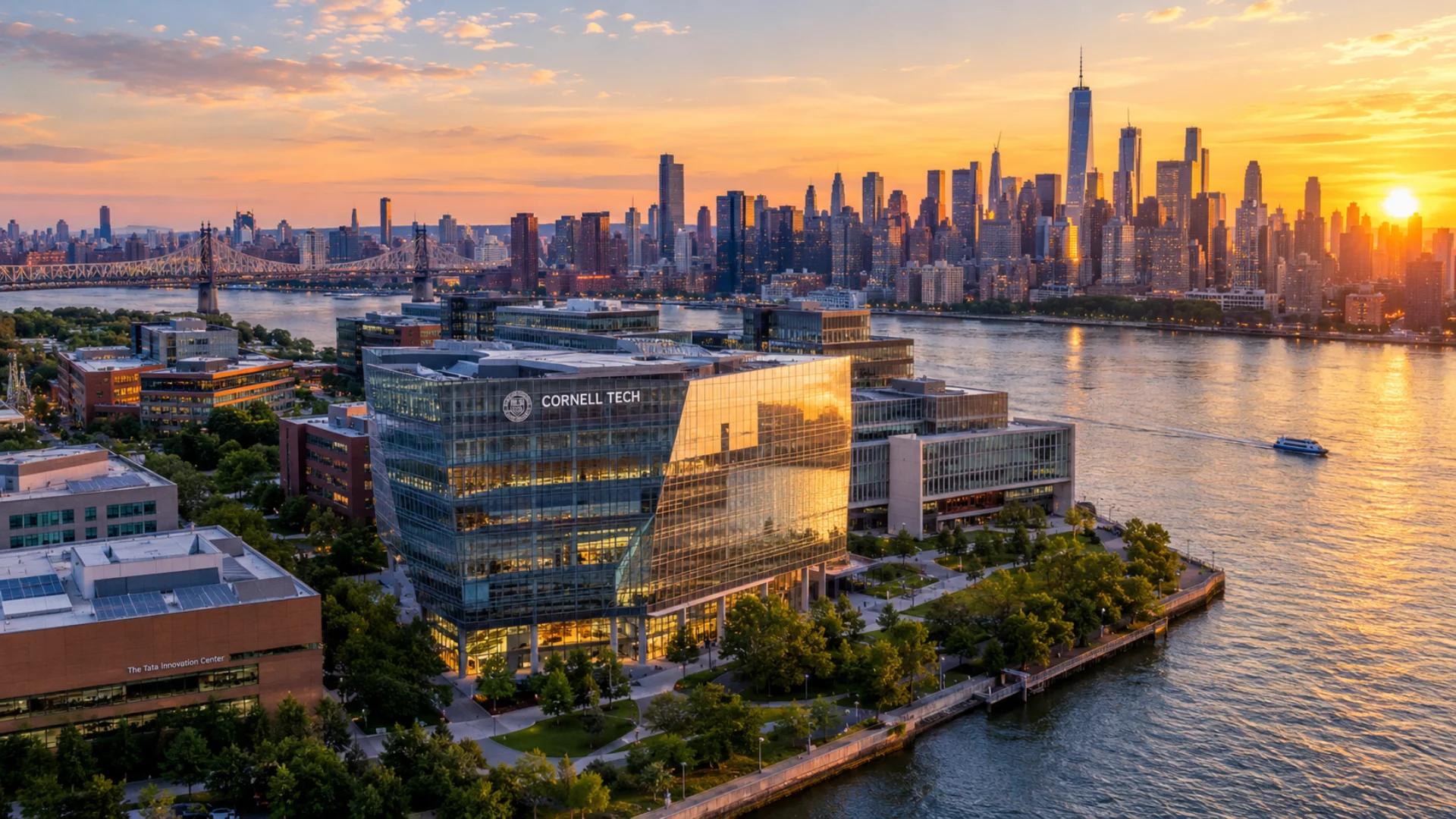
What makes it distinct is where it operates and who it serves. Cornell Tech sits on Roosevelt Island in New York City, roughly 200 miles from the main Ithaca campus, and it’s exclusively graduate-level. There’s no undergraduate program here. Every student walking through the Bloomberg Center already holds a bachelor’s degree and came specifically for a master’s, MBA, LLM, or PhD focused on technology, business, or law at the intersection of the two.
The campus also runs the Jacobs Technion-Cornell Institute, a joint academic partnership between Cornell and the Technion, Israel’s leading science and technology university. Students in that program earn degrees from both institutions, which is a structure you won’t find anywhere else on a standard Cornell diploma.
How a Mayor’s Economic Bet Became a Graduate School
Cornell Tech exists because New York City wanted more engineers who would actually start companies there instead of leaving for the West Coast.
Back in 2008, Mayor Michael Bloomberg’s administration studied how New York could compete in the tech economy and concluded the city was short on one thing: a concentrated source of technical talent willing to build startups locally. In late 2010, the city launched an open competition, inviting universities to propose a new applied sciences campus in exchange for city land and a $100 million investment.
Eighteen universities showed early interest, and seven formal bids came in. Stanford, paired with the City College of New York, was considered the frontrunner for most of the process. Then, ten days before the deadline, Cornell and the Technion revealed a joint bid that had been developed quietly, including meetings in Beijing and at the Cornell Club in New York. Shortly after, Stanford withdrew, and the city awarded the project to Cornell and the Technion in December 2011.
The pitch was ambitious even by New York standards. Cornell and the Technion projected the campus would eventually create 28,000 jobs, help launch 600 companies, and generate roughly $23 billion in economic impact over its first three decades. Google co-founders Sergey Brin and Larry Page, despite their own Stanford ties, donated office space in Chelsea so Cornell Tech could start classes in 2012 while its permanent campus was still years from breaking ground.
The Roosevelt Island Campus Today
Construction on Roosevelt Island required demolishing part of a former hospital site and cleaning up the land underneath it. The first phase, covering five acres, opened on September 13, 2017, with three buildings: the Bloomberg Center, the Tata Innovation Center, and a residential tower known simply as the House.
The Bloomberg Center is worth understanding on its own, because it says a lot about how Cornell Tech thinks about its physical space. Designed by Morphosis Architects, it was New York City’s first net-zero energy academic building, meaning it generates as much power as it uses. The roof holds nearly 1,500 solar panels, and 80 geothermal wells pull heat from the ground below the island.
The House, a 26-story residential tower, was built to the strict Passive House energy standard, which the developers say cuts energy use by roughly 60 to 70 percent compared to a typical high-rise of the same size. It’s currently one of the tallest buildings in the world built to that standard.
There’s one recent wrinkle worth knowing about if you’re researching the campus closely. The Graduate Hotel at Cornell Tech, which opened in 2021 as the island’s first hotel, closed abruptly in November 2025 after its operator defaulted on its loans, leading Cornell to file suit in early 2026. It doesn’t affect academics, but it’s a change from how the campus looked just a year earlier.
The full campus is expected to reach 12 acres by 2037, with two more construction phases still ahead. For now, students get to campus mainly by the Roosevelt Island Tramway or the F and M subway lines, since the campus was deliberately designed with no parking lots to encourage transit use.
Degree Programs You Can Actually Study Here
Cornell Tech offers a fairly focused set of graduate degrees rather than trying to cover every discipline under one roof.
Master’s programs include Computer Science, Electrical and Computer Engineering, Operations Research and Information Engineering, and Data Science. Cornell Law School offers a Master of Laws focused specifically on law, technology, and entrepreneurship, aimed at lawyers who want to work at startups or in tech policy rather than traditional litigation. There are also dual degree tracks, including a combined MBA and Master of Engineering, and a joint JD and MEng for students who want both a law degree and technical training.
PhD students can pursue doctoral work in Computer Science, Electrical and Computer Engineering, Operations Research, Biomedical Engineering, and Information Science, all housed at the Roosevelt Island campus rather than Ithaca.
The Studio Curriculum
What separates Cornell Tech from a typical technical master’s program is something it calls Studio, a practicum built into every degree track. Instead of purely theoretical coursework, students work in small interdisciplinary teams on real product challenges, often sponsored by outside companies, and build something that actually functions by the end of the term. It’s less classroom, more startup incubator, which lines up with the entire reason the campus exists.
Cornell Tech MBA Explained
If you’re specifically researching the Cornell Tech MBA, here’s what it actually looks like day to day.
The program is officially called the Johnson Cornell Tech MBA, and it’s a distinct offering from the traditional two-year MBA taught at the Johnson School in Ithaca. It runs as an accelerated one-year program aimed at candidates who already have solid experience in the tech industry, generally around three or more years of digital or tech-related work, and want to move quickly into a leadership or founder role rather than spend two years in a general management program.
Cornell also offers a dual-campus option, sometimes called the 1+1 track, where students spend their first year in Ithaca completing core MBA coursework, then move to the Roosevelt Island campus for their second year to focus specifically on technology, entrepreneurship, and product management alongside the one-year cohort.
Admissions for the Johnson Cornell Tech MBA run through a completely separate application from the Ithaca MBA programs, with its own $200 application fee and its own priority and rolling deadlines each cycle. Applicants need a bachelor’s degree, a resume capped at two pages, and international transcripts evaluated through a credential review process.
On outcomes, the numbers back up the program’s tech focus. The Class of 2024 for the Johnson Cornell Tech MBA reported a median base salary of $152,000, with 73 percent of graduates employed and about 8 percent launching their own companies instead of taking a traditional job offer. The most common job functions after graduation were product management and product marketing, followed by analytics and consulting roles, which tracks closely with what you’d expect from a program built specifically around New York’s tech and startup scene.
What the Rankings Actually Say About Cornell Tech
Search results for Cornell Tech rankings can get confusing fast, mostly because different publications rank different things. Some rank Cornell University as a whole, others rank specific Cornell Tech programs, and a few conflate the two. Here’s how to read it correctly.
Cornell University as a whole placed 12th in U.S. News & World Report’s 2026 National Universities rankings, sitting between Caltech and a tie between Brown and Dartmouth. On the global side, Cornell ranked 16th in the QS World University Rankings for 2026.
For Cornell Tech’s specific programs, U.S. News ranked its Computer Science graduate program 2nd in the nation in its most recent Best Computer Science Graduate Programs rankings, a strong showing for a campus that’s barely more than a decade old. On the business side, the Financial Times placed the Cornell Tech MBA at 3rd in the United States in its Global MBA Rankings, and Poets & Quants separately ranked it 1st in the country specifically for technology and information management MBAs.
The takeaway is that Cornell Tech doesn’t usually appear as its own standalone entry in broad global university rankings, since those rankings measure entire universities. Its strength shows up instead in program-specific rankings, particularly computer science and its tech-focused MBA, where it consistently lands near the very top nationally.
Notable Outcomes and the Startup Track Record
By the time the Roosevelt Island campus had been open for just about a year, Cornell Tech’s students and graduates had already started more than 50 companies between them, and over 500 graduates had been hired directly by technology companies. The campus has also been cited as a factor in Amazon’s initial consideration of New York City for its second headquarters search, even though that plan was later scrapped.
The Jacobs Technion-Cornell Institute runs its own postdoctoral program called Runway, specifically built to help postdocs launch startups rather than pursue traditional academic careers. Companies that came out of that pipeline include Nanit, a baby monitor company that uses computer vision to track infant sleep patterns.
If you’re curious how graduate-founded startups like these grow into full companies, our Tech Companies hub covers founder stories and funding paths across a wide range of tech sectors.

Cost of Attendance and What to Budget For
Tuition at Cornell Tech varies significantly by program, so it’s worth checking the specific degree rather than assuming one number applies across the board. As a reference point, Cornell Johnson’s two-year MBA in Ithaca runs $88,934 for the 2026-2027 academic year, with total estimated cost of attendance closer to $125,778 once living expenses are included. Living costs specifically at the Roosevelt Island campus are estimated separately at around $40,746 per year for housing, dining, and other expenses.
Because pricing changes yearly and differs by program, always check Cornell Tech’s official tuition and fees page directly before budgeting for a specific degree.
Getting Into Cornell Tech
Apply to the specific program, not just “Cornell Tech” broadly. Each master’s track, the MBA, and the LLM all run separate applications with separate requirements, so double-check you’re applying through the right portal for your intended degree.
Weigh the one-year MBA against the dual-campus track carefully. The accelerated Johnson Cornell Tech MBA suits candidates who already have tech experience and want speed. The 1+1 dual-campus option gives you a fuller Ithaca foundation first if you’re coming from a less tech-heavy background.
Budget for New York City living costs separately from tuition. Cornell Tech’s estimated living expenses reflect Manhattan-adjacent costs, which run noticeably higher than a typical college town.
Few Misunderstandings About Cornell Tech
- Assuming Cornell Tech is a separate university from Cornell. It isn’t. It’s an official campus of Cornell University, and diplomas from Cornell Tech carry the same institutional name as any Ithaca degree.
- Thinking undergraduates can attend classes there. Cornell Tech is graduate-level only. There’s no undergraduate admissions path onto the Roosevelt Island campus.
- Confusing Cornell Tech’s overall reputation with a single global ranking number. As covered above, Cornell Tech’s strongest rankings show up at the program level, especially in computer science and its MBA, rather than as one all-encompassing school ranking.
Frequently Asked Questions
Is Cornell Tech part of Cornell University?
Yes. Cornell Tech is an official graduate campus of Cornell University located in New York City, and its degrees are conferred by Cornell.
What is Cornell Tech’s ranking?
Cornell Tech’s Computer Science graduate program ranked 2nd nationally according to U.S. News, and its MBA ranked 3rd in the U.S. by the Financial Times. Cornell University overall ranked 12th nationally in U.S. News’ 2026 rankings.
How long is the Cornell Tech MBA?
The Johnson Cornell Tech MBA is a one-year accelerated program. Cornell also offers a dual-campus 1+1 track combining a first year in Ithaca with a second year at Cornell Tech.
Where is Cornell Tech located?
Cornell Tech is located on Roosevelt Island in New York City, connected to Manhattan by the Roosevelt Island Tramway and the F and M subway lines.
Does Cornell Tech offer undergraduate programs?
No. Cornell Tech is exclusively a graduate school offering master’s, MBA, LLM, and PhD programs.
What degrees can you earn at Cornell Tech?
Programs include master’s degrees in Computer Science, Electrical and Computer Engineering, Operations Research and Information Engineering, and Data Science, along with the Johnson Cornell Tech MBA, a technology-focused LLM, and several PhD tracks.
The Bottom Line
Cornell Tech is what happens when a city, an Ivy League university, and an international science institute all decide to bet on the same idea at once. That bet has turned a stretch of Roosevelt Island that once held a hospital into one of the most closely watched graduate campuses in the country, with a computer science program ranked among the best in the nation and an MBA built specifically for people who want to work in tech, not just study it from a distance.
If you’re weighing whether to apply, the deciding factor usually isn’t reputation, since that part is well established at this point. It’s fit. A one-year, fast-paced, project-heavy environment in the middle of New York City suits some people perfectly and overwhelms others. Knowing that going in will serve you better than any ranking number will.