

NIAID Uncovered Powerful Insights on What It Does
NIAID isn’t a company. It’s a federal research institute, and that distinction matters for anyone searching this term, because it shapes everything from how it’s funded to who runs it and how you’d apply for a job there. If you’re a researcher checking a payline, a job seeker eyeing a federal science career, or someone trying to understand a name you keep seeing in health news, this covers all of it in one place.
This guide explains what NIAID does, how it’s structured, who’s currently leading it during an unusually turbulent stretch for the agency, how its grant funding thresholds actually work, and what current job openings look like. It also covers something most existing pages gloss over or leave outdated: the significant leadership changes and budget shifts it has gone through recently.
What Does NIAID Stand For?
NIAID stands for the National Institute of Allergy and Infectious Diseases. It’s one of 27 institutes and centers that make up the National Institutes of Health (NIH), which itself operates under the U.S. Department of Health and Human Services (HHS).
The name covers exactly what the institute researches: allergic and immunologic conditions and infectious diseases, everything from the common cold to HIV/AIDS to pandemic threats like avian influenza. It is one of the largest institutes at NIH by budget and staff, second only to the National Cancer Institute in total funding.
What Is NIAID and What Does It Actually Do?
NIAID’s core mission is to understand, treat, and prevent infectious, immunologic, and allergic diseases through both funding external research and running its own laboratories. It doesn’t manufacture vaccines or treat patients directly, as a hospital does. Instead, it functions more like a combination of a research funding agency and a scientific research organization rolled into one.
The institute traces its roots back to 1887 and has operated under its current name and structure since 1955. Over the decades, its funding and research have contributed to major public health developments, including antiretroviral therapies for HIV, vaccine platforms used during the COVID-19 pandemic, and ongoing work on antimicrobial resistance, a growing public health concern as bacteria evolve resistance to existing antibiotics.
NIAID’s research portfolio breaks down into three broad program areas:
- HIV/AIDS research covers prevention, treatment, and the long-running effort toward a functional cure or vaccine.
- Infectious and immunologic diseases span everything from tuberculosis and malaria to autoimmune conditions and organ transplant rejection.
- Biodefense and emerging infectious diseases cover pandemic preparedness, novel pathogens, and bioterrorism-related threats.
How NIAID Is Organized
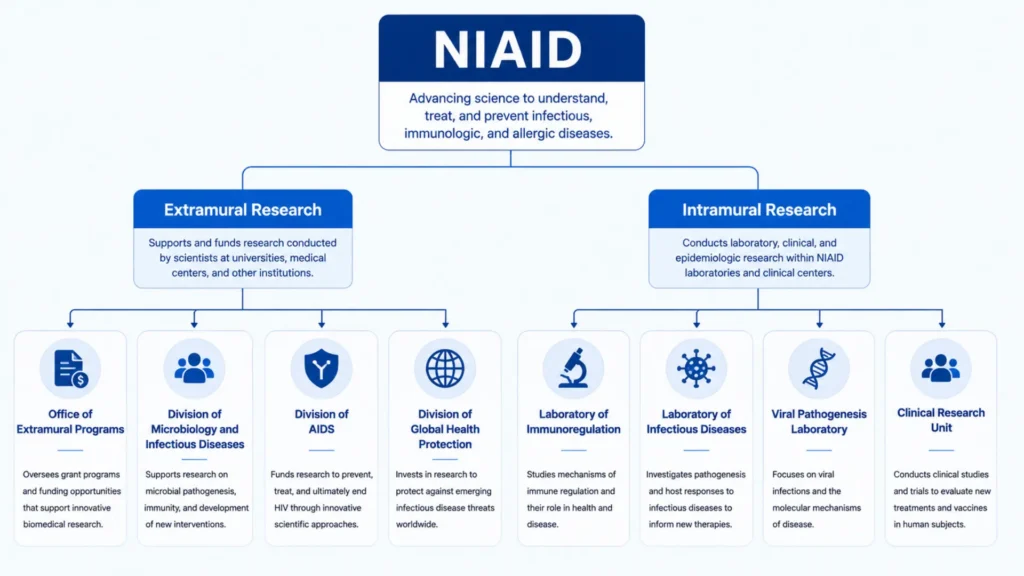
It splits its work between two funding models, and understanding this distinction is essential if you’re a researcher, a student, or just trying to understand how taxpayer money moves through the institute.
Extramural Research
The majority of its budget funds “extramural” research, meaning grants and contracts awarded to universities, hospitals, and independent research institutions both nationally and internationally. Four divisions manage this side of the institute’s work, reviewing grant applications, setting funding priorities, and overseeing awarded projects.
Intramural Research
A smaller portion of its work happens in-house, in laboratories on the NIH campus in Bethesda, Maryland, known as “intramural” research. Three divisions operate on this side of the institute, including the Vaccine Research Center (VRC), which has played a central role in developing vaccine platforms for HIV, Ebola, Zika, and COVID-19.
Director and Recent Leadership Changes
NIAID has been through an unusually turbulent leadership stretch since early 2025, and any article that names one person as “the director” without a date attached is likely outdated.
Dr Anthony Fauci led NIAID for 38 years before stepping down in December 2022. DDrHugh Auchincloss served as acting director afterward, and Dr Jeanne Marrazzo, previously director of the Division of Infectious Diseases at the University of Alabama at Birmingham, was named permanent director in 2023.
According to reporting from Nature and STAT News, Marrazzo was removed from her position in March 2025. Dr Jeffery Taubenberger, a researcher known for his earlier work sequencing the 1918 influenza virus, was then appointed acting director in April 2025. Taubenberger himself stepped down in May 2026, following a period that Nature’s Washington coverage described as one in which eight of the institute’s top ten officials had departed since the start of that administration.
DDrJohn H. Powers III, previously NIAID’s Deputy Director and a principal senior advisor to the institute, was named acting director in June 2026 and currently holds that role. Because its leadership situation has shifted multiple times within roughly a year, and because the director position itself doesn’t require Senate confirmation the way the NIH director role does, it’s worth checking its own “Office of the Director” page directly for the most current name rather than relying on any single article, including this one, as a permanent answer.
What’s Been Happening
Beyond leadership changes, a few developments explain most of what’s driving current NIAID-related news searches.
Budget reductions. NIAID’s Fiscal Year 2026 congressional budget justification outlined a significant reduction in funding for competing research project grants, with overall grant funding dropping by more than 40% from prior levels. That kind of cut has direct downstream effects on how many new grants the institute can fund each year.
A new funding strategy. In November 2025, NIH announced a “Unified Funding Strategy” that affects how institutes, including NIAID, decide which grant applications to fund. Rather than relying solely on a single published percentile cutoff, the new approach weighs peer-review scores against institute-specific research priorities, a shift from how paylines have traditionally worked at NIAID for decades.
Leadership turnover, covered above, has led several members of Congress to publicly raise concerns about the institute’s capacity to respond to emerging infectious disease threats.
For the most current day-to-day updates, NIAID’s own newsroom and press release archive remain the most reliable primary sources, since third-party coverage can lag or get details wrong on fast-moving federal personnel changes.
Understanding NIAID Paylines
If you’re a researcher applying for NIH funding, “NIAID payline” is one of the most practically important terms on this entire page, and it’s worth explaining properly rather than just defining it.
An NIAID payline is the percentile-rank or impact-score threshold the institute sets each fiscal year for a specific grant mechanism, essentially a planning guideline for which peer-reviewed applications it expects to fund. Applications that score at or above the payline are generally funded; those scoring below it generally aren’t, though exceptions do happen.
A few things are important to understand about how this actually works:
- NIAID sets its own paylines independently of every other NIH institute. A payline at the National Institute of Neurological Disorders and Stroke (NINDS) or the National Heart, Lung, and Blood Institute (NHLBI) for the same fiscal year and mechanism has no bearing on NIAID’s number.
- R01 grants use percentile rankings, while most other grant mechanisms, such as R03 and R21 awards, use a raw overall impact score.
- New and early-stage investigators typically get a more generous payline, often several percentile points higher than the standard rate, as part of NIAID’s effort to keep early-career researchers competitive against more established labs.
- Paylines start conservatively and can rise during the fiscal year as NIAID’s budget picture becomes clearer, meaning an interim payline published early in the year isn’t necessarily the final word.
NIAID has historically maintained some of the lowest paylines across NIH, reflecting extremely high application volume relative to its budget, particularly after 2001 and again after the COVID-19 pandemic drove renewed interest in infectious disease research funding. Reporting on FY2025 funding disruptions, NIAID’s effective payline dropped as low as the 8th percentile at points during that year, a meaningfully tighter bar than in prior years.
Given the shift toward NIH’s Unified Funding Strategy in late 2025, researchers should check NIAID’s current Paylines page directly for the fiscal year they’re applying in, since the traditional single-percentile-cutoff model is being adjusted rather than eliminated outright.
Jobs and Careers
They hire across a wide range of career types, and you don’t need an advanced science degree for every role there.
Scientific careers split into two categories: scientific administrative roles, such as program officers who support extramural grants and training, and scientific review officers who manage peer review of grant applications; and laboratory-based roles, such as physician-scientists, postdoctoral fellows, and data scientists working in NIAID’s intramural program, making these specialized research roles strong examples of jobs safe from AI automation that rely heavily on human clinical judgment and complex problem-solving.
Executive careers cover senior leadership roles, including institute and division director positions.
Administrative careers include grants management specialists, contract specialists, budget analysts, and facilities support staff—roles that don’t require a research background but keep the institute’s operations running.
For federal, non-intramural vacancies, applications generally run through USAJOBS.gov, the federal government’s official job portal. It also maintains its own career opportunities listings and participates in NIH’s broader intramural training programs, including postbaccalaureate and summer internship tracks for students exploring research careers before graduate school.
If you’re specifically interested in laboratory research training, NIH’s Office of Intramural Training and Education is worth checking directly, since it lists opportunities across NIAID and other NIH institutes in one place rather than requiring you to check each institute separately.
Common Misconceptions About NIAID
Confusing NIAID with NIH as a whole. It is one of 27 institutes and centers under the NIH umbrella. NIH is the parent agency; NIAID is a specific institute within it focused on allergy, immunology, and infectious diseases.
Assuming Dr Fauci is still involved. Fauci left NIAID in December 2022 after 38 years leading the institute. Given how much media coverage he received during his tenure, this is one of the most common outdated assumptions people carry into a search about NIAID’s current leadership.
Treating a payline as a guarantee. Scoring above a published payline doesn’t guarantee funding, and scoring just below it doesn’t guarantee rejection. Exception funding exists on both sides, though it shouldn’t be counted on for planning purposes.
Assuming NIAID paylines match other institutes. As noted above, each NIH institute sets its own payline. A number you saw for a different institute tells you nothing reliable about NIAID’s threshold for the same year.
Frequently Asked Questions
What does NIAID stand for?
It stands for the National Institute of Allergy and Infectious Diseases, one of 27 institutes and centers within the National Institutes of Health.
Who is the current NIAID director?
Dr John H. Powers III has served as acting director since June 2026, following a period of significant leadership turnover at the institute. Because this position has changed hands multiple times recently, it is recommended to check NIAID’s official “Office of the Director” page for the current name.
What is an NIAID payline?
An NIAID payline is the percentile or impact-score cutoff the institute sets each fiscal year to determine which grant applications are likely to be funded. NIAID sets its paylines independently of every other NIH institute, and they can change over the course of a fiscal year.
Does NIAID still support HIV/AIDS research?
Yes. HIV/AIDS research remains one of NIAID’s three core program areas, alongside infectious and immunologic diseases and biodefense/emerging infectious disease research.
How do I find NIAID jobs? Most federal vacancies at NIAID are posted through USAJOBS.gov. NIAID also maintains its own career opportunities page, and NIH’s Office of Intramural Training and Education lists research training and fellowship openings across the agency.
Has NIAID’s budget changed recently?
Yes. The 2026 congressional budget justification outlined a substantial reduction in research project grant funding compared to prior fiscal years, part of broader NIH-wide budget changes that have also affected how paylines are set.
For a more detailed history of the institute, including its full leadership timeline and organizational evolution since 1887, the Wikipedia entry is a well-sourced starting point that links out to primary government and news sources.
Conclusion
NIAID remains one of the most consequential research institutes in American science, funding and conducting work that shapes how the country responds to everything from seasonal allergies to the next pandemic threat. But it’s also an institute in the middle of real institutional change right now, with new leadership, a shifting funding strategy, and a noticeably smaller research budget than in recent years.
Anyone relying on information about NIAID, whether for a grant application, a job search, or general understanding, should treat details like the current director’s name and current paylines as things that need to be checked against NIAID’s own site rather than assumed from an older article, given how quickly they’ve moved over the past year and a half.