
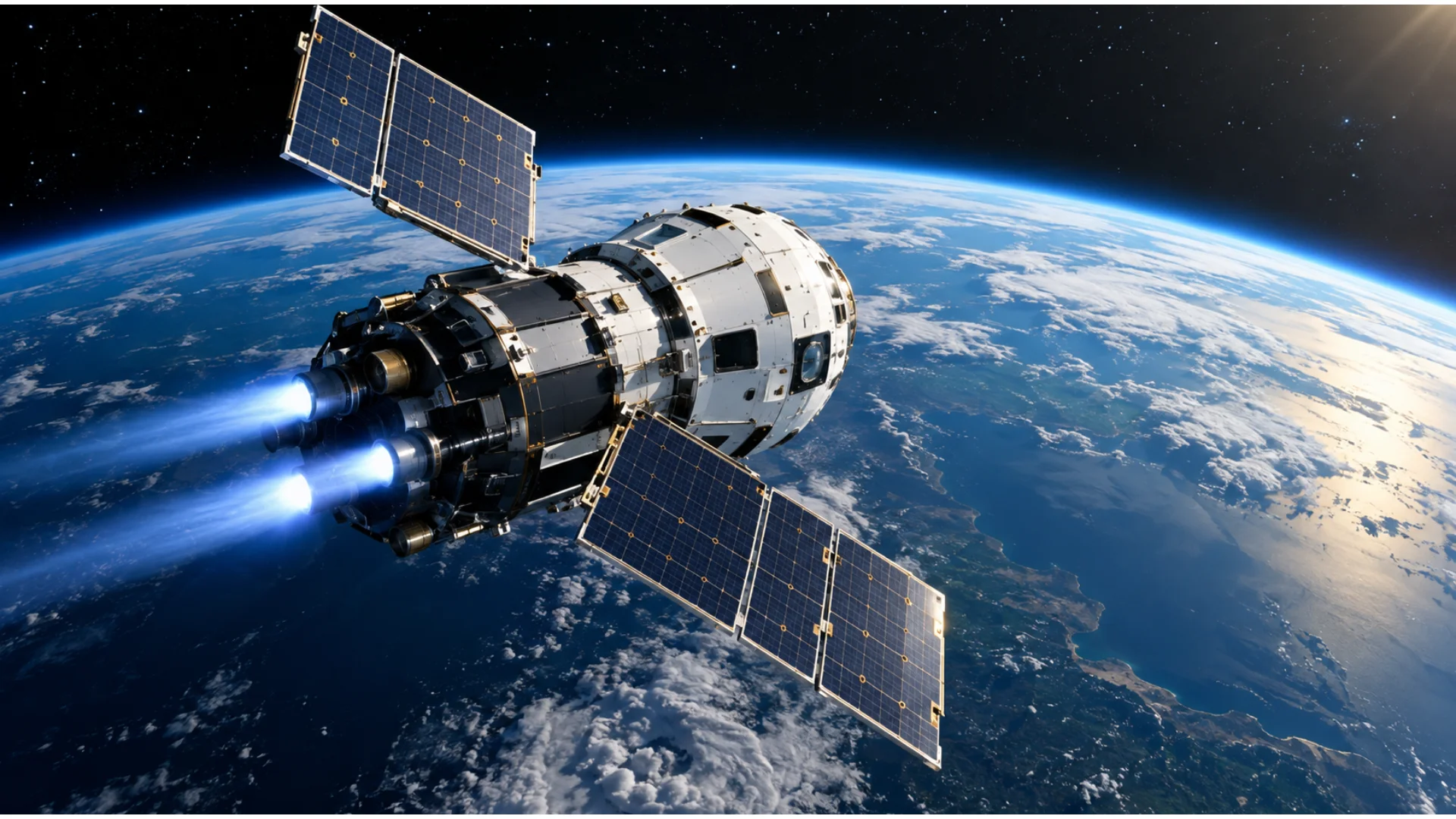
Quantum Space Unleashes a Bold New Era of Orbital Mobility
Satellites have mostly worked the same way for decades. You launch one, it settles into an orbit, and it stays there until it runs out of fuel or breaks down. Quantum Space wants to change that basic rule of spaceflight.
The Rockville, Maryland company is building spacecraft that can move around in orbit on demand, refuel, and stay useful for years longer than a typical satellite. That idea has attracted the U.S. Space Force, pulled in hundreds of millions in funding, and put the company on a path to Wall Street through a SPAC merger.
If you’ve searched for quantum space and landed here, you’re probably trying to sort out what the company actually does, whether it’s the same “Quantum Space” you saw mentioned by NASA’s Jet Propulsion Laboratory, and what its stock, jobs, and locations look like right now. This guide covers all of it in plain English.
What Is Quantum Space
Quantum Space, LLC is an American aerospace company that designs, builds, and operates maneuverable spacecraft for national security, civil, and commercial customers. Its flagship product is a spacecraft platform called Ranger, built to reposition itself across low Earth orbit, geostationary orbit, and even cislunar space, the region between Earth and the Moon.
Most satellites today are fixed assets. Once they reach their orbital slot, they stay there for the rest of their working life. Quantum Space’s pitch is that a fixed satellite is also a predictable target, and predictability is a weakness in a contested space environment. Ranger is meant to solve that by moving, refueling, and adapting to new missions while already in orbit.
The company was co-founded by Dr. Kam Ghaffarian, an entrepreneur who also co-founded Axiom Space and Intuitive Machines, two other well-known names in the commercial space industry. Quantum Space traces its roots to 2021 and 2022, growing out of the same wave of investment that has reshaped the American space sector since NASA began leaning harder on commercial partners.
Meet the People Running the Company
Leadership is one of the more unusual parts of the Quantum Space story, since the executive bench reads like a who’s who of American space policy.
- Jim Bridenstine became CEO in May 2026. Before joining Quantum Space, Bridenstine served as NASA Administrator, and before that, as a member of Congress and a naval aviator. He also helped shape the creation of the U.S. Space Force during his time at NASA, which lines up neatly with Quantum Space’s focus on national security missions.
- Kam Ghaffarian serves as Executive Chairman. He’s a serial founder in the commercial space and energy world, and his fingerprints are on several companies that have gone public through SPAC mergers over the past few years.
- Kerry Wisnosky holds the President role and brings deep experience in space systems engineering.
This is a leadership team built specifically for winning government contracts, and it shows in the customer list.
Inside the Ranger Spacecraft Platform
Ranger is the product at the center of everything Quantum Space does. A few details stand out from the company’s own technical descriptions and its public SEC filings.
Ranger uses multi-mode propulsion, combining chemical and electric propulsion in one spacecraft. That combination gives it both the quick bursts of thrust chemical propulsion provides and the fuel efficiency of electric propulsion for longer maneuvers. The spacecraft is designed to carry roughly 8,800 pounds of storable propellant, according to SEC business combination materials, and it supports on-orbit refueling so it isn’t limited to the fuel it launches with.
The platform is also built for endurance, with an on-station lifespan the company has described as up to fifteen years. That’s meant to support a few mission types:
- Space domain awareness, or watching what else is happening in orbit
- Satellite life extension, giving aging satellites more usable years
- On-orbit refueling for other spacecraft
- Satellite servicing and repositioning
According to company statements, the first Ranger-class satellite is targeted for delivery in the second quarter of next year, with production ramping through 2028.
Where Quantum Space Operates
Quantum Space runs a distributed footprint across three states, and this is where a lot of the “quantum space rockville,” “quantum space hawthorne,” and “quantum space tulsa” searches come from.
- Rockville, Maryland, is the company’s headquarters and its engineering and mission development hub. The main office sits at 801 Thompson Avenue, Suite 201, in Rockville. This is also where the company runs its Quantum Mission Ops Center, which handled command and data operations for its first satellite, Scout-1.
- Hawthorne, California, houses the company’s propulsion and integration test facility. Hawthorne has become something of an aerospace cluster city in Southern California, home to several well-known rocket and satellite companies, and Quantum Space’s presence there fits that pattern.
- Tulsa, Oklahoma, is the newest addition, announced as a dedicated spacecraft manufacturing center that was still under development as of mid-2026. Oklahoma’s long aerospace manufacturing history made it an appealing choice for scaling up Ranger production.

Quantum Space Stock, the SPAC Deal, and What QSPC Means
A lot of investors searching “quantum space stock” want to know if you can actually buy shares. As of now, Quantum Space is privately held, but that’s changing.
On June 8, 2026, Quantum Space announced a definitive business combination agreement with Inflection Point Acquisition Corp. VI, a special purpose acquisition company trading on Nasdaq under the ticker IPFX. A SPAC merger is a way for a private company to go public without running a traditional IPO process. The SPAC is already publicly listed, and it merges with the private target company, which then takes over the public listing.
Under the deal terms, Quantum Space carried a pre-money valuation of $600 million, with the combined company expected to reach roughly $1.2 billion in equity value assuming no shareholder redemptions. Existing Quantum Space equity holders were expected to retain about half of the combined company. The deal also included a $300 million private investment in public equity, known as a PIPE, plus preferred stock arrangements described in SEC filings.
Once the merger closes, the combined company plans to trade on Nasdaq under the ticker symbol QSPC. The transaction was unanimously approved by both boards and was expected to close in the fourth quarter of 2026, pending shareholder approval and other standard closing conditions.
It’s worth noting that this SPAC playbook isn’t new for the people involved. Inflection Point previously took Intuitive Machines public through a similar SPAC deal in 2023, and Ghaffarian co-founded that company too.
If you’re researching this as an investor, remember that pre-merger financial projections in SPAC deals are forward-looking estimates, not guarantees, and the transaction still needed to clear regulatory and shareholder hurdles before Quantum Space stock became something the public could actually buy.
Who Quantum Space Works With
Government contracts are the backbone of Quantum Space’s revenue story so far. The company has disclosed six contracts and pending proposals with the Space Force, the Department of War, DARPA, and the Air Force Research Laboratory.
The biggest of these is the Andromeda program, a Space Force indefinite-delivery, indefinite-quantity contract vehicle focused on fielding a proliferated constellation of space domain awareness satellites in geostationary orbit. Quantum Space was one of 14 companies selected for Andromeda, alongside larger defense names like Northrop Grumman, Lockheed Martin, and L3Harris, plus newer space companies like True Anomaly and Astranis. The Andromeda ceiling has since been raised toward $6.2 billion in total shared value across all awardees, though individual companies aren’t guaranteed a specific share.
Quantum Space also has a joint venture with Astro Digital that won a Space Force contract in 2025 under the Space Test Experiments Platform 2.0 program, a vehicle designed to fast-track satellite bus procurement for orbital experiments.
Winning slots on IDIQ contract vehicles doesn’t guarantee revenue by itself. It gives a company the ability to compete for individual task orders once the government decides to spend money under that vehicle, which is an important distinction if you’re trying to size up how much business Quantum Space actually has locked in.
Careers and Jobs at Quantum Space
If you searched “quantum space careers” or “quantum space jobs,” here’s the practical picture. The company is actively hiring across its three main locations, with roles concentrated in aerospace engineering, propulsion, spacecraft integration, mission operations, and manufacturing as the Tulsa facility comes online.
Given the mix of national security work and commercial contracts, expect many roles to require U.S. citizenship and the ability to obtain a security clearance, which is standard across the defense-adjacent space sector. Openings are typically posted through the careers section of the company’s official website, and LinkedIn is another reliable place to track new listings and company updates, including recent milestones like satellite launches and contract wins.
For anyone comparing this kind of hardware-heavy, defense-adjacent hiring environment against roles in software and AI, our breakdown of which jobs are holding up best against automation is a useful companion read, since aerospace manufacturing and mission operations roles tend to be more insulated than routine desk work.
Don’t Confuse These Other Uses of “Quantum Space”
The phrase quantum space shows up in a few unrelated contexts, and search results can blur them together.
- JPL’s Quantum Space Innovation Center is a completely different thing. NASA’s Jet Propulsion Laboratory established this internal center to coordinate its work on quantum detectors, quantum communication, and advanced sensors, building on JPL projects like the Cold Atom Lab and the Deep Space Atomic Clock. It has nothing to do with Quantum Space, LLC. JPL’s center focuses on quantum physics research, not maneuverable spacecraft, and it publishes its own 20-year roadmap for quantum technology on NASA’s JPL quantum site.
- Quantumspace in India is a separate, unrelated startup based in Hyderabad that works on quantum key distribution and satellite optical communication for secure data links. It was incorporated in September 2025 and has no corporate connection to the Rockville, Maryland company covered in this article.
If you’re researching the American spacecraft company, the official site is quantumspace.us, and the Wikipedia entry, LinkedIn page, and SEC filings referenced throughout this article all point to the same Rockville-based business.
How Quantum Space Fits Into the Broader Space Industry
Quantum Space competes in a crowded and fast-moving field of new space companies, many of which have also used SPAC mergers to reach public markets, including Rocket Lab, Spire Global, Redwire, and Intuitive Machines.
What sets Quantum Space apart on paper is its specific bet on maneuverability as a category. Rather than building a constellation of identical small satellites, as many commercial space companies do, Quantum Space is positioning Ranger as a flexible platform that can be reassigned to new missions after launch. That’s a more defense-oriented value proposition, closer in spirit to companies like True Anomaly or Astroscale, which focus on space domain awareness and satellite servicing rather than communications or Earth observation.
For a broader look at how funding-heavy hardware startups are reshaping industrial sectors, our profile on Gecko Robotics covers a similar story of a defense-adjacent hardware company scaling from startup to unicorn status through government contracts. And if you’re tracking aerospace and drone companies more broadly, our Garuda Aerospace profile is a good point of comparison from a different corner of the industry.
Frequently Asked Questions
Is Quantum Space publicly traded?
Not yet. The company is private, but it has a pending SPAC merger with Inflection Point Acquisition Corp. VI that would list the combined business on Nasdaq under the ticker QSPC once the deal closes.
What does Quantum Space actually build?
Its core product is Ranger, a maneuverable spacecraft designed for space domain awareness, satellite servicing, life extension, and on-orbit refueling across multiple orbits.
Where is Quantum Space headquartered?
Rockville, Maryland, with a propulsion and test facility in Hawthorne, California, and a manufacturing center under development in Tulsa, Oklahoma.
Who runs Quantum Space?
Jim Bridenstine is CEO, Kam Ghaffarian is Executive Chairman, and Kerry Wisnosky is President.
Is Quantum Space the same as JPL’s Quantum Space Innovation Center?
No. That’s a NASA JPL research center focused on quantum physics and sensing technology, unrelated to the Rockville spacecraft company.
Conclusion
Quantum Space is still a young company navigating a public listing, a growing manufacturing footprint, and a defense customer base that takes years to fully mature into revenue. Whether Ranger delivers on its maneuverability promise at scale is something that will play out over the next few launches, not overnight, but the pieces the company has put in place so far, from its leadership bench to its Space Force contract wins, give it a real shot at becoming one of the defining names in the orbital mobility category.