Gecko Robotics Wins Big With Navy Robot Inspections
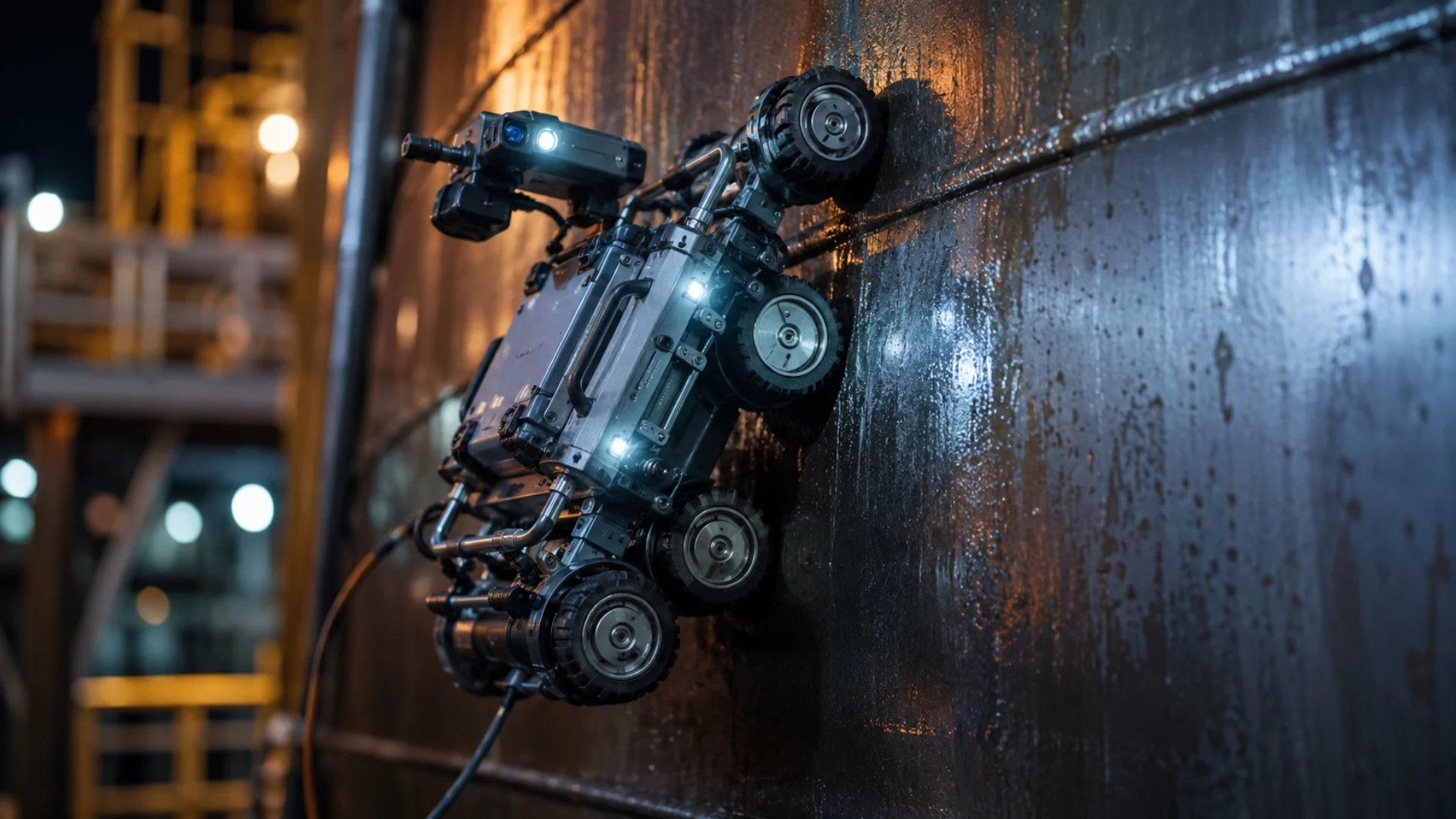
Roughly 40 percent of the U.S. Navy’s fleet is unavailable at any given time, according to The Next Web’s report on a contract announced in March 2026. A Pittsburgh startup now holds a five-year deal that started with a $71 million ceiling and was raised to $300 million in October 2026 to help change that, using robots that climb hulls and crawl through ballast tanks.
That startup is Gecko Robotics. This guide explains what the Navy contract does and does not guarantee, how the robots and software fit together, where the money came from, and what the company is worth.
Why The Navy Needs Robots Inside Its Ships
Maintenance delays keep vessels in port longer than planned. Hulls, decks, welds, and tanks are hard to reach, and checking them by hand is slow and sometimes dangerous, which is the gap Gecko is selling into.
On March 17, 2026, the Navy and the General Services Administration awarded Gecko a five-year contract with a $71 million ceiling. The ceiling was later raised to $300 million. The initial award covers up to $54 million of work on 18 ships in the Pacific Fleet, according to Gecko’s announcement and Bloomberg’s coverage. The Navy has set a goal of 80 percent fleet readiness by 2027. Gecko says one robotic evaluation of a flight deck removed more than three months of potential maintenance delay for a single vessel.
What An IDIQ Contract Does Not Guarantee
The deal is an indefinite delivery, indefinite quantity contract. Its ceiling started at $71 million and was raised to $300 million in October 2026, but a ceiling is a limit, not a promise of spending. Actual revenue depends on task orders the Navy places over five years, and the $54 million initial award is the more realistic near-term figure.
Because the vehicle runs through the GSA, other Department of Defense branches can order from it too. That is the real upside. If the first 18 ships go well, the same paperwork can carry work for more of the fleet without a new competition.
What The $300 Million Ceiling Does Mean
Raising a ceiling is a signal even though it is not a payment. The Navy and the General Services Administration lifted the cap just six months after the first award, which suggests early work gave program offices a reason to want room for more orders. Gecko says its approach can save the Navy up to $8 million in repair costs per ship and find structural problems up to 50 times faster than traditional methods, cutting inspections from months to days. Those are company figures, so read them as claims to test. Still, a customer that raises the cap this quickly is behaving like a satisfied buyer. The hard evidence will be actual task orders, not the ceiling.
What Komodo Adds
The expansion centers on Komodo, a Gecko system that scans through thick, non-skiraised to $300 million deck coatings without stripping or damaging them. It produces a full deck heatmap of corrosion and material thickness, so repair teams can plan work before a ship enters drydock. Gecko says that was previously possible only after maintenance had begun. Knowing the damage earlier lets crews order parts and schedule labor before the ship is opened up.
How The Robots And Cantilever Work Together
Gecko builds robots that climb, crawl, swim, and fly across industrial structures. The flagship hardware line is TOKA, now in its fifth generation, which carries ultrasonic sensors that measure metal thickness and flag cracks and corrosion. The physics behind that is standard ultrasonic testing, automated and run at scale.
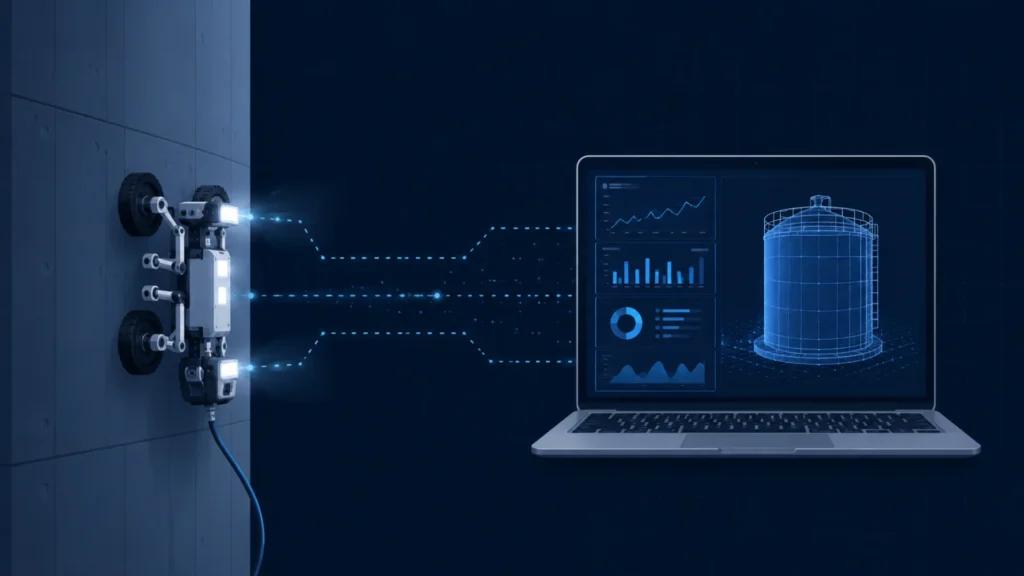
The software side is Cantilever, which turns sensor readings into a digital twin of the asset. RobotToday’s breakdown describes the stack in three layers.
| Layer | What it does | Example |
|---|---|---|
| Data acquisition | Robots, drones, and fixed sensors collect measurements | TOKA crawling a hull or deck |
| Interpretation | AI models detect and rank defects | Flagging thinning metal |
| Decision support | Cantilever turns findings into maintenance and logistics plans | Planning which repairs come first |
Gecko claims its approach finds repairs up to 50 times faster than manual inspection, and that Cantilever tracks more than 500,000 critical assets worldwide. Both are company figures that outside observers have repeated rather than audited.
One business point matters here. As Cantilever accumulates data on a specific fleet, switching away becomes harder, which makes the software the stickier part of the offer.
From A Power Plant Death To A Pittsburgh Unicorn
Jake Loosararian was an engineering student at Grove City College when a class project took him to a power plant. Someone there told him about a worker who had died falling from a boiler while inspecting it. He went back to his dorm and began building a robot that could climb walls with ultrasonic sensors, so no one would have to take that risk.
The first version weighed 40 pounds and helped the plant cut downtime. Loosararian bootstrapped the company from 2013 while holding a full-time automation job, and slept on a friend’s couch for about two and a half years. His original co-founder left. He later teamed up with Troy Demmer, a fellow Grove City graduate with a Carnegie Mellon MBA. The company went through Y Combinator and turned down an early acquisition offer.
Funding, Valuation, And Backers
Gecko has raised more than $347 million across eight rounds since 2014.
| Round | Date | Details |
|---|---|---|
| Series C | December 2023 | $173 million including a $100 million extension, adding Thomas Tull’s US Innovative Technology Fund and Founders Fund, at a $633 million valuation |
| Series D | June 2025 | $125 million led by Cox Enterprises, with USIT, XN, Founders Fund, and Y Combinator, at $1.25 billion |
The Series D made Gecko the eighth Pittsburgh company to reach a billion-dollar valuation in eight years, and the company made CNBC’s 2025 Disruptor 50 list for the second time. It has also begun expanding abroad through a multi-year partnership with ADNOC in the UAE.
Gecko does not publish revenue. Third-party trackers have floated figures around $60 million for 2024, but treat that as an unverified estimate.
Beyond The Navy With Power Plants, Gulf Energy, And Missile Silos
Defense gets the headlines, but Gecko’s customer list is broader. In February 2025, power operator NAES announced a multi-year agreement worth more than $100 million with an option to grow beyond $250 million. NAES says it has about 65 gigawatts of power under management, and the plan is to use Gecko’s robots and Cantilever across thermal and renewable plants as electricity demand rises, partly because of AI data centers.
In the Gulf, Gecko signed a multi-year contract with ADNOC Gas through partner Al Masaood Energy in 2024, which Gecko lists at about $30 million. In November 2025, ADNOC signed three more agreements covering robotics deployment and skills training for UAE nationals. On the defense side, beyond ships, Gecko has an Air Force contract to assess the condition of ICBM launch facilities as part of the Sentinel modernization program.
Taken together, these deals show one product serving navies, power operators, and oil and gas companies. That spread reduces dependence on any single budget, which matters for a company whose Navy contract could otherwise dominate its story. Industrial operators in our Koch Industries profile face the same aging asset problem, and Field AI, which builds a software brain for robots, tackles the physical world from a software-first angle.
Can You Buy Gecko Robotics Stock
No. Gecko is private and has not filed for an IPO. If you saw GERO.PVT on Yahoo Finance, the PVT tag only marks a private company tracked for reference, and the figure reflects funding rounds and secondary activity, not a tradable price.
Realistic access is limited to funding rounds open to institutions, secondary marketplaces such as Forge Global or Nasdaq Private Market for accredited investors, and employee stock options. A public listing is plausible given the valuation and defense momentum, but nothing is confirmed.
Careers And Headquarters
The company is based at Nova Place on Pittsburgh’s North Side, with roughly 300 employees there. Gecko offers stock options or RSUs as part of its compensation packages, and because some of its work is for the military, certain roles may carry citizenship or clearance requirements. Check the company’s careers page for current openings.
Where Gecko Fits In Robotics And Defense
Gecko sits at a useful crossing point of three trends. It collects data from the physical world the way Skild AI tries to train robot intelligence, though Gecko sells inspection results rather than a general robot brain. It also serves operators of aging infrastructure, the kind of heavy industry covered in our Hilcorp Energy profile. And it sells into the same defense market as Mach Industries, though with inspection services instead of munitions. For a lighter hardware comparison, India’s Garuda Aerospace shows how drones tackle inspection in another market.
Honest Limits And Risks
Three cautions apply. First, concentration. Government work can be lumpy, and a single large Navy contract can make revenue look steadier than it is. Second, most performance numbers, including the 50 times faster claim and the per-ship savings, come from Gecko itself and have been repeated by outlets rather than independently audited. Third, competition is real. Other robotics makers sell legged and drone-based inspection tools that can reach confined spaces, and some industrial software firms offer asset analytics. Gecko’s answer is to combine wall-climbing hardware with its own software, so switching later means replacing both. That bundle is the moat, and it is also what a skeptical buyer would test in a pilot.
Questions People Ask About Gecko Robotics
Who founded Gecko Robotics?
Jake Loosararian and Troy Demmer, both Grove City College graduates.
How big is the Gecko Robotics Navy contract?
The ceiling is $300 million after an October 2026 increase from $71 million. The first award covered up to $54 million of work on 18 Pacific Fleet ships.
How much is Gecko Robotics worth?
$1.25 billion as of its June 2025 Series D.
Is Gecko Robotics publicly traded?
No. There is no ticker, and GERO.PVT is only a reference label for a private company.
How do the robots inspect a structure?
They carry ultrasonic sensors that measure material thickness and detect flaws, then send the data to Cantilever for analysis.
Where is Gecko Robotics headquartered?
Pittsburgh, Pennsylvania, at Nova Place on the North Side.
What is Komodo?
Komodo is a Gecko system that scans through thick non-skid deck coatings without stripping them and produces a heatmap of corrosion and thickness across a whole deck.
Does Gecko Robotics only work for the Navy?
No. Gecko also works with the Air Force, power operators such as NAES, and energy companies such as ADNOC.
Has the Gecko Robotics Navy ceiling changed?
Yes. It started at $71 million in March 2026 and was raised to $300 million on Oct 20, 2026.
What To Watch Next
The first real test is how many task orders the Navy places against the $300 million ceiling. After that, watch whether other defense branches use the GSA vehicle, whether the ADNOC work grows, and whether Gecko signals IPO plans.